
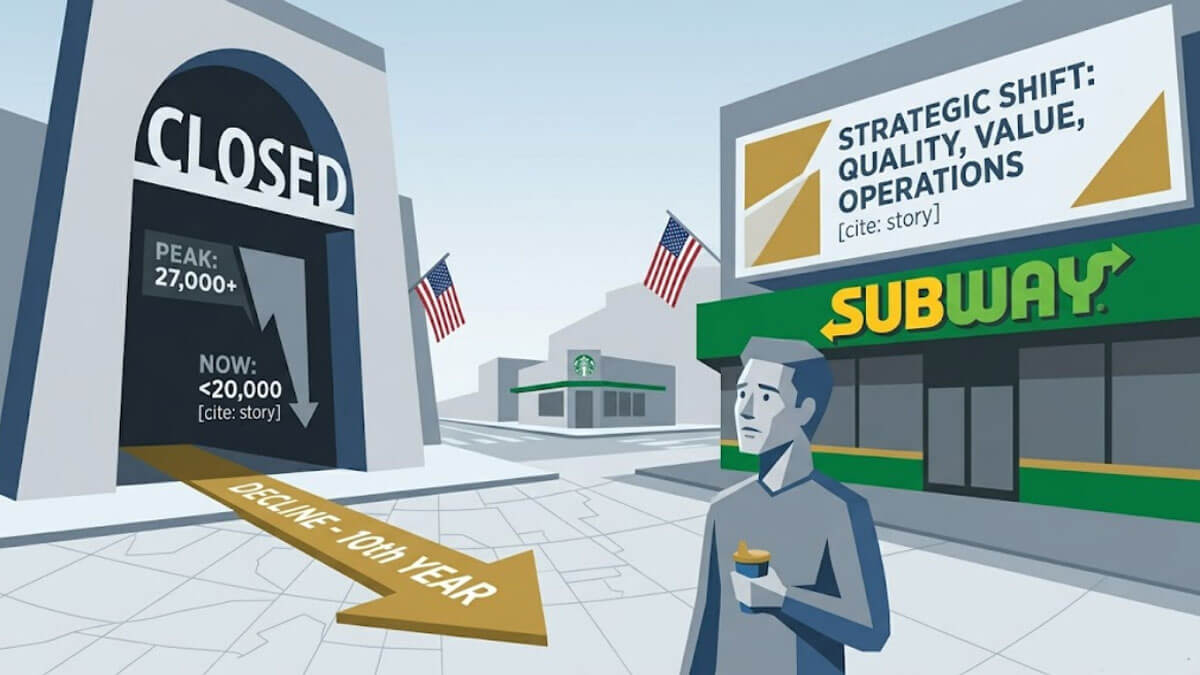
Subway, once ubiquitous across the American landscape, reported a net closure of 729 United States locations in 2025, marking the tenth consecutive year of domestic contraction for the sandwich chain. This decline brings its total US restaurant count to 18,773, a figure that places it below the 20,000-store threshold for the first time in two decades. The significant pullback reflects a challenging period for the brand that peaked in 2015 with over 27,000 domestic restaurants. Since that time, Subway has shed a net total of 8,345 locations nationwide.
The 2025 reduction represents the sharpest single-year drop since 2021, when the company's net store count fell by more than 1,000 locations. Despite these closures, Subway still maintains its position as the largest fast-food chain in the United States by store count, surpassing Starbucks, which operates 16,860 locations, and McDonald’s, with 13,706. All of Subway's remaining US locations are independently owned and operated by franchisees.
"In the US, Subway is focused on ensuring restaurants are in the right locations, with the real estate, visibility and operations that set franchisees up to succeed long-term." — Subway Statement
In response to inquiries regarding the ongoing domestic closures, Subway issued a statement emphasizing a strategic shift: “In the US, Subway is focused on ensuring restaurants are in the right locations, with the real estate, visibility and operations that set franchisees up to succeed long-term.” The company also noted that internal performance evaluations and customer Google reviews have reached their highest marks in two years, suggesting some success in its targeted improvements. Franchise disclosure documents indicate plans to open approximately 100 new American locations in 2026, though industry observers anticipate that hundreds more closures will likely occur concurrently.
The competitive landscape in the fast-food sector remains intense, particularly in the value segment. Subway has introduced a new value menu featuring 15 items priced at $4.99 or less, a direct effort to attract budget-conscious consumers. This strategy mirrors moves by other major players, including McDonald’s, which rolled out its "Under $3 Menu" on April 21. McDonald's revamped offerings include a $1.50 Sausage McMuffin for breakfast and a selection of lunch and dinner items such as the McChicken, McDouble, 4-piece Chicken McNuggets, a small order of fries, and a small drink, all priced under three dollars. A McDonald’s press release stated that the updated menu "offers more choice, more flexibility and more ways to build a meal that fits their day and budget." Internally dubbed “McValue 2.0,” this new structure replaced the chain’s previous buy-one-get-one-for-$1 deal, while bundled Meal Deals remain available.
While its domestic operations face significant headwinds, Subway's international expansion efforts are robust. In 2025, the chain opened more than 1,000 new locations worldwide. The company has secured over 30 master franchise agreements designed to facilitate the opening of an additional 12,000 restaurants globally in the coming years. These expansion deals span Europe, the Middle East, and Asia, with targeted growth in countries including Sweden, Spain, South Korea, Qatar, Panama, and Taiwan. Subway's total global footprint now exceeds 35,000 restaurants.
Domestically, Subway is implementing several initiatives to revitalize its business. Executives report an increase in delivery orders placed through third-party platforms. The company is also modernizing its store interiors through a program called “Fresh Forward,” aiming to update the look and feel of its locations. Furthermore, Subway has signaled plans to expand its menu lineup and pursue strategic beverage partnerships, all part of a broader push to increase customer traffic and enhance franchisee earnings.
The company itself has undergone a significant transformation at the corporate level. Co-founded by Fred DeLuca and Dr. Peter Buck in 1965, Subway remained under family control for nearly six decades. This changed in 2024 when private equity firm Roark Capital finalized its acquisition of the brand for an estimated $9.6 billion. Following the sale, Jonathan Fitzpatrick, an executive veteran from Burger King, was appointed as the new chief executive officer, signaling a new era of outside leadership for the company. This change in ownership and leadership comes as Subway navigates a complex global market, balancing domestic consolidation with aggressive international growth.