


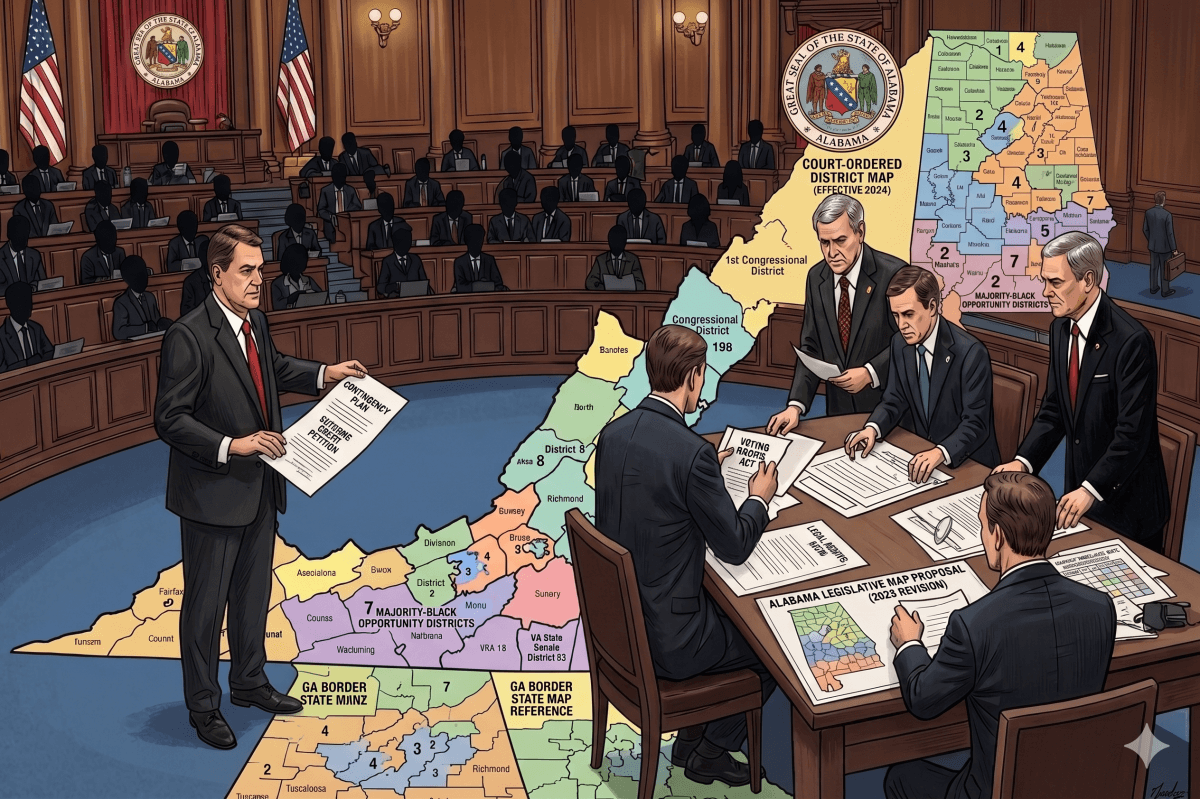
Alabama Governor Kay Ivey convened a special session of the state legislature on Monday, May 6, in Montgomery, aiming to establish a contingency plan for the state's congressional map. This move comes as Alabama Republicans seek to potentially redraw district lines that could impact the two congressional districts currently held by Democratic U.S. Representatives Terri Sewell of Birmingham and Shomari Figures of Mobile. The session was called in response to an emergency petition filed with the U.S. Supreme Court by Alabama Attorney General Steve Marshall, requesting the dissolution of an injunction that currently blocks the state from implementing its own congressional map.
"Because the lower court’s injunction cannot stand in light of the Supreme Court’s ruling, we have asked the court to lift the injunction. Alabama deserves the right to use its own maps, just like every other state." — Steve Marshall, Alabama Attorney General
The current legal landscape for Alabama's congressional districts stems from a series of judicial decisions. In 2023, the U.S. Supreme Court ruled that Alabama’s initial House map violated the Voting Rights Act. Following this ruling, state lawmakers submitted a replacement map, which was subsequently rejected by a three-judge panel. This panel included two judges appointed by President Donald Trump. The panel determined that the state's proposed maps were unconstitutional, citing Alabama’s racially polarized voting patterns, where a significant majority of white Alabamians support Republican candidates and Black Alabamians predominantly support Democrats.
Ultimately, a court-appointed expert drew the final map that is currently in effect. This court-ordered map created two House districts where Black voters constitute a significant share of the electorate, both of which are presently represented by Democrats. The state is currently operating under an injunction that bars any redrawing of its congressional maps until after the next census, with the May 19 primary elections set to proceed under the court-ordered map.
Attorney General Marshall’s emergency petition, filed on Thursday, May 2, asks the Supreme Court to lift this injunction, arguing that a recent Supreme Court ruling in a Louisiana redistricting case has altered the legal standard for challenging congressional districts on racial discrimination grounds. Justice Samuel Alito’s majority opinion in the Louisiana case is understood by some legal observers to have raised the bar considerably for such challenges. Marshall moved quickly after that ruling, stating, "Because the lower court’s injunction cannot stand in light of the Supreme Court’s ruling, we have asked the court to lift the injunction. Alabama deserves the right to use its own maps, just like every other state."
Governor Ivey echoed this sentiment, explaining the purpose of the special session. "By calling the Legislature into a special session, I am ensuring Alabama is prepared should the courts act quickly enough to allow Alabama’s previously drawn congressional and state Senate maps to be used during this election cycle," Ivey said. She further clarified the potential outcome: "If the court-ordered injunction is lifted, Alabama would revert to the maps drawn by the Legislature for congressional districts in 2023 and state Senate districts in 2021."
The Republican-controlled Legislature's objective in pursuing a new map is clear. House Speaker Nathaniel Ledbetter and Senate President Pro Tem Garlan Gudger issued a joint statement, declaring that the Legislature now has an opportunity to send seven Republicans to Congress. This goal would necessitate dismantling the districts currently held by Representatives Sewell and Figures. During the opening day of the special session, House Pro-Tem Chris Pringle filed House Bill 1. This bill would authorize new primary elections in any affected congressional districts should a federal court lift the injunction on the 2023 legislature-approved map, and if that ruling occurs too late to be incorporated into the existing 2026 primary schedule.
Alabama is not alone in its efforts to redraw electoral maps. Governor Bill Lee of Tennessee also called a special session for his state, set to begin on Tuesday, May 7. Governor Lee stated, "We owe it to Tennesseans to ensure our congressional districts accurately reflect the will of Tennessee voters." Furthermore, Florida moved to redraw its House maps prior to the Supreme Court's Louisiana ruling, with Republicans projecting gains in four seats. Last summer, Texas shifted five Democratic districts toward the GOP, prompting California to respond by moving five Republican-held districts to the left.
Attorney General Marshall emphasized a changing demographic and political landscape in Alabama, remarking, "The Alabama in 2026 is not the Alabama of the early 1960s. It’s a new time and a different era." However, opponents of the redistricting effort argue that federal courts have already established that Alabama intentionally discriminated against Black voters when drawing district lines following the 2020 census. These opponents contend that the state has repeatedly refused to comply with court orders directing it to rectify the problem, suggesting that the current push is another attempt to disenfranchise minority voters. The Supreme Court's decision on Marshall's emergency petition will determine the immediate future of Alabama's congressional map and potentially influence similar redistricting battles nationwide.

