


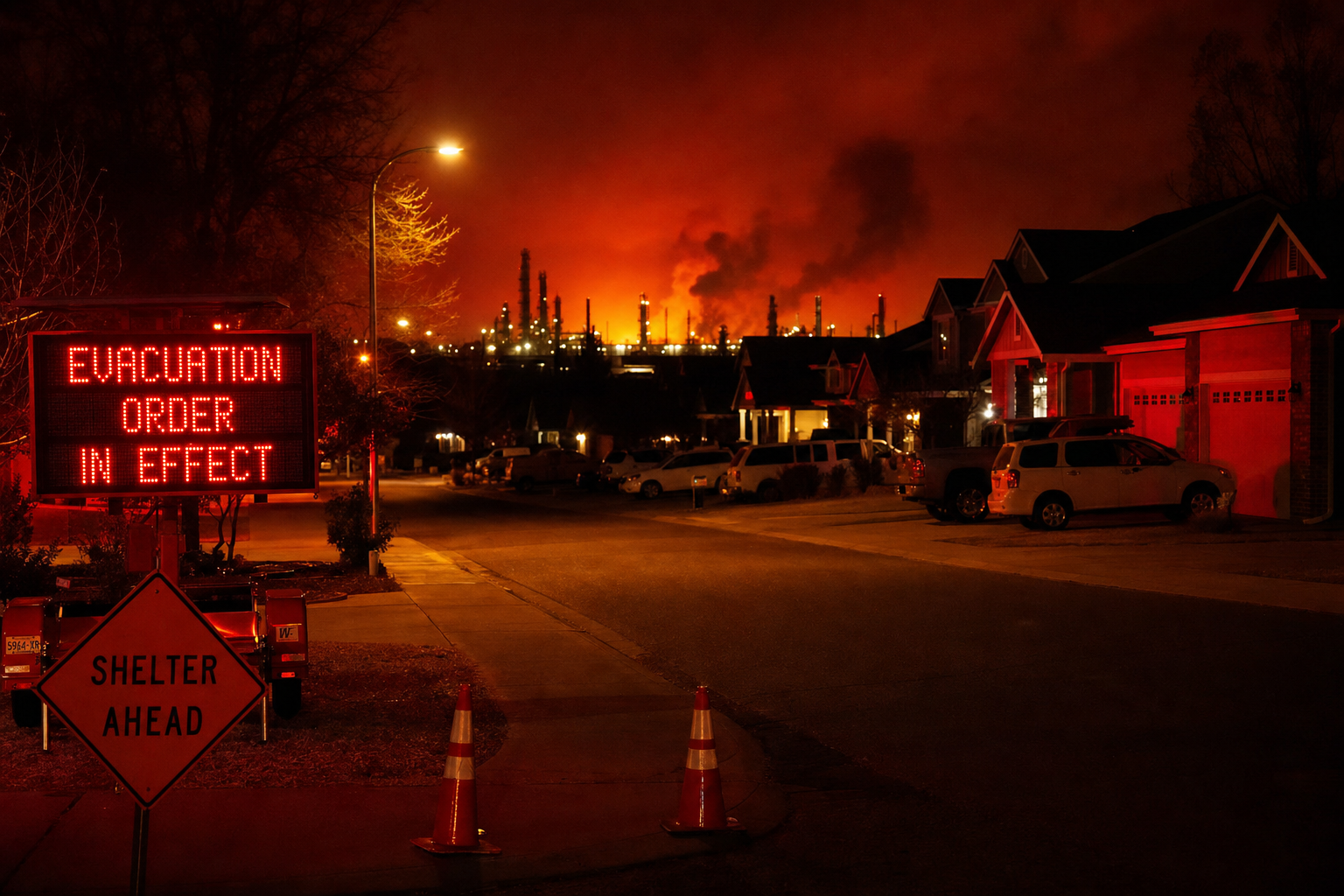
More than 40,000 residents across parts of Southern California were ordered to evacuate on Friday following warnings from officials that a massive chemical storage tank at an aerospace manufacturing facility was at imminent risk of rupturing or exploding. The unfolding crisis began Thursday night at the GKN Aerospace plant, where authorities reported a large storage tank containing highly volatile chemicals began releasing toxic fumes. Emergency crews have been actively engaged on site, battling what Orange County fire officials described as a rapidly deteriorating and potentially catastrophic situation.
"This is not precautionary. This is gonna happen unless some brilliant guy behind me here figures out how we can mitigate this incident." — Orange County Fire Division Chief Craig Covey
The emergency response was initiated after crews discovered a leak in a 34,000-gallon tank containing methyl methacrylate (MMA). MMA is a highly flammable, toxic industrial chemical widely utilized in aerospace manufacturing processes and the production of plastic epoxies. Initially, firefighters believed they had stabilized the situation by implementing emergency cooling operations around the compromised tank, which briefly allowed some evacuated residents to return to their homes. However, by Friday morning, officials confirmed that conditions had significantly worsened, necessitating an expanded and more urgent evacuation order.
Orange County Fire Division Chief Craig Covey addressed the public during an emergency press conference, conveying the gravity of the situation. "We have determined that the tank that is in the biggest crisis is in fact unable to be secured and mitigated," Covey stated. He further elaborated on the extreme dangers posed by the chemical, emphasizing, "This is highly volatile, it’s highly toxic, it’s highly flammable." Covey made it clear that the evacuation was not a mere precaution but a response to an unavoidable threat, adding, "This is not precautionary. This is gonna happen unless some brilliant guy behind me here figures out how we can mitigate this incident."
Authorities are now preparing for two distinct worst-case scenarios. One involves the tank rupturing, which could spill an estimated 6,000 to 7,000 gallons of dangerous chemicals into the surrounding areas. The second, and potentially more devastating, scenario is a "thermal runaway" event. This occurs when rapidly increasing temperatures inside the tank trigger a major explosion. Officials fear such an explosion could ignite nearby storage tanks containing additional fuel and other hazardous materials, leading to a chain-reaction disaster across the facility. Covey underscored the dire preparations, stating, "We are setting up these evacuations in preparation for these two options: It fails, or it blows up."
While officials confirmed there was no active toxic plume spreading through the air as of Friday afternoon, the potential for such an event, coupled with the risk of a chemical spill or explosion, justified the immediate and widespread evacuations. Amir El-Farra announced the expanded evacuation zone Friday morning, as authorities worked diligently to clear residents from all threatened areas adjacent to the GKN Aerospace facility. El-Farra stressed the paramount concern for public safety, affirming, "Community safety is our highest priority."
To accommodate the displaced population, emergency evacuation centers have been established in both Garden Grove and Cypress, providing shelter and assistance for affected residents and families. As of the latest reports on Friday afternoon, no injuries or fatalities had been reported in connection with the incident, a testament to the rapid response and evacuation efforts.
The escalating crisis has also drawn the attention and involvement of federal agencies. Representative Derek Tran (D-CA) confirmed he is actively coordinating with both the Federal Emergency Management Agency (FEMA) and the Environmental Protection Agency (EPA) to assess the situation and facilitate possible federal assistance. Rep. Tran urged public cooperation, advising, "I encourage everyone in the affected area to follow guidance from local authorities and avoid the impacted zones until further guidance is issued."
Emergency crews remain continuously on scene, meticulously monitoring the increasingly unstable chemical tank. Officials have not provided a timeline for when the situation might stabilize or when residents might be able to return home, highlighting the unpredictable nature of the ongoing threat. This incident has rapidly evolved into one of the most significant chemical emergency responses in Southern California in recent years, with authorities maintaining that the danger remains active and unpredictable. The coordinated efforts of local and federal agencies aim to contain the threat and ensure the safety of the affected communities.

