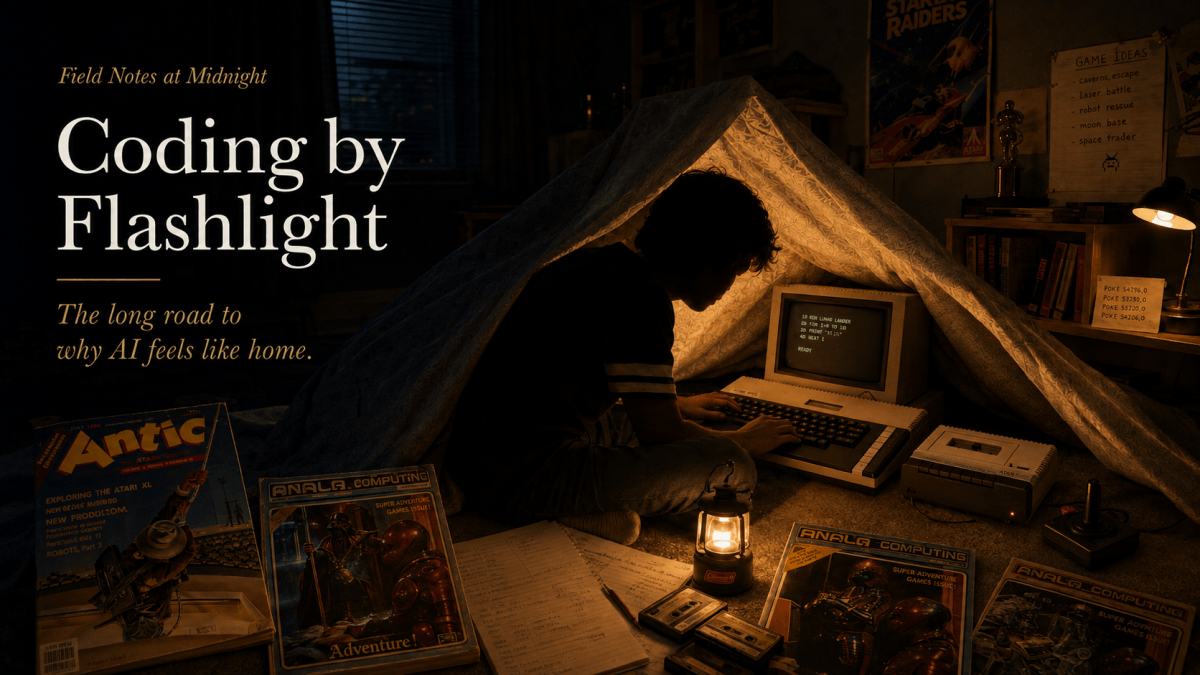
Long before I wrote a line of code, I read about it under the covers.
I guess you could call this my legacy story.
Computer magazines, by flashlight, after my parents thought I was asleep. I could not afford most of them, so the ones I got I read until the covers went soft, cover to cover, ads and all. I still remember an issue built around tape and disk drives, and me lingering on an ad for the newest drive, the fast one, doing the math on an allowance that was never going to get there, wanting it the way you only want stuff at that age. Then, when I actually wanted to build something, I'd sit at my desk in the dark with that same flashlight propped so it threw just enough light on the keyboard, quiet as I could be so I wouldn't wake anyone, and type assembly code until my eyes gave out.
I could write you a piece about compilers. Some weeks that's what this column is, the guts of building a language, the parser, the thing that broke at 2am and cost me a night. I could write the grumbling one too, the burned-out founder doing too much alone, and some weeks that's the honest one. But tonight I want to tell you where this actually comes from, because Mohio didn't start three months ago. It started under a blanket with a flashlight. It has been floating around in my head, in one shape or another, for most of my life, along with a dozen other things I am only now able to pull out and hand to the world, because the tools finally caught up to the ideas. This is the story of how a kid turned into someone who could do that.
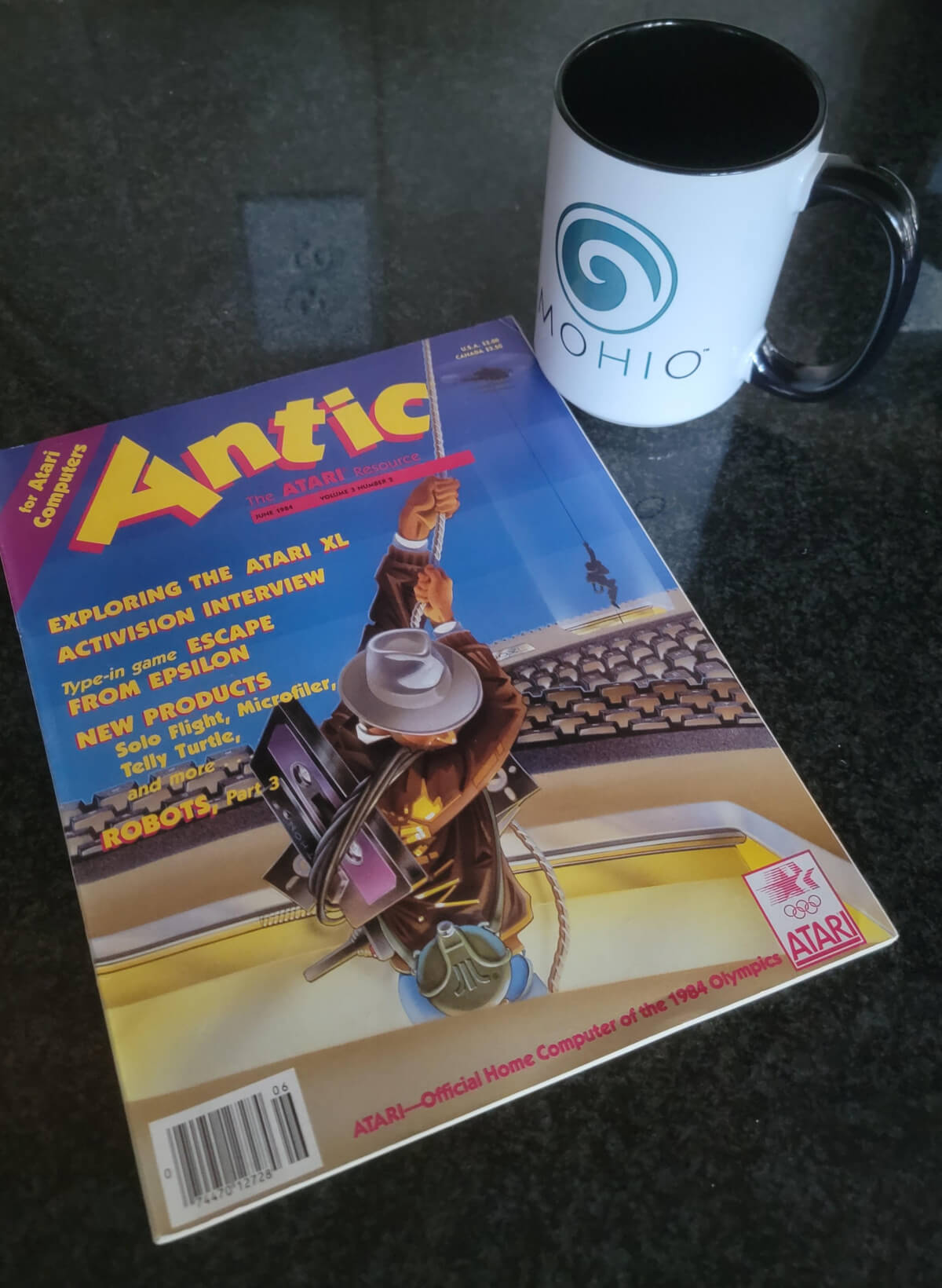
Here's something many people don't remember about those days. Magazines printed programs right in their pages, line after line of code you typed in yourself, by hand, character by character. I read all of them I could get, Antic, ANALOG Computing, COMPUTE!, and they came out monthly, and the big programs ran in parts. Type in part one this month, save it to the cassette tape. Part two next month, type it in, save it again. You built a single game across months of issues, hunched at a desk in the dark, hoping you didn't fat-finger a single character across all those pages, because if you did, the machine simply would not run and would not tell you why. I lost count of the hours I spent hunting one wrong character through pages of my own typing. The one that hooked me for good was a game called Escape from Epsilon, by J.D. Casten, the Game of the Month in the June 1984 issue of Antic. You guided a little guy named Sylvester Biffdrop down through five dungeon levels, Alpha to Epsilon. And then came the part younger people will never feel in their bones, the load. You'd hit play on the cassette deck and wait, listening to that awful screech and warble of data coming off the tape, watching the counter crawl. You wrote those counter numbers down, by hand, so you could wind back to the exact spot next time, and you babied the highest-quality tape you could afford and prayed it hadn't stretched or gone bad on you, because one corrupted stretch near the end would wipe out hours of typing with a single error and nothing to tell you why. When it finally ran, when Sylvester finally moved on my screen off my own cassette tape, that feeling went straight into my chest and never left. I've built an entire life chasing the moment it finally runs. The issue is still archived online, code and all, if you want to see what an entire game looked like as something you typed by hand. Just search it out on Google and you will find it typed and ready to run throught an emulator.
But the machine wasn't even the beginning. The beginning was two teachers who each, in their own way, refused to let me quit on myself.
Which is where Mrs. Scott comes in. Old, gray-haired, ornery as a cornered cat, my trig teacher, and I was genuinely bad at trig. Geometry I'd been fine at. Trig just would not sit right in my head, and I had mostly written myself off, figured some people were math people and I wasn't one of them, and settled in to coast.
“I’ve built an entire life chasing the moment it finally runs.”
Mrs. Scott would not allow it. She was not warm about it, this was not a movie where the kind teacher believes in the troubled kid. She was tough and a little mean and her whole attitude was just do it, it's math, there are no opinions in here. She kept me after class. She made me do it again, and again, arms crossed, unimpressed, waiting. I did not like her. And trig never really clicked, not for me. I clawed my way to a C or a C-minus and called it a win.
What she saw, and I couldn't, was that when I actually put my mind to something I could do it. The struggle was effort, not ability. And that same year, the very first year our school had computers at all, tenth grade, she was one of the teachers running the brand-new computer class. She told me uncerimoniously that she figured I'd probably do well in it. Coming from a woman who handed out approval like it cost her money, that landed. She had seen something in all my trig suffering that I hadn't, and she pointed me straight at it.
She was right. That class cracked me wide open. After they taught us the basics, the assignment was to make something ourselves, and I wrote a program that drew moving fractals on the CRT. The first thing I ever made a computer do that I hadn't copied out of a magazine, mine, from nothing but instructions I strung together. Shapes blooming out of the green glow, repeating smaller and smaller into forever, and I nailed it fast, or at least that's how I remember it. I sat there watching this thing I had summoned into existence and felt something crack open in my chest. That was it. I was hooked. I have been chasing that exact feeling for forty years and never once gotten tired of it. There have been years at a time where I stepped away from actual coding but always found my way back. Either someone pulls me back in like Mrs.Scott did and makes me learn something new (shout out to Rich F.), or something waiting to be created takes hold and restarts the obsession.
That class did something else too. I already ran with a wide crowd, hockey, theater, a D&D table, and walking into that room I crossed clean over into full nerd territory and never looked back. It's also where I found the one other kid in a sea of Commodore 64s and 128s who had an Atari like me. His dad worked on home computers for Atari at the time, which made him the most interesting person in the building to me. We bonded over being the only two on the wrong machine, which turned out to be the right one. I haven't talked to him since tenth grade. I think the family moved out to wherever Atari was headquartered. But for that year, in that room, we were the Atari kids, and that was everything.
Mrs. Scott never knew any of it. Never knew she'd drilled a future language designer through math he'd need decades later, never knew that pointing one stubborn C student toward a computer lab set the whole rest of his life in motion. You almost never know, in the moment, which of the people leaning on you is building you.
The other one was my English teacher, and that story I think about more than any of them, because of where and how it landed.
I was in eighth or ninth grade and I wrote a sequel. Twenty-plus pages, a full continuation of Piers Anthony's Xanth books, which I loved. Poured everything into it. And she failed me. Flat out failed the assignment, because she did not believe a kid my age could have written something like that. She was sure I'd copied it from somewhere. I hadn't. So I proved it, however you prove such a thing at fourteen, and when she finally believed me she didn't just change the grade, she gave me an A-plus and then spent the rest of that year pushing me to write. The accusation flipped into belief, and the belief flipped a switch in me.
"AI didn’t catch me off guard. It caught up to how my brain has worked since I was a teenager with a flashlight in the dark." - Ron Smith, Founder of Mohio
I still write. I am, in the most literal sense, writing right now, decades later, and some of the reason why traces straight back to a teacher who failed me because my work was maybe a little too good for my age, then turned around and made me a writer. Funny how the person who doubts you hardest can become the one who sets you loose, if they're big enough to admit they were wrong.
The machine at home was an Atari 800XL. We'd had a 2600 like every other family, but the 800XL was the one I actually learned on, and I wanted a Commodore 64 so badly it ached, same as I did in that classroom. Everybody had one but me. What I only understand now, decades later, is that the Atari did me a favor by making me work for it. Nothing was easy on that machine. You wanted it to do something, you told it exactly how, one careful instruction at a time, and it did precisely what you said and not one bit more. It never guessed. It never smoothed anything over for you. It taught me that a computer is not magic, it is a very fast, very literal thing that will do exactly what you tell it, which means every failure is yours and every success is yours too. I did not know it then, but that is the entire mindset of a person who would one day sit down and try to design a language. The machine I was embarrassed by was quietly teaching me how to think.
That is the part that gets me, looking back. None of it looked like preparation at the time. It looked like a kid up too late, a magazine he couldn't afford, a computer he didn't want, a teacher he couldn't stand, a story that got him accused. You cannot see the thread while you are living it. You only see it later, when you turn around and realize every one of those nights was pointing at the same place.
Because here is where it all led. I spent the years after that chasing every new way to make things, and I did not always chase them gracefully. I fought some of them hard before I gave in, and that is a whole story for another day (actually, that's a story I am editing now!). But the pattern underneath never changed. I was the kid who had to see it run. I still am.
So no, AI didn't leave me behind. That's the story I keep hearing is supposed to happen to a man my age, the wave that arrives and rolls right past you. It doesn't feel like that from in here. It feels like the wave I've been waiting for my whole life. It's the most creative tool I've ever held, I learn something from it just about every day, and that's exactly what keeps me sharp while people assume the opposite about someone greying around the edges. AI didn't catch me off guard. It caught up to how my brain has worked since I was a teenager with a flashlight in the dark.
I'm writing this at one in the morning, one small desk lamp on, the rest of the house dark. If that sounds familiar it should, because it's the same setup I had at fourteen, a flashlight instead of a lamp. I got so deep in the nostalgia writing this that I went and found the actual issue, the June 1984 Antic, and bought it off eBay. It's on its way to me right now, forty-plus years later.
And if any of this stirred something in you, as I mentioned, the code is still out there. You can pull up that exact type-in game, the one I hunted through character by character across months of my childhood, already written out, and run it in an Atari emulator tonight. Google it and see where I started.
Then know that the same kid is sitting here in the dark all these years later, still typing, still needing to see it run. Except now the thing I'm building is Mohio, a whole programming language, and the flashlight is a desk lamp, and the wave I waited my whole life for finally came.
The flashlight's gone. The wanting never left.
Back at it tomorrow.
.........................................................
Field Notes at Midnight is a weekly column by Ron Smith, who is building Mohio, an AI-native programming language, alone. New entries post weekly. The writing is unfiltered: the real work, the real setbacks, and what building something new actually feels like from the inside.