

Breaking
Sponsor Advertisement
D’Souza Book Highlights Archaeological Support for Bible
Image for: D’Souza Book Highlights Archaeological Support for Bible

D’Souza Book Highlights Archaeological Support for Bible

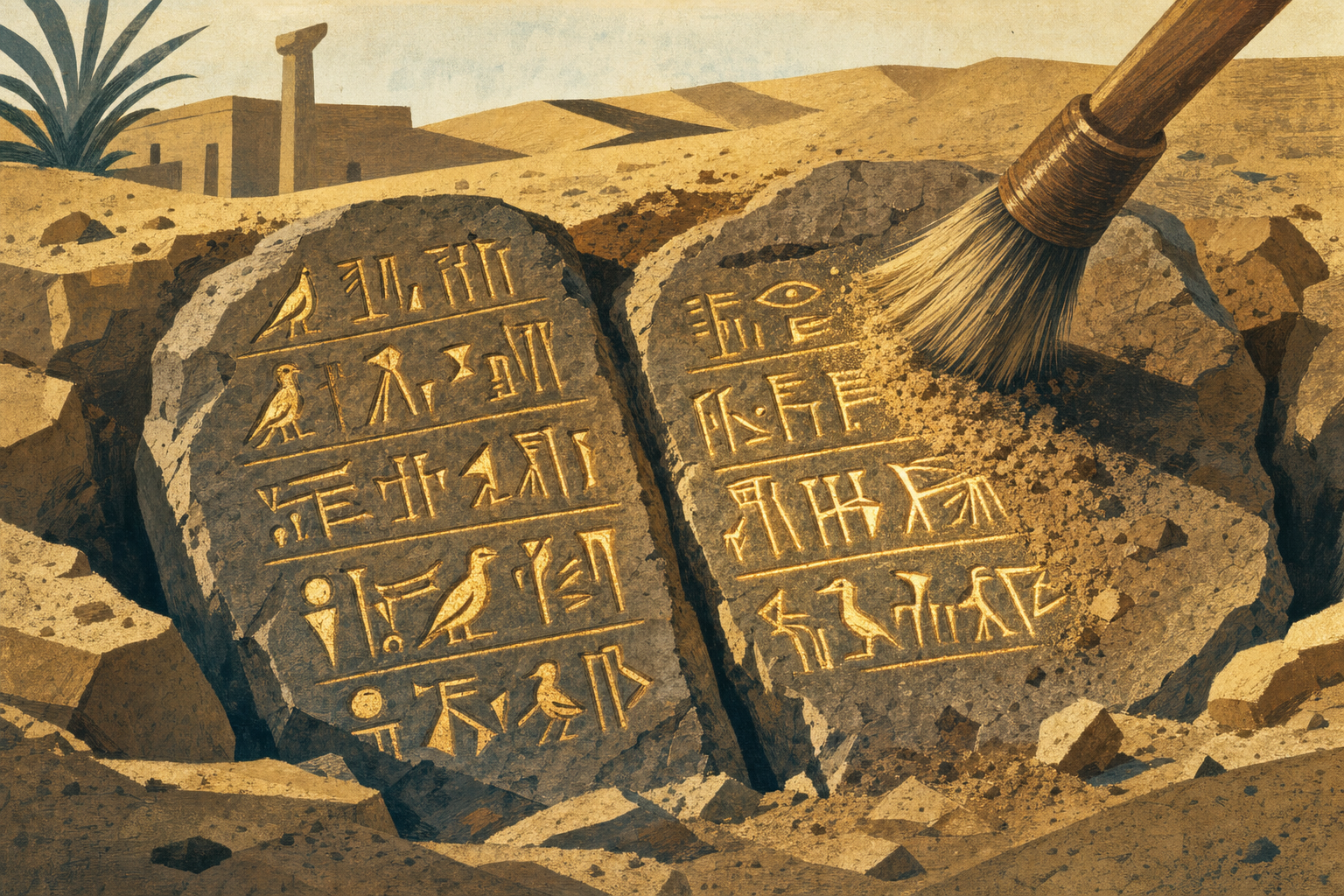
Conservative author Dinesh D'Souza's new book, "The Stones Cry Out," investigates archaeological discoveries that he argues corroborate biblical narratives. The book highlights findings such as the Pilate Stone and the Caiaphas ossuary, which D'Souza believes challenge historical skepticism.
Jump to The Flipside Perspectives

Conservative author and filmmaker Dinesh D’Souza is set to release his new book, "The Stones Cry Out," on October 13. The book explores archaeological findings that D'Souza contends provide compelling evidence for the historical accuracy of biblical accounts, spanning both the Old and New Testaments. D’Souza's interest in biblical archaeology reportedly stemmed from a 2022 trip to Israel, leading to a three-year investigation into the field.

"Archaeology provides this kind of stunning corroboration for the people, the places and the events in the Bible." — Dinesh D’Souza, Author and Filmmaker

Speaking with Fox News Digital, D’Souza articulated his conviction that archaeological discoveries "stunningly support the historicity of the Bible." His research, detailed in the forthcoming book, focuses on physical evidence linked to specific individuals, locations, and events described in Scripture. D'Souza posits that some of the most potent evidence emerges not from major biblical figures, but from minor characters whose names have been unearthed in ancient inscriptions.

A central example D'Souza cites is Pontius Pilate, the Roman governor mentioned in the New Testament as presiding over Jesus' trial. For centuries, questions lingered regarding the historical veracity of Pilate's portrayal until a 1961 excavation in Caesarea Maritima, Israel. This dig uncovered the Pilate Stone, an inscribed artifact that directly names Pilate and identifies him as "prefect of Judea." The artifact is now a permanent exhibit at the Israel Museum in Jerusalem. D'Souza emphasized the significance of this find, stating, "Boom. Not only does it confirm the existence of Pilate, but the Bible writers had his title exactly correct." He further noted that while Pilate's title later changed to procurator, the biblical designation as prefect was accurate for the period of Jesus' life.

Another case presented in "The Stones Cry Out" originates from ancient Moabite territory, now part of Jordan. The Old Testament recounts the Israelites' journey toward the Promised Land, during which a Moabite king hired a diviner named Balaam to curse them. In 1967, archaeologists at a site called Deir ‘Alla discovered a plaster inscription containing the phrase "Balaam, son of Beor." This name and family lineage precisely match the diviner described in Scripture. D’Souza described the initial skepticism surrounding such biblical figures, followed by the archaeological corroboration. "So skeptics, no surprise, go, ‘This stuff is clearly made up,'" he recounted. "Well, fast-forward. … This is a guy who has just a few sentences in the Bible, and yet, thanks to this plaster inscription found in Jordan, he jumps out of the pages of the Bible and into the pages of history via the pathway of archaeology."

Perhaps the most impactful discovery highlighted by D'Souza concerns Caiaphas, the high priest who oversaw Jesus' trial and is characterized by D'Souza as "one of the villains of the Bible" for orchestrating the crucifixion. For a long period, Caiaphas's existence was primarily confined to biblical texts. "Yet for many, many centuries, Caiaphas had a kind of shady existence. He was mainly in the Bible, but not really outside the Bible," D'Souza explained. This changed with the excavation of an ossuary—a stone box for bones—in Jerusalem, inscribed with the name "Yehoseph bar Caiapha." D'Souza detailed the find: "They look inside the box. It’s the bones of a 60-year-old man. They date it. It goes to the first century A.D. It’s Caiaphas." For D'Souza, the presence of actual remains adds significant weight to the historical confirmation, underscoring how "Archaeology provides this kind of stunning corroboration for the people, the places and the events in the Bible."

D’Souza intends his book to serve as a bridge, making complex academic scholarship accessible to a broader audience who may not engage with peer-reviewed archaeological reports. He acknowledged the field's complexity but emphasized its rewards. Beyond the book, D’Souza advocates for Christians to visit Israel, referring to it as "our spiritual homeland" and distinct from the broader Levant region. He notes that "All of the Old Testament and Jesus’ own ministry takes place in the [land] of Israel," suggesting that experiencing the physical terrain, such as the Pool of Siloam, enhances comprehension of biblical narratives. For those unable to travel, D'Souza suggests his book as "the next best thing."

Advertisement

The Flipside: Different Perspectives

Progressive View

From a progressive viewpoint, the exploration of biblical archaeology, as presented in Dinesh D’Souza’s new book, offers an opportunity to engage with historical inquiry and cultural heritage. While acknowledging the value of archaeological discoveries in illuminating ancient history, a progressive perspective would emphasize the critical and nuanced interpretation of such findings. Archaeology is a scientific discipline, and its discoveries contribute to our collective understanding of human civilization, regardless of their specific religious implications.

Progressives would stress that historical findings should be analyzed through rigorous academic methods, considering multiple interpretations and avoiding selective use of evidence to support pre-determined conclusions. The focus should be on how these discoveries enhance our understanding of ancient societies, their cultures, and their interactions, rather than solely on validating specific religious texts. While the existence of figures like Pilate or Caiaphas can be historically confirmed, this does not necessarily affirm the theological or miraculous aspects of religious narratives. Furthermore, a progressive lens would encourage an empathetic approach to understanding diverse belief systems, recognizing that faith and historical evidence serve different, though sometimes overlapping, purposes for individuals and communities. The pursuit of knowledge about our shared past should foster inclusivity and a deeper appreciation for the complexities of human history and belief.

Conservative View

The release of Dinesh D’Souza’s "The Stones Cry Out" resonates deeply within conservative thought, particularly its emphasis on historical truth and the defense of foundational religious texts. For many conservatives, the Bible is not merely a spiritual guide but also a historical document, and archaeological corroboration reinforces its authority and intellectual credibility. In an era where traditional values and institutions are frequently challenged, evidence that supports biblical historicity offers a vital counter-narrative to secular skepticism.

This perspective aligns with a broader conservative commitment to objective truth and skepticism towards intellectual trends that dismiss religious foundations without robust evidence. The idea that "the stones cry out" speaks to a belief that truth, when sought diligently, will reveal itself, even if it contradicts prevailing academic or cultural orthodoxies. Furthermore, D'Souza's work can be seen as a defense of Western civilization's Judeo-Christian roots, which many conservatives view as essential for societal stability and moral order. Promoting such scholarship fosters intellectual freedom by encouraging inquiry that challenges conventional wisdom and affirms the value of faith-based perspectives in public discourse. It also implicitly supports the right of individuals to explore and affirm their religious beliefs through historical and scientific means, rather than simply accepting secular interpretations.

Common Ground

Despite differing interpretations, there are genuine areas of common ground regarding the value of archaeological research and historical inquiry. Both conservative and progressive viewpoints can agree on the importance of preserving archaeological sites and artifacts as part of our shared human heritage. These discoveries offer invaluable insights into ancient civilizations, their daily lives, political structures, and cultural practices, enriching our understanding of the human story.

There is also shared appreciation for the scientific methodology and dedication of archaeologists who meticulously unearth and analyze these historical treasures. The pursuit of factual accuracy and the rigorous process of verifying historical claims through physical evidence are universally valued. Whether one seeks to corroborate religious texts or simply to deepen historical knowledge, the commitment to objective investigation is paramount. Furthermore, making complex academic fields like archaeology accessible to a broader public, as D'Souza aims to do, is a constructive endeavor. Promoting education and informed discussion about history, culture, and the origins of human belief systems can foster a more knowledgeable and engaged citizenry, regardless of individual ideological or religious leanings.

What's your view on this story? Share your thoughts and remember to consider multiple perspectives and being respectful when forming and voicing your opinion. "If you resort to personal attacks, you have already lost the debate..."

Advertisement

Contact Us About This Article

Have a question or comment about this article? We'd love to hear from you.

About Fair Side News

At Fair Side News, we believe in presenting news with perspectives from both sides of the political spectrum. Our goal is to help readers understand different viewpoints and find common ground on important issues.