


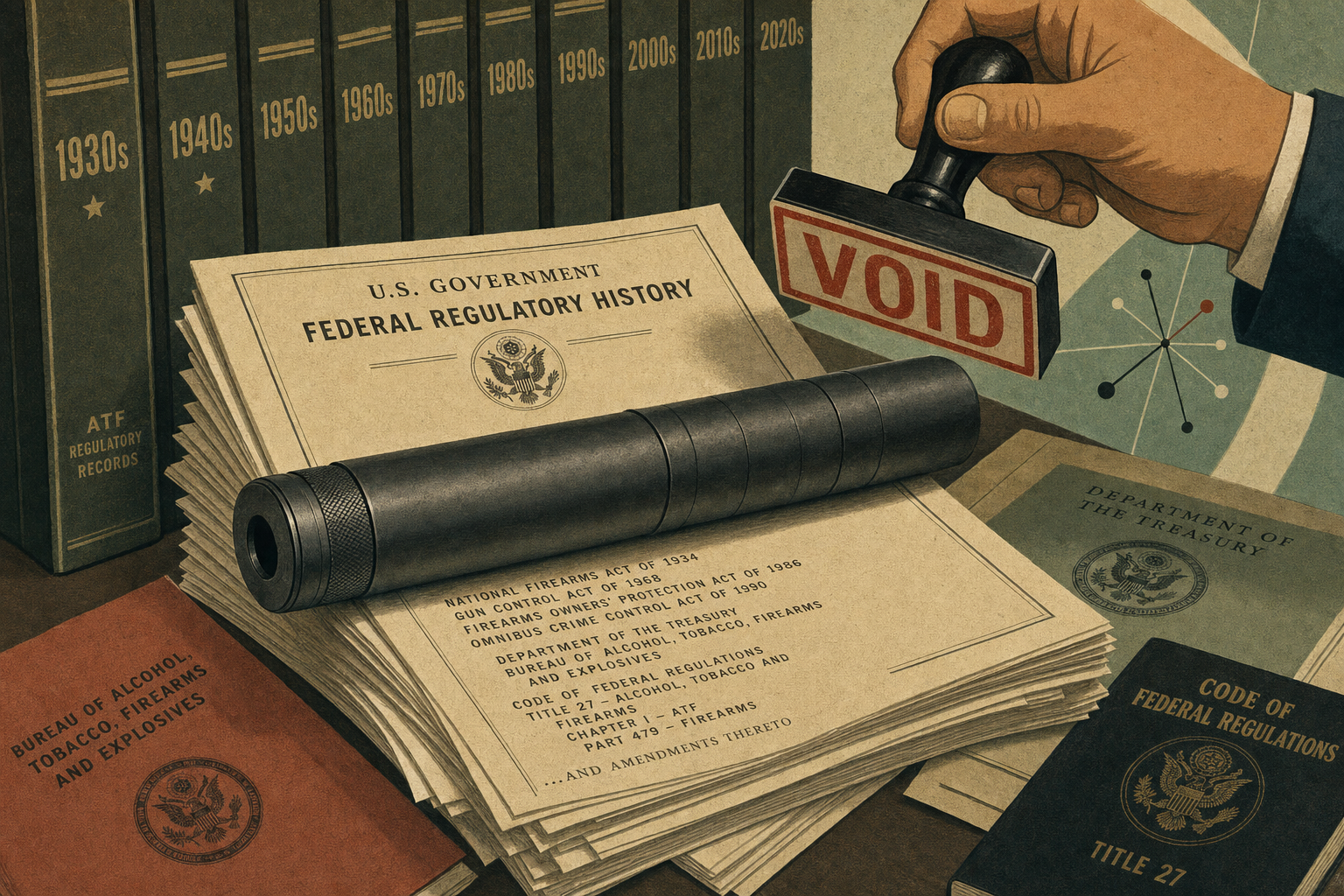
The Trump administration's Justice Department has opted not to appeal a federal court decision that invalidated key registration requirements for firearm suppressors and specific weapons, a move celebrated by gun rights advocates as a substantial victory. The deadline for the Justice Department to challenge the ruling passed on Thursday, August 15, 2026, allowing the court's decision to take effect without further federal intervention. This development represents a significant curtailment of gun regulations that have been in place for over 90 years.
"The Department of Justice had the opportunity to act to protect our safety, but it failed to do so." — Kris Brown, President of Brady: United Against Gun Violence.
The legal and legislative efforts leading to this outcome focused on the National Firearms Act (NFA) of 1934. This landmark legislation imposed a $200 tax and federal registration requirements on various firearms and accessories, including suppressors, short-barreled rifles, and short-barreled shotguns. Last year, Republicans in Congress enacted the One Big Beautiful Bill Act, which effectively eliminated the $200 tax by reducing it to $0.
Following the elimination of the tax, gun rights organizations initiated legal challenges, arguing that once Congress removed the taxation component, the federal government no longer possessed the constitutional authority to maintain the associated registration requirements. A federal judge subsequently sided with these challengers. It is important to note, as reported by the Associated Press, that this specific ruling applies only to the parties involved in the lawsuit and does not constitute a nationwide injunction that would invalidate the requirements for all citizens across the country. However, the Trump administration's decision not to appeal the ruling is seen as a crucial step, preventing a higher court from potentially reinstating the registration requirements for the affected parties.
Rep. Andrew Clyde (R-GA), a prominent advocate for gun rights and a former gun store owner, played a significant role in the legislative push to reduce the NFA tax. He hailed the Justice Department's decision as "the greatest restoration" of Second Amendment rights in nearly a century. Clyde has consistently argued that taxing the exercise of a constitutional right is inherently problematic. "If you can tax something legitimately, then you can actually destroy it through increased taxation," Clyde told Fox News Digital. He elaborated on the potential for such taxation to render a right effectively inaccessible: "You might, quote, 'have a right on paper,' but you don’t really have a right because you can’t afford the right. Is that really a right? It’s not."
Clyde further contended that by removing the tax, the primary constitutional justification for the federal registration system was undermined. "So here we are removing the taxation on a constitutional right from a bill that was passed in 1934," Clyde stated. "And once you remove the tax aspect of it, then you remove the constitutionality of the registration aspect." He characterized the outcome as an "incredible win for the Second Amendment" and expressed optimism for future victories in expanding gun protections.
Rep. Clyde was among 48 Republican lawmakers who collectively urged Attorney General Todd Blanche not to challenge the federal court's decision. In their letter, the lawmakers asserted, "An appeal would prolong regulatory uncertainty for law-abiding gun owners and businesses and would consume DOJ resources defending a position that this Congress and now a federal district court has said cannot stand." The Justice Department ultimately heeded this call. Clyde also emphasized the broader significance of the Second Amendment, describing it as a fundamental safeguard for all other constitutional rights. "When you protect the Second Amendment, which protects every other amendment in the entire Constitution — I think that’s the teeth behind the Constitution," he said.
Gun rights organizations have widely celebrated the administration’s decision, viewing it as another testament to President Donald Trump’s commitment to expanding Second Amendment protections. Conversely, the move has drawn sharp criticism from gun control advocacy groups. Kris Brown, President of Brady: United Against Gun Violence, expressed strong disapproval, accusing the federal government of dereliction in its duty to protect public safety. "Today, our government is failing us," Brown said in a statement. She specifically criticized the deregulation of suppressors, short-barreled rifles, and shotguns, arguing that the Justice Department had an imperative to appeal the ruling. "The Department of Justice had the opportunity to act to protect our safety, but it failed to do so," Brown stated.
This latest development continues a decades-long debate over the scope and application of the National Firearms Act. While the court's ruling is limited to the specific parties involved, the administration's choice not to appeal solidifies a significant legal precedent for gun rights groups challenging longstanding federal firearms regulations. For figures like Rep. Clyde, whose career prior to Congress was rooted in the firearms industry, this outcome represents the culmination of sustained legislative and legal efforts to dismantle restrictions that have been in place since 1934.

