


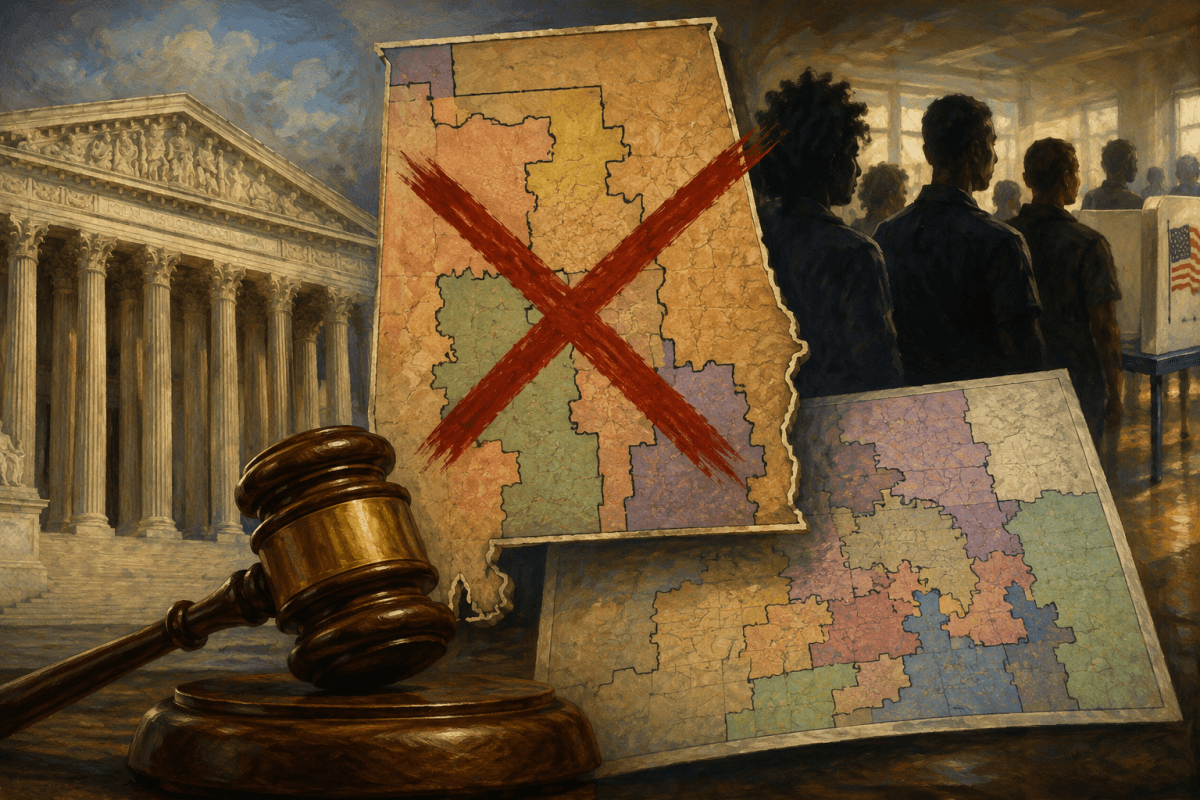
A three-judge federal panel on Tuesday issued a preliminary injunction preventing Alabama officials from implementing new congressional district boundaries, setting the stage for another potential U.S. Supreme Court battle over voting maps. The ruling requires Alabama to continue using the court-drawn districts from the 2024 election cycle, which had been imposed after previous maps were deemed to weaken Black voting strength.
"Ultimately, we cannot see our way clear to requiring Alabamians to cast their votes in the 2026 elections under a districting plan tainted by intentional race-based discrimination." — Three-Judge Federal Panel, Ruling
The dispute centers on Alabama Republicans' efforts to reinstate congressional lines approved by state lawmakers in 2023. These boundaries faced immediate legal challenges, as courts concluded they did not adequately address concerns about racial vote dilution. The current court-approved map, which the state must now continue to use, notably led to the election of Democrat Rep. Shomari Figures in Alabama’s 2nd Congressional District.
The judicial panel concluded that Alabama’s 2023 congressional design remained "constitutionally problematic," despite recent Supreme Court guidance regarding Voting Rights Act standards. The judges stated that their earlier findings of intentional racial discrimination in the state's proposed maps remained unchanged. "Ultimately, we cannot see our way clear to requiring Alabamians to cast their votes in the 2026 elections under a districting plan tainted by intentional race-based discrimination," the panel wrote in its decision.
State officials had argued that lawmakers pursued political objectives rather than racial considerations when crafting the challenged district boundaries. They contended that their map reflected partisan goals, not race-based decision-making, citing recent Supreme Court rulings on Voting Rights Act claims. However, the judicial panel rejected this argument, finding that the evidence presented during litigation did not support claims that party politics, rather than race, primarily drove the development of the challenged map. "These events, along with legislators’ contemporaneous statements about race, support only one inference: the purpose of the 2023 Plan was to distribute Black voters across districts to dilute their votes, at least in part because they are Black," the judges wrote.
Following the ruling, Alabama Attorney General Steve Marshall announced plans to appeal the decision directly to the U.S. Supreme Court. "This is a very fluid situation, and I will do my best to keep the people of Alabama apprised of our efforts," Marshall stated. "Know this—in my mind, it is not a matter of whether we win this case, only when." Governor Kay Ivey (R) also voiced support for the appeal, asserting that Alabama should retain the authority to draw its own congressional districts. State Republicans had hoped that revised district lines could strengthen their electoral outlook, potentially allowing them to regain a congressional seat currently held by Democrats.
This ongoing legal battle in Alabama mirrors broader redistricting disputes unfolding across the nation. Both major parties are actively examining district changes that could influence congressional control in upcoming election cycles. Republican-led states such as Tennessee, South Carolina, and Louisiana have explored district adjustments in recent months, while Democrats have pursued map changes in states like California and are closely monitoring legal developments elsewhere that could impact House races.
The Alabama congressional mapping dispute has now moved through multiple rounds of litigation over several election cycles. In 2023, the Supreme Court determined that Alabama’s previous congressional design likely violated federal voting protections by failing to create sufficient opportunities for Black voters to elect their preferred candidates. Lawmakers subsequently approved another district map, which also became the subject of legal challenges, leading to the current dispute.
While acknowledging that ongoing judicial oversight of elections is not ideal, the judges concluded that continued involvement remains necessary as the dispute proceeds. For now, Alabama voters will continue to use the existing court-approved districts unless the Supreme Court intervenes. With state officials preparing their appeal, Alabama’s congressional map fight is poised for another significant test before the nation’s highest court, amidst a national landscape of evolving redistricting battles.

