

Breaking
Sponsor Advertisement
GOP Governors Join Bipartisan Push for State-Led Immigration Solutions
Image for: GOP Governors Join Bipartisan Push for State-Led Immigration Solutions

GOP Governors Join Bipartisan Push for State-Led Immigration Solutions

Republican Governors Spencer Cox and Kevin Stitt are collaborating with Democratic counterparts on a National Governors Association task force, advocating for state-level approaches to immigration policy, particularly regarding workforce needs.
Jump to The Flipside Perspectives

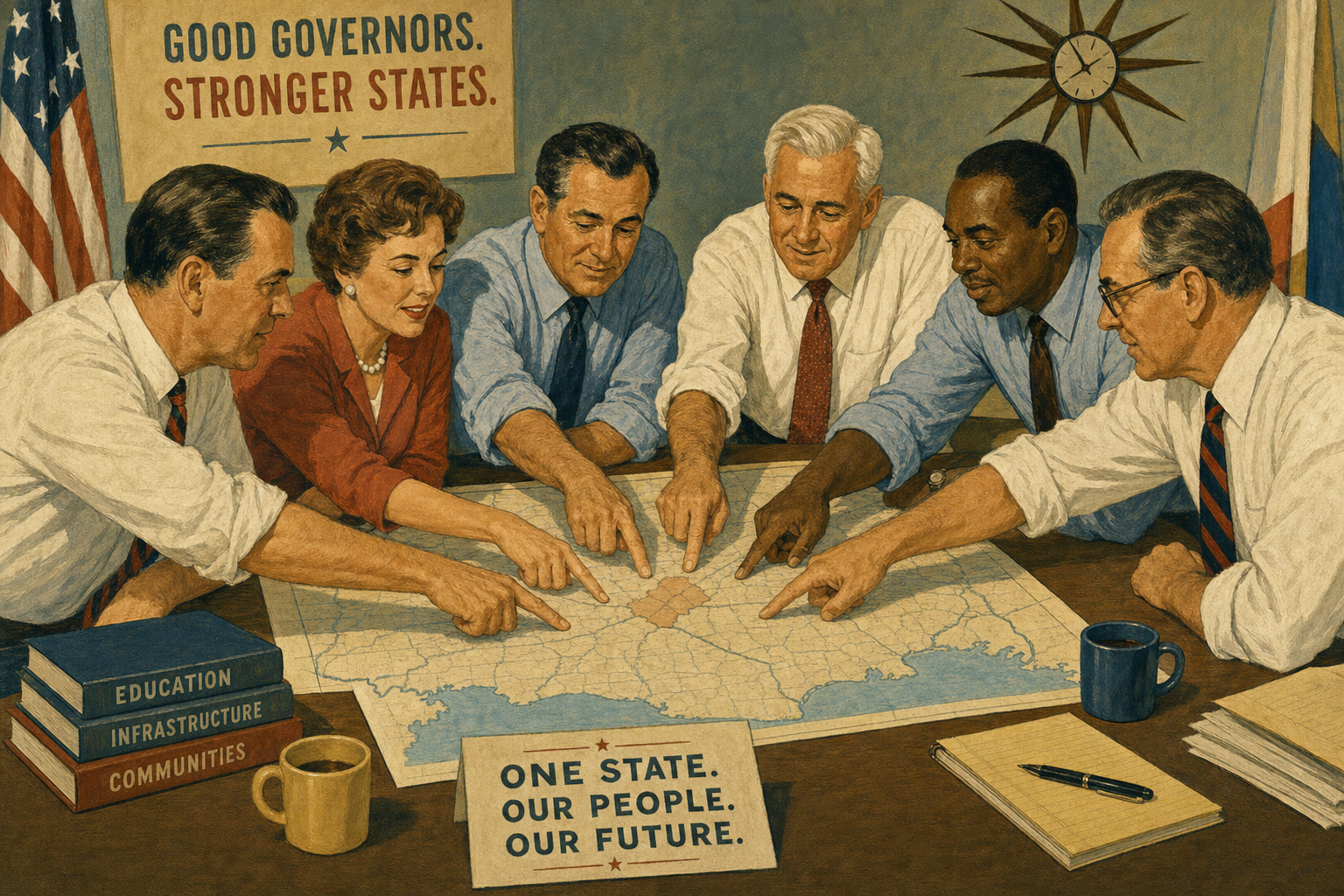
Republican Governors Spencer Cox of Utah and Kevin Stitt of Oklahoma have joined a bipartisan National Governors Association (NGA) task force focused on developing state-level solutions for immigration policy, with a particular emphasis on addressing workforce concerns. The initiative, which also includes Democratic Governors Wes Moore of Maryland and Matt Meyer of Delaware, seeks to explore new avenues for immigration reform amidst a reported decline in illegal border crossings.

"I think what the American public loves is that me and the governor of New York can agree on a lot of issues on immigration reform." — Oklahoma Governor Kevin Stitt

Governor Cox, discussing the effort in an interview with Bloomberg, indicated that Republican and Democratic governors found significant common ground on both border security and broader immigration issues. He suggested that a more secure border environment could create an opening for lawmakers to consider systemic changes, including reforms to legal workforce programs. This sentiment was echoed by Governor Stitt, who noted that the task force originated from shared concerns raised by businesses in key sectors such as agriculture, construction, and hospitality. These industries, Stitt explained, have consistently urged state leaders to explore methods for fulfilling workforce needs, including the potential for governors to issue workforce permits.

The concept of state-sponsored workforce permits aligns with a recent legislative proposal by Utah Senator John Curtis, a Republican, which aims to establish a voluntary state-sponsored visa program. Such a program would grant states a more significant role in managing temporary migrant workforce requirements, potentially decentralizing aspects of immigration policy that have traditionally been federal responsibilities.

During the Bloomberg interview, both Governor Cox and Governor Stitt were directly asked about the effectiveness of the approaches taken by Immigration and Customs Enforcement (ICE) and the Department of Homeland Security (DHS). Neither governor raised their hand in affirmation. Governor Cox specifically voiced concerns regarding "the violence and the deaths" associated with immigration enforcement actions in Minnesota, describing these incidents as "deeply problematic."

This collaborative approach by Governors Cox and Stitt comes amid their complex relationships with President Donald Trump. Governor Cox has faced past criticism from some conservative factions due to his disagreements with President Trump. Notably, Cox did not vote for President Trump in either the 2016 or 2020 elections. Although he initially did not plan to support President Trump in 2024, he later changed his stance following an assassination attempt on President Trump in Butler, Pennsylvania, as reported by The Blaze. In 2022, conservative activist Charlie Kirk called for Cox's removal from the Republican Party after the Utah governor supported policies allowing trans-identifying male athletes to compete in women’s sports.

Governor Stitt, despite having received President Trump's endorsement and fundraising support during his 2022 gubernatorial campaign, has also experienced friction with the President. Stitt endorsed Florida Governor Ron DeSantis, a Republican, during the 2024 Republican presidential primary, leading President Trump to publicly criticize him as a "RINO Governor," according to NOTUS. Despite these past disagreements, Governor Stitt has consistently emphasized the importance of cooperation between governors from both parties, asserting that leaders can maintain differing political views while still effectively collaborating on shared concerns. He stated, "I think what the American public loves is that me and the governor of New York can agree on a lot of issues on immigration reform."

However, not all Republican governors support this state-led approach. Texas Governor Greg Abbott, through his spokesperson Andrew Mehalaris, explicitly rejected proposals that could create incentives for illegal immigration or treat individuals who entered the country unlawfully as a labor source. Mehalaris conveyed to Blaze News that Texas prioritizes its own citizens for jobs and argued that states not experiencing the same level of illegal immigration pressures should not dictate policy for those on the front lines.

The formation of this task force coincides with Governor Stitt’s transition out of his role as chairman of the National Governors Association. In an interview with The Associated Press, Stitt reflected on his experience working with governors across the political spectrum, noting that elected officials often share more common ground than the public perceives. He further underscored the principle of state authority, advocating for states to retain flexibility in pursuing policies aligned with their specific priorities and needs.

As of now, the National Governors Association has not released a detailed agenda for its Immigration Policy Task Force. Requests for comment to Governors Cox, Stitt, Moore, Meyer, and the NGA regarding the group's specific plans have not yet received responses. The discussions, however, signal a growing interest among state leaders in carving out a more active role in shaping national immigration discourse and policy implementation.

Advertisement

The Flipside: Different Perspectives

Progressive View

Progressive perspectives on immigration emphasize comprehensive reform that is humane, equitable, and addresses the root causes of migration while recognizing the economic contributions of immigrants. The collaboration between Republican and Democratic governors on a state-led task force is seen as a pragmatic and positive development. This approach acknowledges that states often have unique workforce needs and are directly impacted by immigration policies, making them well-suited to develop tailored solutions. The focus on workforce permits and legal pathways is particularly welcome, as it provides a structured method for individuals to contribute to the economy and addresses labor shortages in critical sectors like agriculture and hospitality.

From a progressive standpoint, the concerns raised by Governor Cox about "violence and deaths" associated with immigration enforcement highlight the need for a more compassionate and less punitive system. Empowering states to manage aspects of temporary migrant workforce needs could lead to more flexible and responsive programs, reducing reliance on federal enforcement mechanisms that are often criticized for their harshness and lack of accountability. This initiative aligns with the belief that a well-regulated, accessible legal immigration system benefits everyone, fostering economic growth and social integration. It also underscores the importance of collective well-being, recognizing that a stable workforce and a humane approach to immigration are interconnected and contribute to a more just society.

Conservative View

Conservative thought on immigration often prioritizes national sovereignty, border security, and the rule of law. From this perspective, any immigration reform must first ensure a secure border to deter illegal crossings and maintain national integrity. The involvement of Republican governors like Cox and Stitt in a bipartisan task force exploring state-level workforce permits could be viewed with cautious optimism or skepticism. Advocates of states' rights might appreciate the emphasis on state authority and local control over workforce needs, seeing it as an opportunity for states to tailor solutions that align with their specific economic realities without federal overreach. This aligns with the principle of limited government, allowing states to innovate and address issues that directly impact their constituents.

However, a strong conservative stance, exemplified by Governor Greg Abbott, would be wary of any proposal that could inadvertently create incentives for illegal immigration or legitimize the employment of individuals who entered the country unlawfully. The concern is that issuing state-level work permits could circumvent federal immigration laws and undermine efforts to control the border. Prioritizing legal immigration pathways and ensuring that jobs are available for citizens and legal residents is paramount. While addressing workforce shortages is a valid concern, conservatives typically insist that such needs be met through legal means, without compromising national security or the integrity of existing immigration laws. The challenge to President Trump's approach, which emphasizes strict enforcement, might also be seen as a deviation from a necessary federal posture.

Common Ground

Despite partisan differences, there are genuine areas of agreement regarding immigration reform, particularly at the state level. Both conservative and progressive leaders acknowledge the existence of critical workforce shortages in various industries across the country. There is a shared understanding that an orderly and efficient system is preferable to the current challenges. The bipartisan NGA task force represents a practical, collaborative effort to explore solutions that could benefit state economies and address business needs.

Both sides can agree on the importance of secure borders, though they may differ on the methods and extent of enforcement. A more secure border, as Governor Cox suggested, could create a better environment for discussing and implementing reforms to legal immigration pathways. Furthermore, there is common ground in the belief that states should have a voice in shaping policies that directly affect their populations and economies. This respect for state authority and local control can foster innovative solutions that are less dependent on a one-size-fits-all federal approach. By focusing on shared problems like workforce development and seeking practical, state-driven solutions, governors are demonstrating a willingness to move beyond ideological stalemates to find common-sense approaches that serve their constituents.

What's your view on this story? Share your thoughts and remember to consider multiple perspectives and being respectful when forming and voicing your opinion. "If you resort to personal attacks, you have already lost the debate..."

Advertisement

Contact Us About This Article

Have a question or comment about this article? We'd love to hear from you.

About Fair Side News

At Fair Side News, we believe in presenting news with perspectives from both sides of the political spectrum. Our goal is to help readers understand different viewpoints and find common ground on important issues.