


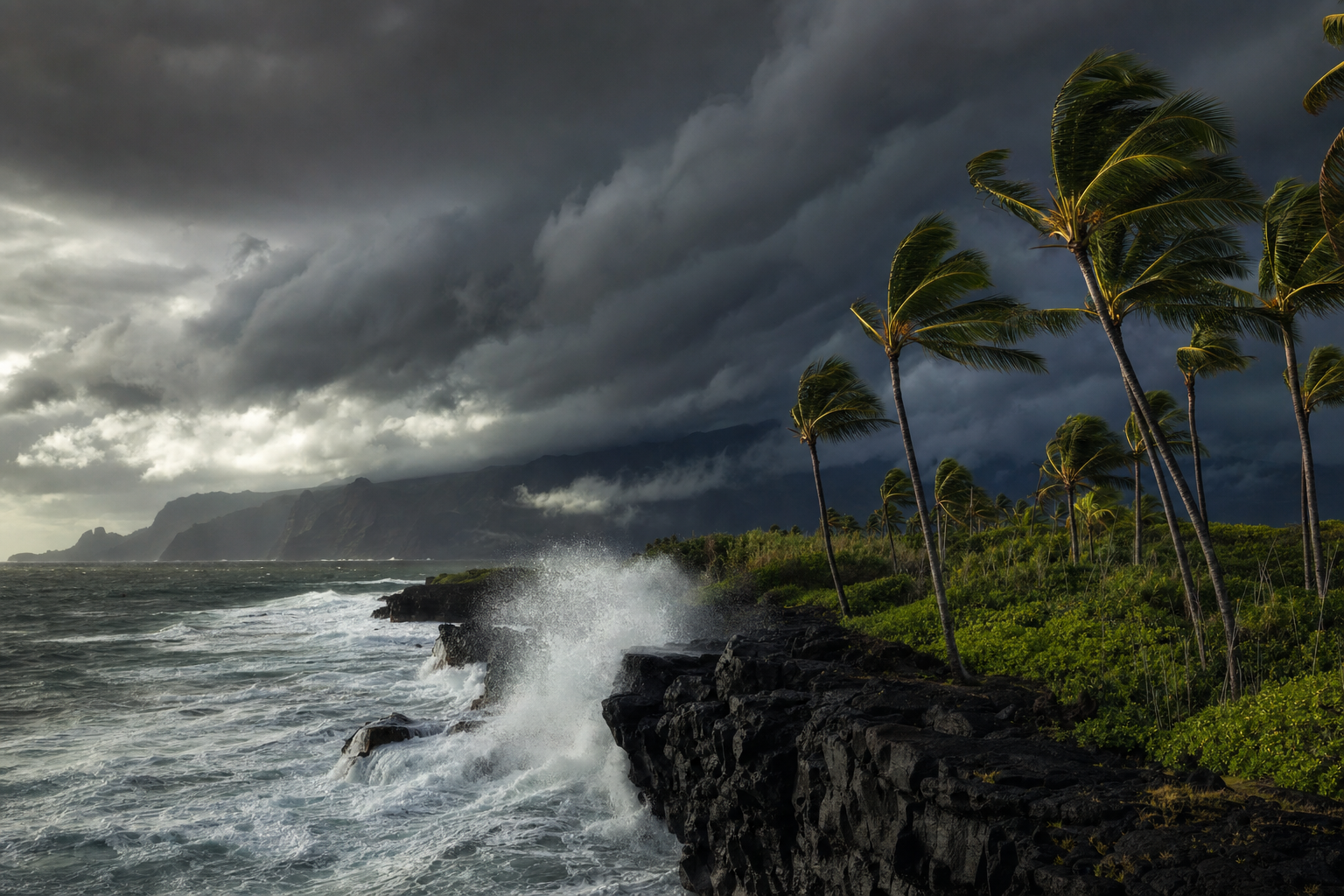
A hurricane watch has been issued for portions of Hawaii’s Big Island as Tropical Storm Lala barrels toward the state, threatening to unleash hurricane-force winds, torrential rainfall, and potentially catastrophic flooding beginning Friday. The storm, less than 700 miles southeast of Hawaii on Thursday morning, is moving west with sustained winds of approximately 40 mph, according to forecasters.
"Despite never making landfall in Hawaii, Hone brought more than two feet of rain to portions of the Big Island, causing significant flooding, as well as winds in excess of 70 mph." — Alex DaSilva, AccuWeather Lead Hurricane Expert
Meteorological agencies, including the National Weather Service and the National Hurricane Center (NHC), have warned that Tropical Storm Lala could strengthen significantly as it approaches the Hawaiian Islands, potentially escalating into a Category 1 hurricane. Hurricane-force winds are possible within the watch area over the next 48 hours, with conditions expected to deteriorate Friday and the greatest threat anticipated Friday evening into Saturday.
The National Weather Service has cautioned that some communities on the Big Island could experience wind gusts reaching 75 mph. Furthermore, parts of the island could receive as much as 15 inches of rain. Forecasters describe the potential resulting flooding as "devastating to catastrophic," warning it could wash out roads, overwhelm rivers, and render some homes uninhabitable. The National Hurricane Center has also alerted residents to the possibility of life-threatening flash flooding and mudslides, particularly in areas of steep terrain. "Heavy rainfall associated with Tropical Storm Lala will begin to impact the Big Island Friday, spreading westward across the island chain during the weekend," the NHC stated. "This rainfall may produce life-threatening flooding and mudslides, especially in areas of steep terrain."
Officials are urging residents in potentially affected communities to finalize their preparations before conditions become dangerous. Beyond wind and rain, the storm could trigger widespread power outages, dangerous surf, and coastal flooding. Additionally, several tornadoes are possible as the system traverses the region. While the Big Island is currently projected to bear the brunt of the storm's impacts, Lala could affect communities across the entire Hawaiian archipelago. The state is home to more than 1 million people, with major population centers including Honolulu, Waikiki, Kahului, and Kihei.
The impending storm arrives during Hawaii’s peak summer tourism season, a period when approximately 250,000 visitors can be vacationing across the islands on any given day between June and mid-August. As of Thursday, Maui, Molokaʻi, Lanaʻi, and Oʻahu had not been placed under a hurricane watch. However, forecast models indicate that Lala could pass close enough to these islands to bring heavy rain, strong winds, and rough surf. The National Hurricane Center projects winds approaching 30 mph across some of the smaller islands, and prolonged heavy surf could lead to coastal flooding and significant beach erosion throughout the state this weekend.
AccuWeather forecasts between four and eight inches of rain across the Big Island and Maui. However, its worst-case scenario predicts significantly more severe conditions, with as much as 24 inches of rain and hurricane-force winds reaching 85 mph possible on the Big Island. Alex DaSilva, AccuWeather Lead Hurricane Expert, drew parallels between the approaching system and Hurricane Hone, which impacted Hawaii in 2024 despite never making landfall. DaSilva noted, "Despite never making landfall in Hawaii, Hone brought more than two feet of rain to portions of the Big Island, causing significant flooding, as well as winds in excess of 70 mph."
The precise trajectory of Tropical Storm Lala remains uncertain. Meteorologists have noted that the storm could ultimately track farther south, which would reduce direct impacts on Hawaii. However, such a shift could also allow the storm to spend additional time over warm Pacific waters, potentially enabling it to strengthen into a larger hurricane.
This approaching storm coincides with predictions of heightened tropical activity across the Pacific during the 2026 hurricane season. AccuWeather had previously projected between 17 and 22 named Pacific storms this season, including nine to 13 hurricanes and as many as eight major hurricanes reaching Category 3 strength or higher. So far this year, nine named storms have already formed in the Pacific, with Fausto and Genevieve having reached hurricane status. If Lala strengthens as anticipated, it would become the season’s third hurricane. DaSilva previously cautioned Hawaiians against complacency, stating, "Hawaii has gone a long time without a direct hurricane landfall, but that should not lead to complacency."

