


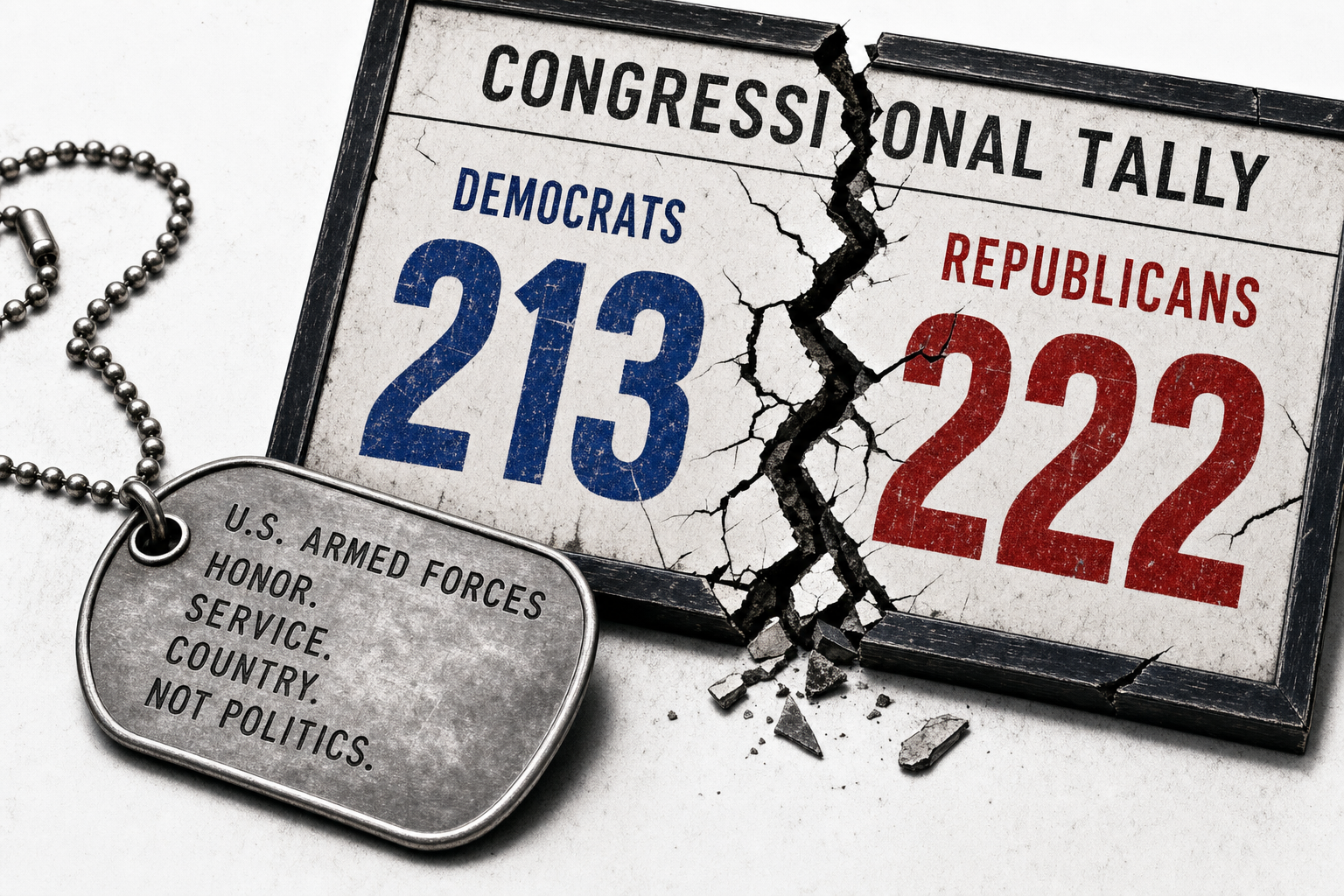
An amendment aiming to permanently enshrine President Donald Trump's executive order banning transgender individuals from military service into federal statute failed this week in the House of Representatives. The measure, proposed by Representative Lauren Boebert (R-CO), was defeated by a narrow margin of 212-217, with four Republican lawmakers joining all Democrats in opposition.
"expressing a false ‘gender identity’ divergent from an individual’s sex cannot satisfy the rigorous standards necessary for military service." — President Donald Trump, Executive Order on Military Service
The vote took place during the ongoing debate surrounding the National Defense Authorization Act (NDAA), Congress’s annual legislative package that dictates military spending and policy. The NDAA is one of the few pieces of legislation that consistently passes through Congress, making it a critical vehicle for policy changes affecting the armed forces. Representative Boebert's amendment sought to convert President Trump's January 2025 executive order, which restricts transgender individuals from serving in the military, into permanent law. Such a move would make the policy significantly harder for future presidential administrations to reverse compared to an executive order.
The unexpected defeat of the amendment stemmed from defections within Republican ranks. Four GOP lawmakers ultimately voted against the measure: Representative Mike Lawler of New York, Representative Brian Fitzpatrick of Pennsylvania, Guam Delegate James Moylan, and Northern Mariana Islands Delegate Kimberlyn King-Hinds. Their votes proved decisive, as Democrats remained unified in their opposition, with not a single member crossing over to support the amendment.
President Trump’s executive order, which remains in effect, states explicitly that "expressing a false ‘gender identity’ divergent from an individual’s sex cannot satisfy the rigorous standards necessary for military service." Beyond the service ban itself, the order mandates that Pentagon officials ensure biological males are kept out of female-only sleeping, changing, and bathing areas, and similarly, biological females from equivalent male-only spaces. The outcome of this week's vote does not alter the current operational status of President Trump's executive order.
However, the legal landscape surrounding the policy has seen recent developments. In June, a federal appeals court delivered a partial setback to the administration. The D.C. Circuit Court, in a 2-1 ruling, found that Defense Secretary Pete Hegseth's approach to removing certain currently serving transgender troops likely stemmed from unconstitutional bias rather than legitimate military justification. Crucially, that ruling specifically distinguished between the removal of already-serving transgender personnel and the standards for future recruitment, leaving the latter untouched. The court explicitly treated the question of enlisting new transgender troops as legally distinct from the question of retaining those already serving.
This week's floor vote is part of a broader Republican strategy unfolding across Washington, which involves targeting transgender participation in various arenas, including the armed forces and women’s athletics. Proponents of these efforts frame them around objectives such as protecting women's safety, preserving battlefield readiness, and maintaining fairness in competitive environments. Conversely, Democratic lawmakers have consistently rejected this framing, arguing that such restrictions constitute unlawful discrimination against transgender Americans.
The legislative journey for the NDAA is far from over. Additional amendments are still pending consideration in the House, and once its version is finalized, lawmakers will need to reconcile it with the Senate’s version before a comprehensive defense bill can be sent to President Trump’s desk for signature. This means the debate over the permanent codification of the policy regarding transgender military service is likely to continue as the NDAA progresses through the remainder of the legislative process.

