


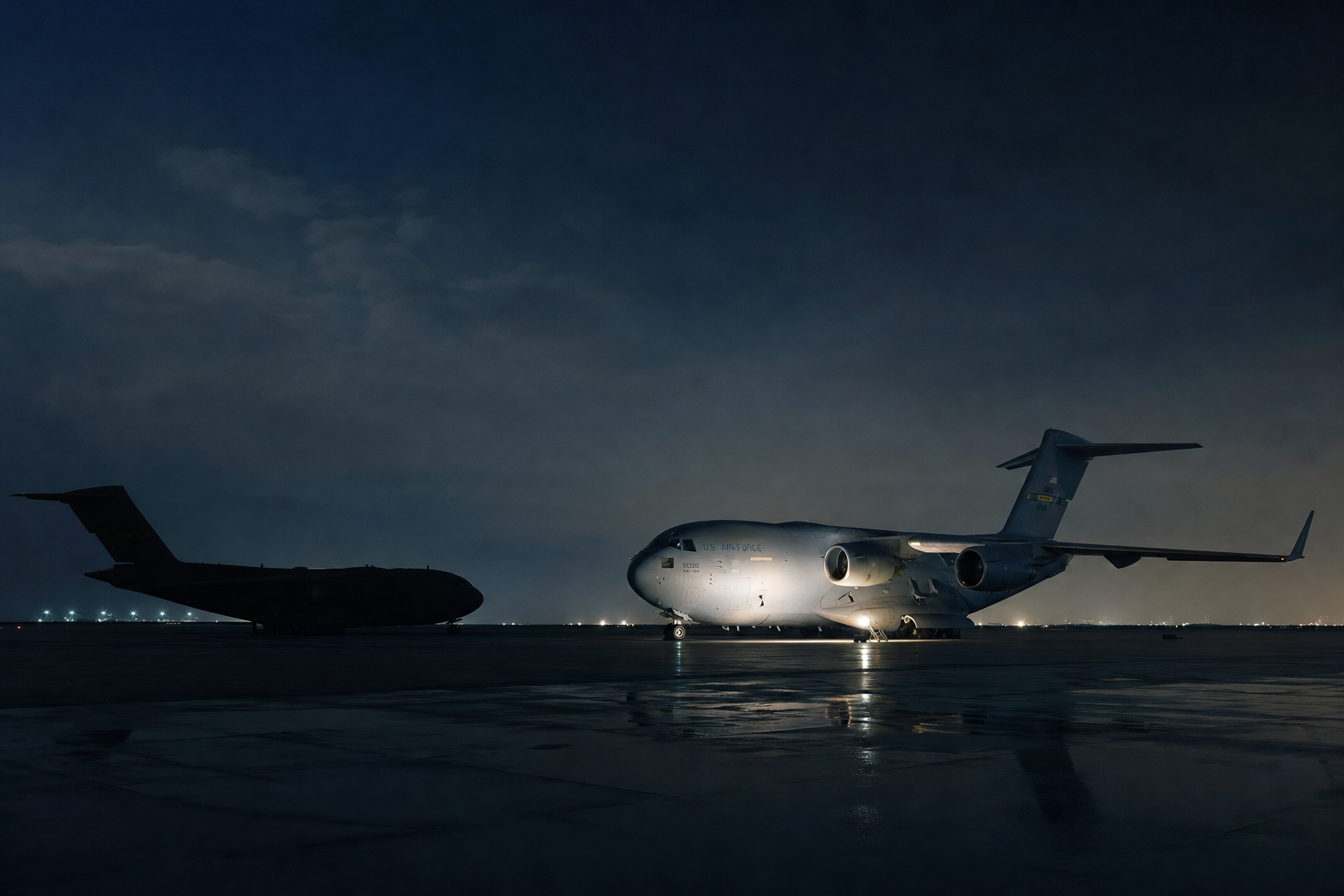
WASHINGTON D.C. – President Donald Trump was secretly moved from a legacy Air Force One aircraft to a smaller C-32A jet following the NATO summit in Turkey last month, an operation prompted by an alleged Iranian assassination threat that some U.S. intelligence officials reportedly deemed of "low-confidence." The extraordinary security measure, which involved a decoy plane, has raised questions within the intelligence community and among lawmakers regarding the assessment of the threat.
"I am very curious about the extent to which the Israeli-provided intelligence was not only credible but independently verifiable." — Sen. Chris Van Hollen, (D-MD)
The incident, which occurred on July 8 as President Trump departed Turkey, saw the President covertly transferred from a Boeing 747-8, which had carried him to the summit, to a C-32A via an airport catering truck. This clandestine transfer was executed without the knowledge of journalists and even some senior White House officials traveling with the presidential delegation. The larger Air Force One continued its flight with the press and staff aboard, effectively serving as a decoy, while President Trump and a small group of aides traveled separately to the United Kingdom.
According to current and former U.S. officials who spoke to The Washington Post, the intelligence concerning a potential Iranian plot against President Trump originated with the Israeli government and was subsequently provided to the Central Intelligence Agency (CIA). However, some American intelligence analysts reportedly found the information unconvincing and communicated their reservations to Trump administration officials. One official familiar with the intelligence characterized it as "Israeli-derived" and "low-confidence," noting that analysts did not consider it "particularly compelling."
Despite these internal reservations, security officials implemented extensive precautions to ensure President Trump's safety. The operation commenced after President Trump boarded the older aircraft in view of cameras, before being secretly moved to the C-32A. An unnamed U.S. official told The Post, "As the President has said, he has faced numerous threats on his life, including ones from Iran, and every measure is taken to ensure his safety. The United States Secret Service’s core mission is protecting the President, which they achieved."
The latest revelations have added new layers of complexity to the understanding of the security operation. Some current and former U.S. officials suggest that this episode could align with a broader pattern where Israeli intelligence warnings might be intended not only to provide information but also to influence U.S. policy decisions. These officials posited that Israel could have an interest in shaping President Trump’s approach toward both Iran, which it considers a major security threat, and Turkey, given concerns about the increasingly close relationship between Washington and Ankara. President Trump has maintained a close relationship with Turkish President Recep Tayyip Erdogan. One former U.S. official stated that the intelligence warning "fit a broader pattern" of Israeli reporting that some American officials believe can be intended to influence presidential decision-making.
Further details surrounding the security operation have fueled skepticism about the perceived seriousness of the alleged threat. Notably, Secretary of State Marco Rubio reportedly remained aboard the legacy Air Force One, the decoy plane, despite having been briefed on both the Israeli intelligence and the plan to secretly move President Trump. Another U.S. official reportedly questioned the gravity of the threat given the extensive security presence already surrounding the NATO summit in Turkey.
Democrats in Congress are now seeking additional information and clarity regarding the intelligence that prompted such an elaborate and unprecedented security measure. Senator Chris Van Hollen (D-MD) expressed his concerns to The Post, stating, "I am very curious about the extent to which the Israeli-provided intelligence was not only credible but independently verifiable." He added, "I have no doubt that Iran would like to see the president gone, but this all seems a little fantastical."
President Trump addressed the secret plane switch on Tuesday, confirming his agreement to the operation at the request of the Secret Service. "I just follow what they’d like me to do," President Trump said. "They wanted me to go on a different flight, a different plane, equal safety, so I do it. I do what they say." He indicated that he did not personally scrutinize the intelligence behind the decision, stating, "I guess there was a threat out there. I didn’t really ask too much about it. I get a lot of threats." President Trump even suggested the smaller aircraft he flew on might have faced greater danger. "I think actually the plane that I flew on was at greater risk!" he remarked. "I think it was at greater risk because that would be the plane, I think that they would be more likely to go for it." President Trump has consistently spoken about threats from Iran against his life, affirming after the flight that he remains a primary target for Tehran. The incident underscores the continuous challenges in assessing and responding to national security threats amidst complex geopolitical dynamics and intelligence flows.

