


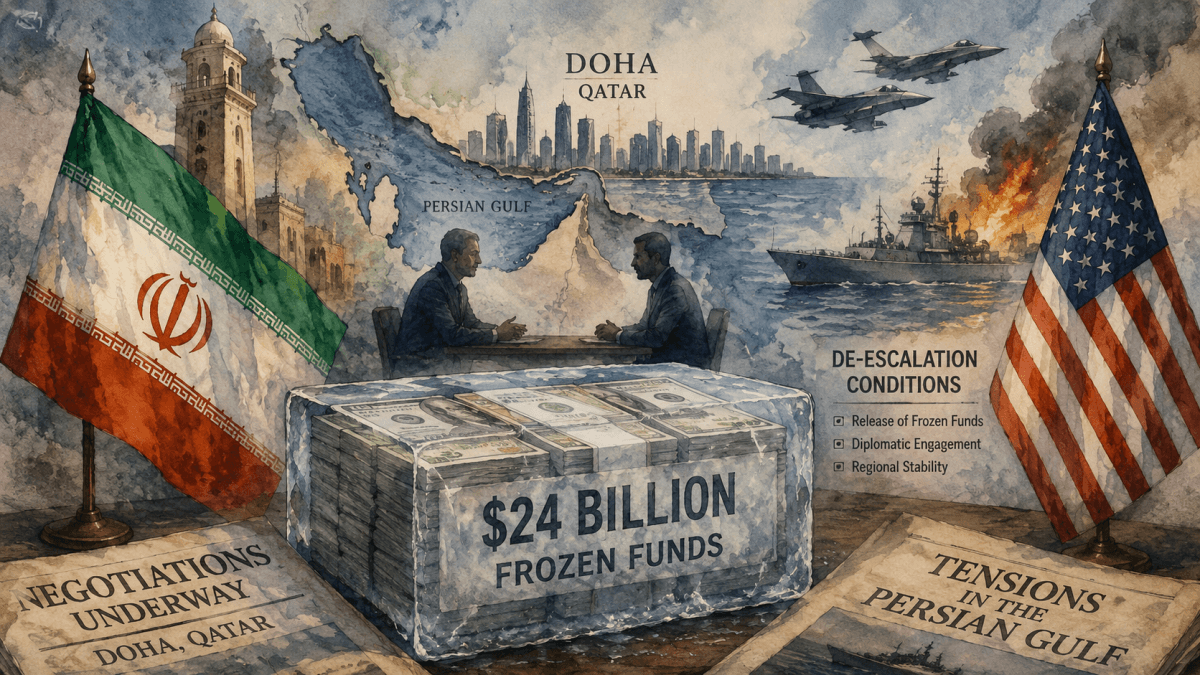
Tehran has presented a clear demand to Washington: release $24 billion in frozen Iranian funds, or diplomatic efforts to de-escalate tensions will not progress. Iran's Parliament Speaker Mohammad Bagher Ghalibaf arrived in Doha, Qatar, on Monday to represent the regime in ongoing negotiations, even as military exchanges between the two nations continue.
"Without a doubt, the Islamic Republic of Iran will leave no act of aggression unanswered and will not hesitate in the slightest to defend Iran’s sovereignty." — Iran’s Foreign Ministry
Iranian state media confirmed the financial requirement, detailing a two-part payment plan. The initial demand calls for an immediate $12 billion payment upon the formal signing of any memorandum of understanding between the two governments. A subsequent installment of another $12 billion is to follow within 60 days of the agreement. Sources close to the Iranian negotiating team informed state media that Ghalibaf's primary objective in Doha is to finalize the logistical mechanisms for Iran to access the first payment without impediment.
These diplomatic discussions in Qatar's capital unfolded concurrently with U.S. military actions hundreds of miles away. U.S. Central Command reported conducting strikes along Iran’s southern coastline, targeting Iranian missile launch infrastructure and naval vessels. The U.S. military stated these vessels were in the process of deploying underwater mines within the Strait of Hormuz.
Tehran promptly responded to the U.S. strikes. The Iranian Revolutionary Guard Corps (IRGC) announced it had shot down a U.S. MQ-9 drone operating over the Persian Gulf during the exchange. The IRGC further asserted that a second American drone and an F-35 stealth fighter were compelled to exit Iranian airspace after encountering fire from Iran’s air defense network. Iran’s foreign ministry issued an official statement, formalizing its grievance and declaring the U.S. had committed "a blatant violation of the ceasefire in the Hormozgan province over the past 48 hours." The ministry underscored the potential repercussions, stating, "Without a doubt, the Islamic Republic of Iran will leave no act of aggression unanswered and will not hesitate in the slightest to defend Iran’s sovereignty." A separate warning from the Iranian regime indicated that any future ceasefire breach by the United States or its allies would elicit what Tehran termed "decisive" retaliation.
In Washington, Secretary of State Marco Rubio addressed reporters, downplaying any suggestions that the talks had collapsed and maintaining that a final agreement remained achievable. President Donald Trump has consistently articulated his own "red line" throughout the negotiation process, vowing not to endorse any agreement that would permit Iran to continue its pursuit of nuclear weapons or to retain its existing stockpile of highly enriched uranium.
At the core of the broader dispute is the Strait of Hormuz, a critical maritime chokepoint through which approximately one-fifth of the world’s daily oil supply transits. American diplomats are pressing Iran to cease its deployment of armed speedboats and halt naval mining operations, which have endangered U.S.-aligned oil tankers navigating the waterway. Iran's counteroffer focuses on President Trump lifting the naval blockade currently impacting its ports. This blockade has severely restricted Tehran's ability to engage in its most lucrative oil trade relationships, particularly with China and other buyers across Southeast Asia.
The $24 billion sought by Iran represents a portion of its much larger predicament concerning frozen assets. Estimates suggest the total value of Iranian funds held in accounts across various countries ranges between $100 billion and $123 billion. These assets have been frozen over decades due to American-led sanctions, primarily in response to Tehran’s nuclear ambitions and its financial and logistical support for militant organizations operating abroad. The ongoing negotiations in Doha aim to bridge these significant financial and security divides, seeking a path toward de-escalation amidst persistent military tensions.

