


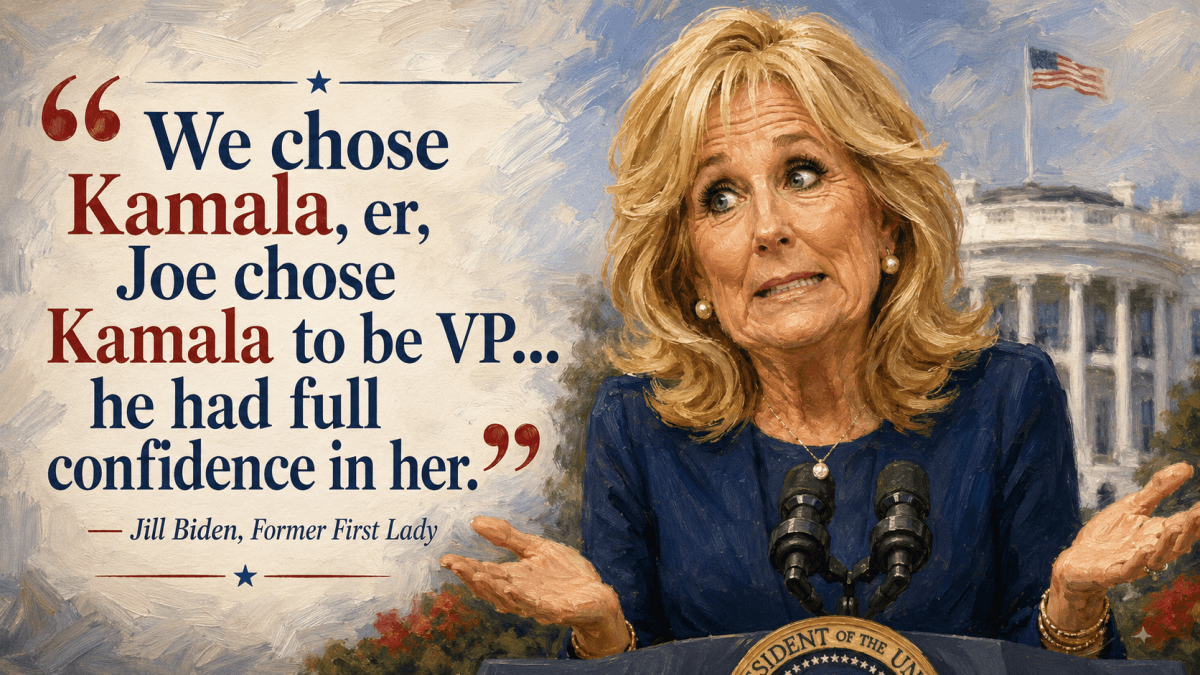
During a book tour appearance on national television Tuesday, Jill Biden made a verbal remark that quickly drew national attention, reopening questions about the decision-making processes within the Biden White House. Biden appeared on MSNBC’s “Morning Joe” on June 2 to promote her new memoir, “View from the East Wing,” when the incident occurred.
"We chose Kamala, er, Joe chose Kamala to be VP…he had full confidence in her." — Jill Biden, Former First Lady
The interview was primarily intended to highlight the book, but a single verbal slip became the focus of online discussion. While discussing the selection of then-Senator Kamala Harris as her husband's 2020 running mate, Biden initially used a first-person plural phrase. She stated, "Joe and Kamala, me, Doug [Emhoff], I thought we were a great team." This comment was immediately followed by a correction that garnered more attention than the original remark: "We chose Kamala, er, Joe chose Kamala to be VP," Biden clarified, adding, "So we were supportive of her."
The clip, which was posted by RNC Research on social media platform X, accumulated tens of thousands of views within hours of its airing. Following the correction, Biden emphasized her support for Harris, leaning in her seat as she continued, "When Joe got out, he handed over the reins to Kamala. He had full confidence in her. I went out on the road a lot — a lot — for Kamala. And honestly, I truly believed she was going to win."
These declarations of loyalty during the interview stood in notable contrast to earlier reports about Biden's private sentiments regarding Harris's initial consideration as a Vice Presidential candidate. A 2022 book authored by two New York Times reporters quoted Jill Biden reacting to the prospect of selecting Harris by asking, "Why do we have to choose the one who attacked Joe?" According to that account, the Biden family reportedly viewed Harris’s criticisms during the 2019 Democratic primary debates as "a smear and a betrayal."
The Tuesday interview's verbal slip quickly led to a flurry of activity among X users, with many interpreting the remark as confirmation of long-held suspicions about who held actual authority and influence in the West Wing during the Biden administration.
The memoir itself has generated controversy even before its release. Former Biden aides and campaign insiders have reportedly pushed back against the book’s framing, telling various outlets that the account appears "selfish" and "disingenuous." These critics suggest the memoir portrays the former president and his inner circle as bearing no responsibility for the 2024 election loss. John Morgan, a Florida attorney and a significant fundraiser for the Biden campaign, characterized the book as "unhelpful," stating that "ripping open a healing scab is never helpful." This internal criticism from Democratic ranks has reportedly followed Biden throughout much of her promotional tour.
The book's release comes approximately a year and a half after the Bidens departed the White House. It also marks a significant shift from Jill Biden's public stance following her husband’s June 2024 presidential debate, when she publicly stated, "he did great." Her memoir now reportedly concedes what she did not express at the time: that while watching her husband debate, she feared he was experiencing a stroke or some form of acute cognitive failure.
During the "Morning Joe" interview, Biden also expressed her belief that Joe Biden would have defeated President Donald Trump had he remained in the 2024 race. "I believe he would have beat Donald Trump in that election," she stated. She described the writing process for her memoir as "cathartic," telling the Associated Press, "I wrote about all the, you know, sometimes painful — but other times, most of it really beautiful moments that Joe and I shared during his presidency."
The memoir's title references the East Wing of the White House, the traditional location of the first lady's office, a wing that President Trump ordered demolished last year to make way for a $300 million ballroom. Ultimately, the morning's interview delivered an unscripted moment of candor that, according to observers, cut through years of carefully managed public messaging, resonating with an impact that the memoir itself may struggle to match.

