

Breaking
Sponsor Advertisement
Kevin Warsh Sworn In As New Federal Reserve Chairman
Kevin Warsh has officially assumed the role of the 17th Chairman of the Federal Reserve

Kevin Warsh Sworn In As New Federal Reserve Chairman

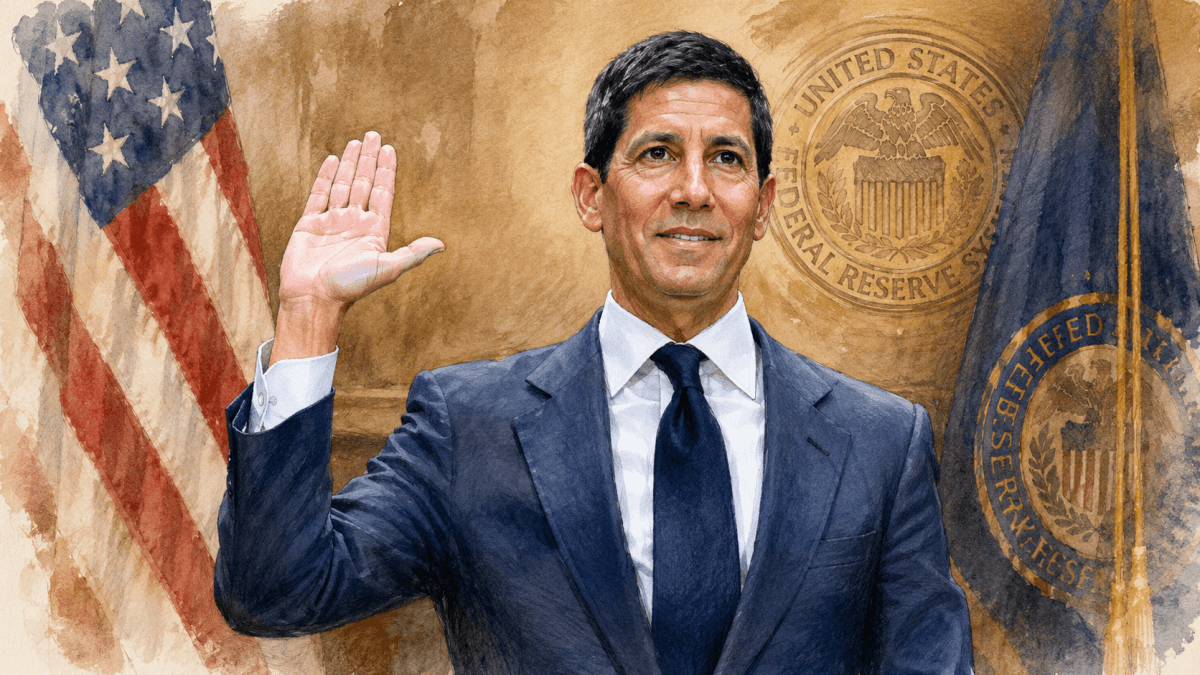
Kevin Warsh has officially assumed the role of the 17th Chairman of the Federal Reserve, taking the oath of office in a White House ceremony. President Donald Trump praised Warsh's appointment while criticizing previous Fed leadership for straying from its core economic mandate.
Jump to The Flipside Perspectives

Kevin Warsh was officially sworn in as the 17th Chairman of the Federal Reserve on Friday during a White House ceremony, marking a significant leadership change for the nation's central bank. President Donald Trump presided over the event in the East Room, where Justice Clarence Thomas administered the oath of office to Warsh before a gathering of administration officials, economic advisers, and invited guests. The appointment sees Warsh replace previous chair Jerome Powell and signals President Trump's continued efforts to reshape key federal institutions with officials aligned with his economic vision.

"When we pursue those aims with wisdom and clarity, independence and resolve, inflation can be lower, growth stronger, real take-home pay higher, and America can be more prosperous." — Kevin Warsh, Federal Reserve Chairman

Warsh, who previously served as a Federal Reserve governor during the 2008 financial crisis, outlined his vision for the central bank during his remarks. He emphasized a return to the Fed's traditional mission of controlling inflation, protecting price stability, and supporting employment growth. "When we pursue those aims with wisdom and clarity, independence and resolve, inflation can be lower, growth stronger, real take-home pay higher, and America can be more prosperous," Warsh stated, articulating his focus on core economic principles. He further elaborated on his intention to lead a "reform-oriented" Federal Reserve, aiming to modernize the institution by drawing lessons from both past successes and failures. "To fulfill this mission, I will lead a reform-oriented Federal Reserve, learning from past successes and mistakes both, escaping static frameworks and models, and upholding clear standards of integrity and performance," he affirmed. Warsh also acknowledged the influence of his predecessors, particularly Alan Greenspan, who was appointed by President Ronald Reagan in 1987. "I’ve known five of my predecessors in this job, some of them quite well, but Chairman Greenspan was the first to tell me and show me what this role demands," Warsh remarked, adding, "Like Alan… I intend to fill the role of chairman with energy and purpose."

President Donald Trump used the occasion to express strong confidence in Warsh while also delivering sharp criticism of the Federal Reserve's recent direction under prior leadership. "I think Kevin will go down as one of the truly great chairmen of the Federal Reserve that we’ve ever had," President Trump stated before the ceremony. He accused the institution of becoming overly focused on political and ideological priorities outside its core economic mandate. "It became distracted by concerns far removed from its core mission and mandate, drifting into matters such as climate policy and DEI initiatives," President Trump asserted. He also attributed the recent inflation surge to previous Fed leadership and the Biden administration's policies. "With the Fed straying from its mandate while the last administration blew out the deficit, Americans suffered the worst inflation that we had in history," President Trump argued. Despite his strong critiques of past leadership, President Trump repeatedly stressed his desire for Warsh to maintain independence from the White House. "I want Kevin to be totally independent," President Trump emphasized. "Don’t look at me, don’t look at anybody, just do your own thing and do a great job."

Warsh assumes leadership of the Federal Reserve at a critical juncture, facing ongoing inflation concerns, global economic instability, and persistent debates surrounding interest rates and economic growth. Investors and financial markets are anticipated to closely monitor Warsh's initial actions and statements for signals regarding potential shifts in monetary policy, particularly concerning interest rate adjustments, inflation management strategies, and the broader scope of the Federal Reserve's role in the U.S. economy. His appointment is seen as a significant step by President Trump to implement his economic agenda through key federal appointments during his second term. The transition underscores the administration's focus on economic stewardship and its stated aim to ensure the Federal Reserve operates strictly within its designated economic mandate. The coming months will reveal how Warsh navigates these challenges and implements his reform-oriented approach to guide the nation's financial landscape.

Advertisement

The Flipside: Different Perspectives

Progressive View

From a progressive standpoint, the appointment of Kevin Warsh as Federal Reserve Chairman raises questions about the future direction of monetary policy and its potential impact on social equity and collective well-being. While acknowledging the importance of inflation control and employment, progressives often argue that the Fed's mandate should encompass a broader understanding of economic health, including addressing systemic inequalities and supporting a just transition to a sustainable economy. President Trump's criticism of the Fed's engagement with issues like climate policy and DEI initiatives is seen by some progressives as a regressive move, potentially undermining efforts to address pressing societal challenges that have significant economic implications. For example, climate change poses substantial long-term economic risks, and ignoring it could lead to future instability. Similarly, diversity, equity, and inclusion (DEI) initiatives are viewed as essential for fostering a more inclusive economy that benefits all segments of society, not just a privileged few. Progressives would advocate for a Fed that considers the distributional impacts of its policies and actively works to mitigate economic disparities, rather than solely focusing on aggregate economic indicators. They would monitor whether Warsh's "reform-oriented" approach genuinely seeks to modernize the institution in a way that promotes broad-based prosperity and resilience, or if it narrows the Fed's scope in a manner that exacerbates existing social and economic divides.

Conservative View

The appointment of Kevin Warsh as Federal Reserve Chairman is viewed by conservatives as a crucial step towards restoring sound monetary policy and economic stability. Proponents of this perspective emphasize Warsh's stated commitment to focusing on the Fed's traditional mandate: controlling inflation, protecting price stability, and fostering employment growth. This aligns with conservative principles of limited government intervention and free markets, suggesting that the Fed should avoid mission creep into social or environmental issues. President Trump's criticism of the Fed's past "drift" into areas like climate policy and DEI initiatives resonates strongly, as conservatives believe such distractions divert resources and focus from the central bank's core economic responsibilities, potentially leading to market distortions and inefficient allocation of capital. The emphasis on Warsh's independence from political pressure is also key, as it underscores the importance of objective, data-driven decision-making in monetary policy, rather than policies influenced by short-term political expediency. Conservatives anticipate that Warsh will implement policies that prioritize fiscal discipline and long-term economic health, ultimately benefiting individual liberty and market efficiency. His experience during the 2008 financial crisis is seen as valuable, providing him with a pragmatic understanding of market dynamics and the need for robust, yet restrained, central bank action.

Common Ground

Despite differing approaches, conservatives and progressives can find common ground regarding the fundamental importance of a stable and prosperous economy for all Americans. Both sides generally agree that the Federal Reserve plays a critical role in maintaining economic stability, controlling inflation, and fostering employment. There is a shared interest in ensuring the Fed operates with integrity and competence, making data-driven decisions that are transparent and accountable. Both perspectives recognize the need for the central bank to learn from past successes and failures, adapting its strategies to evolving economic realities. Furthermore, while they may disagree on the scope, both conservatives and progressives can agree that the Fed should strive to avoid undue political influence and maintain a degree of independence in its decision-making to preserve its credibility and effectiveness. The goal of "real take-home pay higher, and America can be more prosperous," as articulated by Warsh, is a shared objective, even if the preferred pathways to achieve it differ. Practical bipartisan approaches could focus on strengthening the Fed's analytical capabilities, fostering open dialogue on economic challenges, and ensuring policies are clearly communicated to the public and markets, thereby reducing uncertainty and promoting confidence in the financial system.

What's your view on this story? Share your thoughts and remember to consider multiple perspectives and being respectful when forming and voicing your opinion. "If you resort to personal attacks, you have already lost the debate..."

Advertisement

Contact Us About This Article

Have a question or comment about this article? We'd love to hear from you.

About Fair Side News

At Fair Side News, we believe in presenting news with perspectives from both sides of the political spectrum. Our goal is to help readers understand different viewpoints and find common ground on important issues.