


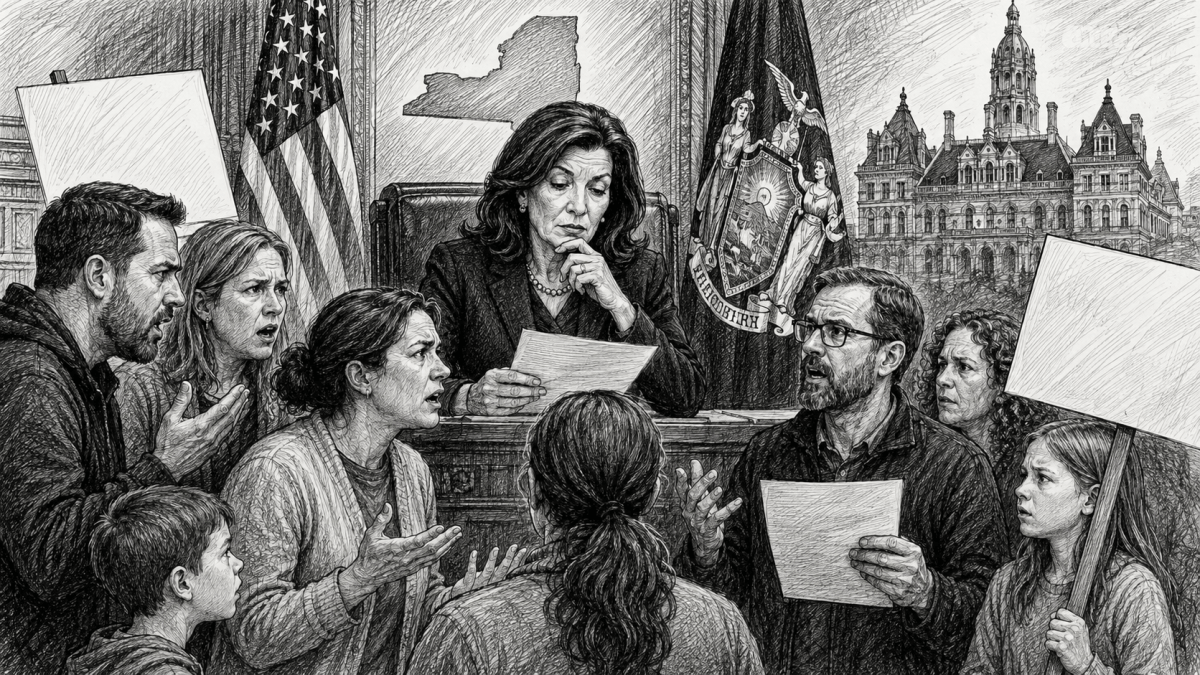
ALBANY, NY — The New York State Legislature has advanced a bill that would replace traditional terms such as "mother" and "father" in state law with gender-neutral terminology, drawing both support for modernization and sharp criticism from opponents. The legislation, which cleared both chambers, now awaits review by Governor Kathy Hochul.
"woke culture run amok" — Gerard Kassar, New York Conservative Party Chairman
At the core of the proposal is a comprehensive revision of family-related statutory language across various sections of state law, including domestic relations, education, and custody statutes. Under the bill, "mother" would be largely replaced with terms like "gestating parent," while "father" would be substituted with "non-gestating parent" or simply "parent." Legal terminology would also see shifts, with "paternity" cases becoming "parentage proceedings" and "putative father" replaced with "alleged parent" in official records.
Sponsored by Senator Luis Sepúlveda of the Bronx and Assemblywoman Amy Paulin of Westchester, the bill is presented by its proponents as a necessary step to align statutory language with existing family court practices. Supporters argue that traditional terms do not always accurately reflect how parentage is established in modern family structures, particularly in cases involving surrogacy, adoption, or same-sex couples, where legal parenthood may not be tied to biological roles. Legal experts supporting the measure suggest that the move toward gender-neutral terminology will create greater consistency across statutes and reduce ambiguity in court proceedings, ensuring that terms like "parentage" better reflect how custody and parental rights are determined under contemporary family law frameworks.
The legislation has, however, ignited a significant political firestorm. Republican lawmakers and conservative organizations have sharply criticized the measure, contending that the language changes extend far beyond mere technical legal updates. Critics argue that the bill reflects ideological priorities at a time when many New Yorkers are grappling with pressing economic concerns such, as inflation, rising housing costs, and public safety issues.
Gerard Kassar, Chairman of the New York Conservative Party, sharply condemned the bill, calling it an example of "woke culture run amok" and asserting that Albany lawmakers are out of touch with the everyday concerns of their constituents. Kassar also warned that the proposal could establish a precedent for further politically driven revisions of commonly used legal language, potentially altering fundamental societal definitions.
Echoing these sentiments, Republican gubernatorial candidate Bruce Blakeman described the measure as an "attack on families." Blakeman argued that replacing terms like "mom and dad" signifies a broader political effort to reshape cultural norms through legislative action. Similarly, Representative Claudia Tenney voiced concerns that state lawmakers are misdirecting their efforts, suggesting they should prioritize addressing economic pressures and public safety over revising parental language in state law.
Governor Kathy Hochul has not yet taken a formal position on the measure, stating that she has not fully reviewed the bill. Her office has indicated that she will evaluate the legislation once it formally reaches her desk. Observers note that her past support for broader gender-neutral language initiatives in state government documents may offer an indication of her potential stance.
The debate surrounding this bill is part of a broader trend within New York towards the adoption of gender-neutral legal language. In recent years, state policy has already moved to replace gendered terms in various official documents. New York City, for instance, previously approved allowing an "X" gender marker on birth certificates for non-binary residents. As this bill moves toward its final consideration, it has become a flashpoint in the wider political and cultural battle over how family is defined and regulated within New York state law. Supporters frame it as a necessary modernization, while opponents view it as a fundamental shift in societal norms.

