

Breaking
Sponsor Advertisement
New York Legislation Replaces Gender-Specific Parental Terms in Law
Image for: New York Legislation Replaces Gender-Specific Parental Terms in Law

New York Legislation Replaces Gender-Specific Parental Terms in Law

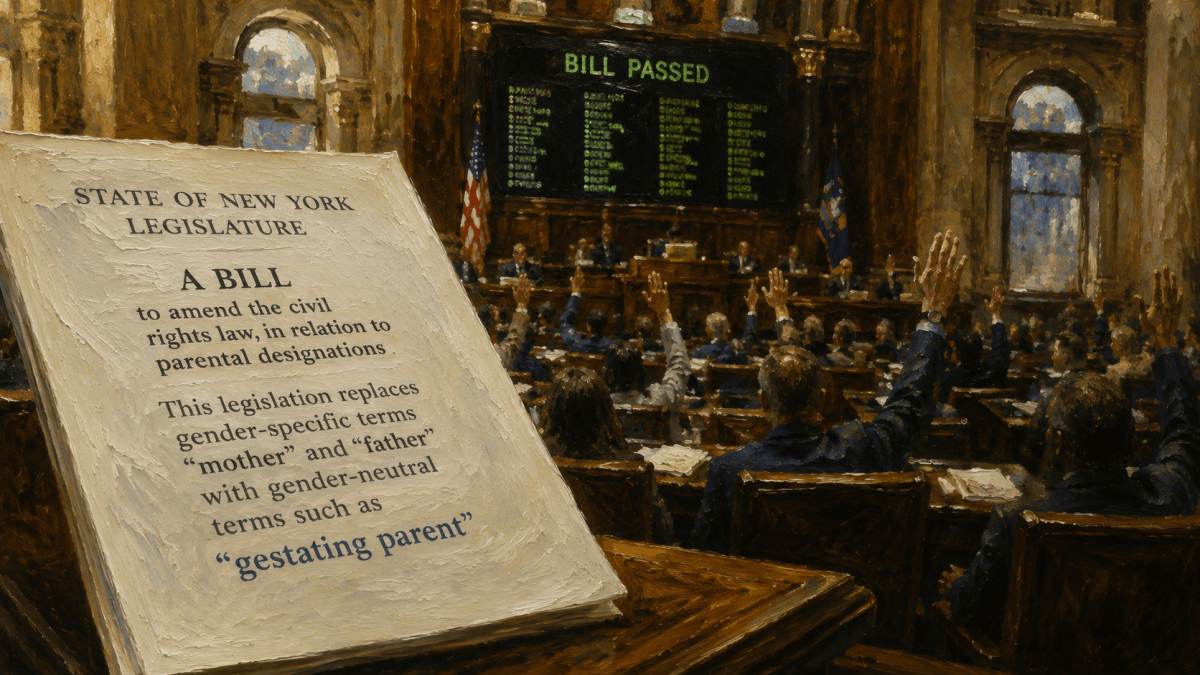
New York lawmakers have approved legislation to replace gender-specific parental terms like "mother" and "father" with gender-neutral alternatives such as "gestating parent" in state law. The measure now awaits Governor Kathy Hochul's decision on whether to sign it.
Jump to The Flipside Perspectives

ALBANY, NY – New York State lawmakers have passed legislation that would replace several gender-specific parental terms in state law with gender-neutral alternatives, a move supporters contend reflects modern family structures and critics argue unnecessarily alters longstanding legal language. The measure, Senate Bill S9316 and its Assembly companion A8382, passed the New York State Senate this week after previously clearing the Assembly. The legislation now proceeds to the desk of Governor Kathy Hochul, who has not yet publicly indicated her stance on the bill.

"Well, I’m not familiar with what was introduced. I’ll take a look at it. This has been my practice for five years.”" — New York Gov. Kathy Hochul, D.

The proposed legislation aims to update terminology used throughout various portions of New York’s legal framework, including the Family Court Act, Domestic Relations Law, Social Services Law, and Education Law. Among the most significant changes, references to "mother" would be replaced in certain legal contexts with the term "gestating parent." Similarly, "father" would be substituted with phrases such as "non-gestating parent" or simply "parent." The bill also seeks to replace legal references to "paternity" with "parentage" and to change "putative father" to "alleged parent" in relevant proceedings.

Sponsors of the measure, Senator Luis Sepúlveda, a Democrat representing the Bronx, and Assemblymember Amy Paulin, a Democrat from Westchester County, argue that the changes are designed to make New York law more inclusive. They assert that the updated language better aligns with the diverse family structures that have become increasingly common in recent years. These include same-sex couples, adoptive families, surrogacy arrangements, and cases involving assisted reproductive technology. According to the sponsor’s memorandum, the bill’s objective is to modernize statutory language by replacing terms rooted specifically in motherhood or fatherhood with broader terminology that encompasses all legally recognized parental relationships.

The proposal builds upon previous legislative efforts, specifically New York’s Child-Parent Security Act, which was enacted in 2021. That act legalized gestational surrogacy and expanded the legal recognition of various parental arrangements within the state. Supporters of the current bill emphasize that family courts are increasingly encountering cases involving individuals who may not fit traditional definitions of mother and father. They contend that updating legal terminology helps ensure consistent and equitable treatment under the law, regardless of the specific composition of a family. Advocates also point to court decisions that have recognized parental rights for same-sex couples and other nontraditional family arrangements, arguing that terms such as "parentage" more accurately describe these legal relationships than older terminology focused exclusively on biological fathers.

Conversely, critics of the legislation have voiced strong objections to the proposed language changes. Opponents argue that replacing commonly understood terms such as "mother" and "father" with phrases like "gestating parent" and "non-gestating parent" removes language that has long served as a fundamental cornerstone of family law and societal understanding. They contend that these traditional terms reflect biological realities and established social roles that are essential to the fabric of society. The debate in New York reflects broader national disagreements over the increasing use of gender-neutral language in government documents, educational institutions, healthcare systems, and legal proceedings across the United States.

When asked about the legislation, New York Governor Kathy Hochul indicated that she had not yet reviewed the bill. As reported by Trending Politics, the governor stated, "Well, I’m not familiar with what was introduced. I’ll take a look at it. This has been my practice for five years.” If signed into law, New York would become one of the most prominent states to formally adopt such comprehensive gender-neutral parental terminology throughout significant portions of its legal code. The measure has the potential to affect a wide range of proceedings, including those involving custody, adoption, child support, surrogacy agreements, and parental rights, thereby reshaping how parental relationships are legally described in New York for years to come.

Advertisement

The Flipside: Different Perspectives

Progressive View

From a progressive standpoint, the New York legislation to adopt gender-neutral parental terms is a crucial step towards creating a more inclusive and equitable legal system that accurately reflects the diversity of modern families. The traditional definitions of "mother" and "father" in law often fail to encompass the realities of same-sex parents, adoptive parents, parents through surrogacy, and other non-traditional family structures that are increasingly common and legally recognized. By replacing gender-specific terms with broader, gender-neutral alternatives like "gestating parent" and "parentage," the law can ensure that all legally recognized parental relationships are treated consistently and fairly, regardless of the parents' gender identity or biological connection to the child.

Proponents argue that this legislative update is not about erasing the roles of mothers and fathers but about expanding legal language to include and affirm all parents and children. It aims to prevent discrimination and ensure that every child has legally recognized and protected parental figures, regardless of how their family was formed. This move is seen as vital for social justice, ensuring that legal frameworks evolve to support the collective well-being of all New Yorkers and reducing systemic barriers for LGBTQ+ families and others who do not fit narrow traditional definitions. It reflects a commitment to empathy and the understanding that legal language must adapt to serve the needs of a diverse populace.

Conservative View

The legislative effort in New York to replace terms like "mother" and "father" with gender-neutral phrases such as "gestating parent" represents a concerning overreach into fundamental societal structures from a conservative perspective. Critics argue that this move dismisses millennia of human understanding regarding family and parental roles, which are deeply rooted in biological reality and cultural tradition. Replacing clear, universally understood terms with abstract, clinical language like "gestating parent" is seen as an unnecessary imposition that can confuse legal and social definitions, potentially eroding the distinct and vital roles that mothers and fathers play in raising children.

Conservatives often emphasize the importance of traditional family units as the bedrock of society, believing that strong, stable families, typically headed by a mother and a father, are crucial for individual well-being and societal stability. Altering legal language to accommodate specific, albeit increasingly common, family configurations is viewed as a capitulation to progressive ideologies rather than a practical legal reform. This approach, critics contend, prioritizes political correctness over common sense and risks undermining the legal clarity and social understanding that traditional terms provide. Furthermore, it raises questions about the government's role in dictating language and potentially devaluing the unique contributions of mothers and fathers to family life.

Common Ground

Despite the divergent viewpoints on the specific language changes, both conservatives and progressives share common ground in their fundamental concern for the well-being of children and the necessity of clear, functional family law. Both sides agree that all children deserve to have legally recognized and protected parental relationships, ensuring access to support, care, and a stable environment. The debate is not over *whether* children should have parents or legal protections, but rather *how* best to define and recognize those relationships within the legal system.

There is a shared interest in ensuring that legal processes related to custody, adoption, and child support are fair, efficient, and provide clear guidance for families and courts. While the terminology itself is contentious, the underlying goal of ensuring that parental rights and responsibilities are clearly defined and enforced for the benefit of children is a bipartisan objective. Future discussions could explore how to achieve legal clarity and inclusivity without alienating segments of the population, perhaps by focusing on the functional roles of caregivers and the legal responsibilities they bear, while respecting varying cultural and personal definitions of family.

What's your view on this story? Share your thoughts and remember to consider multiple perspectives and being respectful when forming and voicing your opinion. "If you resort to personal attacks, you have already lost the debate..."

Advertisement

Contact Us About This Article

Have a question or comment about this article? We'd love to hear from you.

About Fair Side News

At Fair Side News, we believe in presenting news with perspectives from both sides of the political spectrum. Our goal is to help readers understand different viewpoints and find common ground on important issues.