


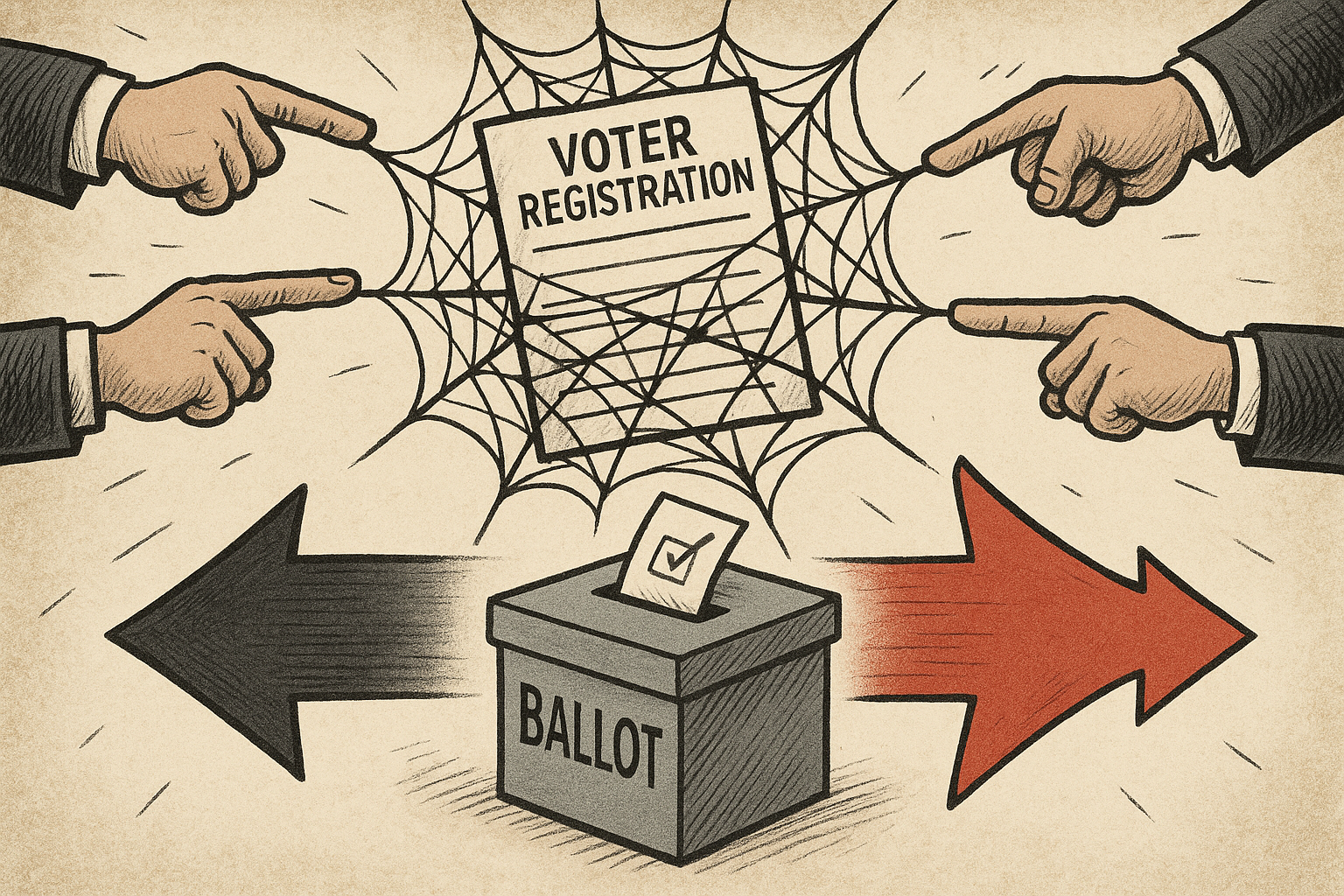
A significant political and technological dispute has erupted in New Jersey concerning the registration of approximately 6,600 noncitizens on the state's voter rolls, a controversy that has now drawn the direct involvement of the federal government. The core of the issue lies in conflicting accounts between New Jersey Governor Mikie Sherrill's administration and IDEMIA, the French technology firm responsible for the state's Motor Vehicle Commission (MVC) system, which facilitates voter registration.
"All 6,600 individuals indicated ‘Yes’ to wanting to register to vote and ‘NO’ to being a US Citizen. This information was recorded correctly and always available." — Lisa Shoemaker, IDEMIA Spokeswoman
Governor Sherrill initially disclosed the issue on Tuesday, attributing the erroneous registrations to a "serious software error" within the MVC system. She indicated that this glitch might have allowed around 400 noncitizens to cast ballots. The registrations reportedly date back to 2023 and 2024, placing the origin of the problem under the administration of former Governor Phil Murphy, Sherrill's predecessor.
However, IDEMIA has strongly challenged Governor Sherrill's explanation. Lisa Shoemaker, a spokeswoman for the company, asserted that IDEMIA's technology performed precisely as designed. According to Shoemaker, the fault lies not with a software error but with how New Jersey processed the data it received. She stated that all 6,600 individuals in question explicitly indicated "No" to being a U.S. citizen while simultaneously selecting "Yes" to wanting to register to vote during their state ID or driver's license application process.
"All 6,600 individuals indicated ‘Yes’ to wanting to register to vote and ‘NO’ to being a US Citizen," Shoemaker stated. "This information was recorded correctly and always available." She further emphasized that the underlying data within IDEMIA’s system was never scrambled or mislabeled, stating, "At no point was a noncitizen ever marked as a citizen in the database." Shoemaker maintained that the records transmitted to state agencies aligned exactly with New Jersey's specifications.
This account is directly disputed by New Jersey state officials. An anonymous state official told The Post that any application listing "no" on the citizenship question should have been automatically blocked from being transmitted to election officials. "No, that is not correct," the official said. "Anytime somebody answers ‘no’ to the citizenship question, that record should not be transmitted to the Division of Elections."
In response to the growing fallout, Governor Sherrill’s office has engaged an outside firm, CSG, to investigate the precise nature of the breakdown. IDEMIA, for its part, maintains that its role is limited to collecting self-reported citizenship and interest data, not managing voter enrollment. Shoemaker also raised further questions, suggesting the state's Division of Elections might share blame for approving individuals for voter rolls even with missing required information, such as party affiliation.
The controversy has quickly attracted national attention, particularly from President Donald Trump and his supporters, who have cited the episode as evidence for the need for stronger federal election law enforcement. President Trump has recently championed the Safeguard American Voter Eligibility (SAFE) Act, a proposed bill that would mandate documented proof of citizenship for voter registration.
The Justice Department, under President Trump’s administration, has promptly intervened, issuing a demand to Governor Sherrill for records identifying every noncitizen mistakenly placed on the voter rolls, setting a five-day deadline for compliance. This federal action also surfaces within an existing, unrelated DOJ lawsuit against New Jersey, where federal attorneys are seeking broader access to the state's voter roll records.
Governor Sherrill's office has pushed back against what it characterizes as a politically motivated federal response. Sean Higgins, a spokesman for the governor, accused the administration of leveraging the situation as a pretext. "The Trump administration has a long history of weaponizing the Justice Department for political purposes and attempting to overturn election results," Higgins stated. He added that Governor Sherrill intends to resist the federal demands using all available legal avenues to protect New Jerseyans' personal information.
The implications of the dispute extend beyond New Jersey. Congressional Democrats from the state, including Rep. Josh Gottheimer, have called for federal budget and procurement officials to review the government’s contracts with IDEMIA. This is significant because IDEMIA's systems are integral to various federal functions, including TSA PreCheck enrollment and driver's license processing across a majority of U.S. states. The ongoing blame game and federal intervention underscore the complex interplay of state and federal responsibilities in ensuring election integrity and data security.

