


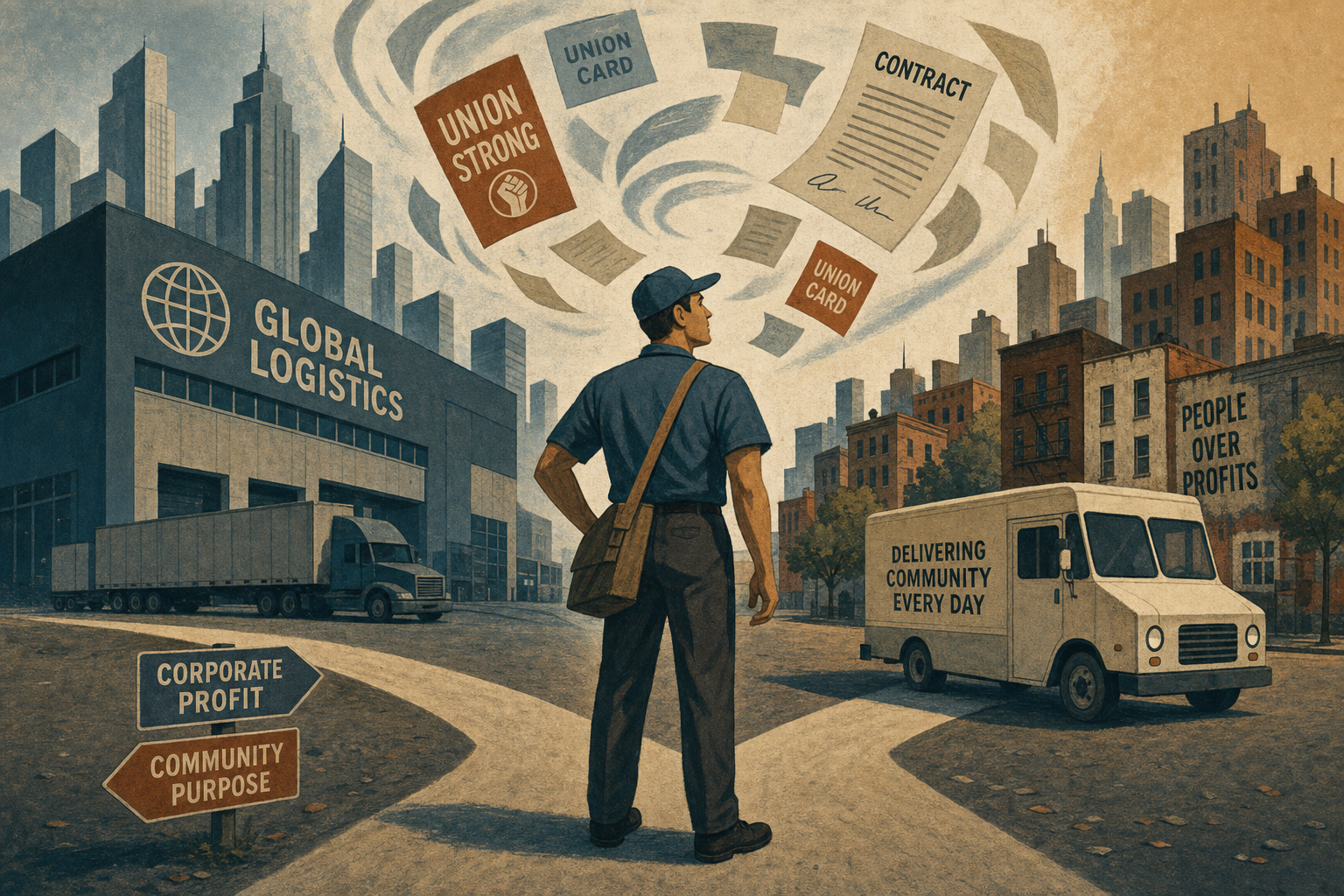
A significant political battle over the future of package delivery in New York City intensified this week as small-business owners, independent delivery drivers, and City Hall collided over a bill that could fundamentally reshape how goods reach millions of residents. At the heart of this dispute is the Delivery Protection Act, a proposal championed by the Teamsters union, which aims to compel companies operating last-mile warehouses to directly hire their delivery workers instead of relying on subcontracting to independent businesses.
"But as written, this legislation would directly undermine that commitment — threatening the small businesses that deliver to customers, putting the jobs of more than 5,000 of their employees at risk and forcing us to consider relocating delivery operations outside of the city." — Kelly A. Nantel, Amazon Spokeswoman
Mayor Zohran Mamdani has publicly backed the measure, lending his political capital to the cause on Monday. The Mayor characterized the current subcontracting model employed by large corporations as exploitative, asserting that these companies insulate themselves from accountability. "Corporations like Amazon build billion-dollar business models by insulating themselves from accountability through a system of exploitative subcontracting," Mamdani stated. He presented the proposed legislation as a straightforward solution, describing it as "common-sense regulation that protects delivery workers, safeguards the communities where these facilities operate and ensures that the corporations benefiting from workers’ labor are responsible for the consequences of their business practices."
However, the potential financial implications of this legislative "fix" have quickly become a focal point of contention. A study conducted by consultancy AKRF projected that the bill, if enacted, would impose an additional $664 annually on the average New York household’s delivery expenses. Industry representatives were swift to react to these estimated costs. Steve Smith, a spokesperson for the Business Council of New York State, voiced a common concern, telling The Post, "This law is just going to raise prices for consumers."
Amazon, a primary target of the legislation, currently operates an extensive network within New York City, comprising over 40 independent Delivery Service Partners (DSPs) that collectively employ upwards of 5,000 workers. Company officials have indicated that the new direct-hire requirements could compel these operations to relocate entirely outside city limits. According to earlier findings by AKRF, such a move would inevitably lead to delivery delays and increased costs for customers who currently depend on rapid delivery services.
Amazon spokeswoman Kelly A. Nantel articulated the company's stance, emphasizing its existing commitments to its workforce and partners. "We’re committed to creating good jobs, supporting our thousands of employees and local small business partners in New York City and providing fast, reliable delivery for New Yorkers," Nantel said. She then elaborated on what Amazon views as the bill's detrimental real-world consequences. "But as written, this legislation would directly undermine that commitment — threatening the small businesses that deliver to customers, putting the jobs of more than 5,000 of their employees at risk and forcing us to consider relocating delivery operations outside of the city," Nantel warned.
Resistance to the bill manifested beyond corporate statements, spilling into the streets on Monday. Delivery workers and small-business owners gathered for a midday demonstration at Thomas Jefferson Park in East Harlem. The rally, organized under the banner of the New York Delivers coalition, aimed to exert pressure on city leaders to reject the proposal. Coalition organizers estimate that the legislation jeopardizes approximately 10,000 delivery jobs across the city, with a significant concentration—about 3,500—in Harlem and the four surrounding City Council districts. Demographic data released by the coalition further informs the debate, indicating that 82% of last-mile delivery workers do not hold a college degree and 84% identify as non-white.
Rudy Cazares, who owns an Amazon Delivery Service Partner business and also contracts with FedEx, stands to lose his entire livelihood if the bill passes. "I would be shutting my business down. I have no business," Cazares told The Post. His company currently employs around 130 people, with additional hiring during peak seasons like the holidays. Cazares detailed his compensation structure, noting that entry-level drivers start at $23.75 per hour, with veteran drivers earning close to $27 hourly. He stressed that his employees are formally employed as W2 workers, either full-time or part-time, receiving benefits and paying payroll taxes. Cazares disputed any characterization of his business as a mere intermediary shielding Amazon from responsibility, explaining, "They control the sorting of the packages. They stage them for us. We pick them up and we go deliver them." While acknowledging that Amazon encourages its partners to achieve greater efficiency, Cazares argued that regulators could address such concerns without destroying the small businesses caught in the middle. He lamented the lack of inclusion for small businesses in the dialogue, warning, "This direct hire mandate will eliminate every small business out there that delivers packages for any business."
Even within city government, some hesitation regarding the bill has surfaced. Carlos Ortiz, deputy commissioner of external affairs for the Department of Consumer and Worker Protection, raised concerns during an April Council hearing. "We want to make sure we don’t have unintended consequences," Ortiz stated. City Council Speaker Julie Menin has yet to take a public stance, according to her spokesperson, who indicated that the Manhattan Democrat prefers the bill to complete its legislative process and gather comprehensive stakeholder input before making a decision.
Conversely, Teamsters spokesperson Matt McQuaid dismissed corporate objections as self-serving. "Amazon will say or do whatever it takes to deny workers stronger rights and wages and abdicate its responsibilities for its own employees, which is why journalists are obliged to expose these greedy corporate tactics and not serve as stenographers for the company’s anti-worker propaganda," McQuaid asserted. FedEx has also joined the debate, with a company spokesperson highlighting the increasing importance of last-mile facilities in citywide logistics and confirming direct coordination with the New York Delivers coalition on the legislation.

