

Breaking
Sponsor Advertisement
Pelosi Faces Democratic Backlash Over Chatbot Criticism
Image for: Pelosi Faces Democratic Backlash Over Chatbot Criticism

Pelosi Faces Democratic Backlash Over Chatbot Criticism

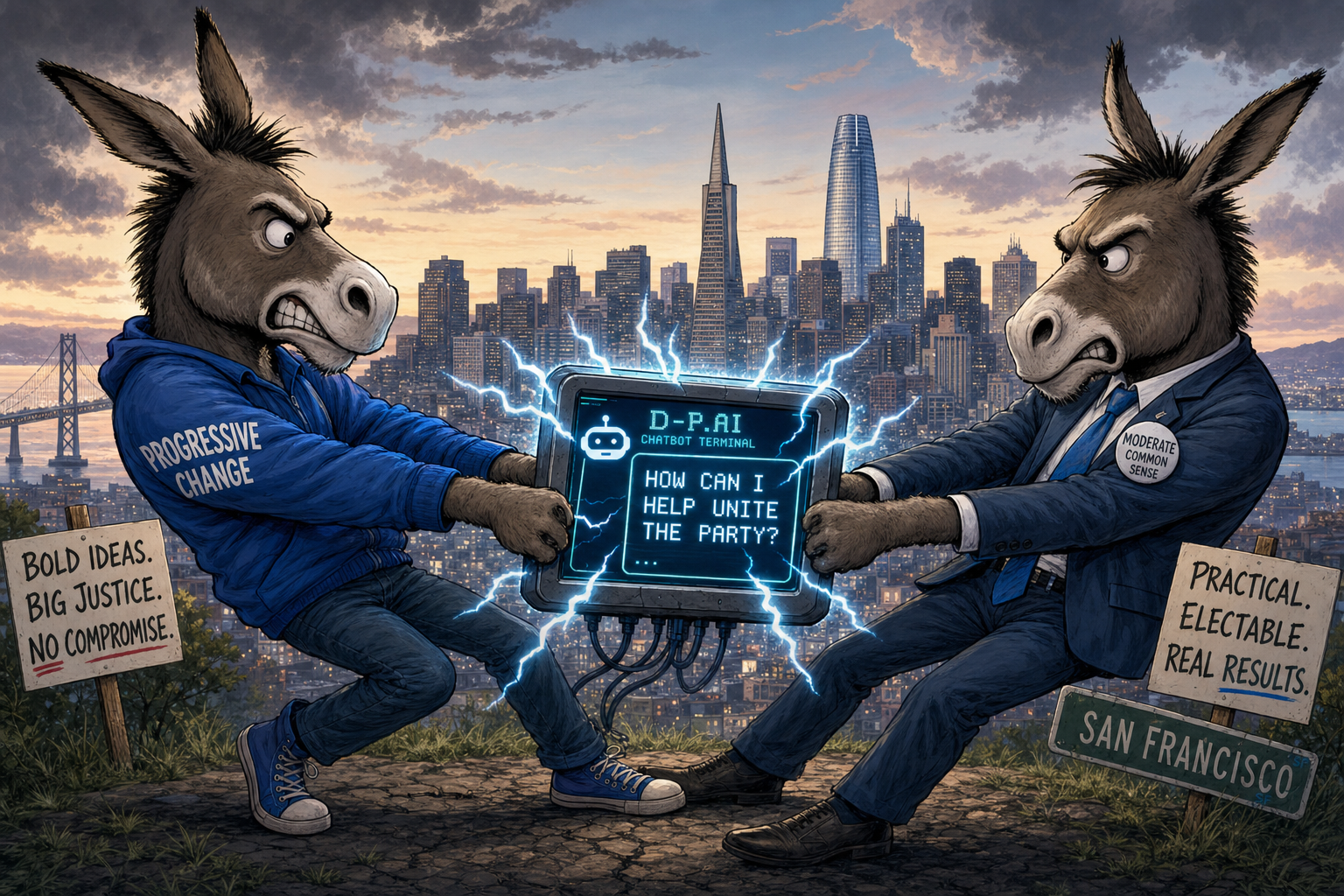
Former House Speaker Nancy Pelosi is facing criticism from prominent Democratic women in San Francisco after accusing a congressional campaign chatbot of sexism. The dispute highlights internal party divisions ahead of a competitive November election for Pelosi's seat.
Jump to The Flipside Perspectives

SAN FRANCISCO – Former House Speaker Nancy Pelosi (D-CA) is encountering significant pushback from within her own party in San Francisco after she publicly criticized an artificial intelligence chatbot used by California state Senator Scott Wiener (D), a candidate vying to succeed her in Congress. Pelosi had labeled the chatbot, which targeted rival candidate San Francisco Supervisor Connie Chan, as sexist and a "gross misuse of technology," but several prominent Democratic women are now challenging her characterization, calling the accusation "absurd."

"It feels like there's a lot of fake outrage about this chatbot" — Nancy Tung, San Francisco Democratic Party Chair

The controversy centers on an AI chatbot launched by Wiener's campaign, designed to engage with voters and highlight perceived weaknesses in Supervisor Chan's record, particularly on housing and development issues. The chatbot, which has since been removed, described itself as "the world's first AI trained to say no to anything you ask," a direct jab at Chan. Both Chan and Pelosi raised objections to responses generated by the chatbot, describing them as racist and sexist. Pelosi, who has officially endorsed Chan in the race for California's 11th congressional district, specifically accused Wiener's campaign of misusing AI by having the chatbot impersonate a female voice, stating it demonstrated a willingness to "erase women's agency."

Wiener promptly removed the chatbot, citing that the controversy had become a distraction from his campaign's core message. However, the decision did not quell the internal party dispute. Instead, it ignited further debate as several influential Democratic women in San Francisco publicly questioned Pelosi's strong condemnation.

Nancy Tung, Chair of the San Francisco Democratic Party, expressed skepticism regarding the severity of the accusations. "It feels like there's a lot of fake outrage about this chatbot," Tung told the San Francisco Chronicle, suggesting the dispute was being leveraged for political gain in the highly competitive congressional race. Tung added, "I suppose you know that's part of the political game – to put as favorable a slant as you want to for your own purposes for each campaign."

Susie Tompkins Buell, a prominent Democratic donor and women's advocate, went even further in her defense of Wiener and criticism of Pelosi. Buell unequivocally called Pelosi’s sexism accusation "totally absurd." Praising Wiener, Buell stated, "He is the most non-sexist, non-racist person," and added, "I don't know who would even say that." Buell also remarked that if Pelosi indeed made the accusation, "it was careless and not appropriate and not true." She questioned Pelosi's aggressive intervention in the race, stating, "Nobody can give a good answer of why she's doing this. It's just a mystery to so many people. Whatever it is, it is rooted in pettiness."

The backlash against Pelosi comes as women supporting Wiener planned a "Women for Scott" rally, signaling a clear division among Democratic factions in the city. Pelosi has maintained an active role in the contest to determine her successor, a seat she has held for decades. Her endorsement of Chan was pivotal in helping Chan advance through the primary and secure a spot in the general election against Wiener, who had long been considered a potential successor. Reports have indicated a tense relationship between Pelosi and Wiener, particularly after Wiener expressed interest in her seat before she announced her retirement.

Pelosi, during an August 11 Politico event, avoided directly criticizing Wiener, instead framing her support for Chan around the goal of increasing the number of women serving in Congress. Meanwhile, Chan's campaign pushed back against Wiener's supporters following the criticism of Pelosi. A campaign spokesperson stated, "It's sad that Scott Wiener's best answer to broad grassroots criticism of his campaign’s AI chatbot from women and people across San Francisco is to convene a rally to attack Speaker Pelosi."

Despite Pelosi's endorsement of his opponent, Wiener has continued to express public admiration for the former speaker. "I have tremendous respect for Speaker Emerita Pelosi and deep gratitude for everything she has done for our city and our country," Wiener said after Pelosi endorsed Chan. The unfolding drama underscores the complexities of intra-party dynamics, particularly when a long-serving incumbent's legacy and influence intersect with emerging political ambitions and technological advancements in campaigning. The November election will not only decide Pelosi's successor but also serve as a barometer for the evolving political landscape within one of the nation's most reliably Democratic districts.

Advertisement

The Flipside: Different Perspectives

Progressive View

From a progressive viewpoint, former House Speaker Nancy Pelosi's initial criticism of the AI chatbot developed by Scott Wiener's campaign is understandable and rooted in important ethical considerations. The use of artificial intelligence in political campaigning, especially when it targets a specific candidate and is accused of perpetuating sexist or racist tropes, raises serious questions about the responsible application of technology. The concern that a chatbot could "erase women's agency" or be seen as a "gross misuse of technology" speaks to the progressive emphasis on ensuring that technological advancements do not inadvertently reinforce existing biases or harm marginalized groups.
Progressives prioritize social justice and equity, and the potential for AI to be weaponized in ways that undermine these values is a significant concern. While free speech is valued, it is often balanced against the need to protect vulnerable communities from harmful rhetoric and to foster an inclusive political environment. The fact that the chatbot was designed to impersonate a female voice and then generate negative responses could be interpreted as a subtle, yet insidious, form of misogyny, even if unintended by the campaign.
Furthermore, the progressive perspective would highlight the importance of accountability in political discourse. When a campaign employs a tool that draws widespread criticism for its content, particularly from a respected figure like Pelosi, it signals a need for self-reflection and correction. While the subsequent pushback against Pelosi from other Democrats indicates internal party friction, the underlying concern about ethical campaigning and the potential for technology to be misused remains a valid progressive critique. The goal is to ensure that campaigns are not only effective but also conducted in a manner that upholds the dignity and agency of all individuals.

Conservative View

The controversy surrounding former House Speaker Nancy Pelosi’s criticism of a campaign chatbot highlights several points often raised by conservative thinkers. From a conservative perspective, the swift accusation of sexism and racism, followed by calls for the chatbot's removal, can be viewed as an example of political overreach and an attempt to stifle free expression in campaigning. The idea of "fake outrage," as suggested by San Francisco Democratic Party Chair Nancy Tung, resonates with concerns that identity politics are sometimes weaponized to gain political advantage rather than addressing genuine issues.
Conservatives often emphasize individual liberty, including the freedom of political speech, even when that speech is critical or uses novel technologies like AI. The immediate demand for the chatbot's removal, rather than a robust debate about its content, could be seen as a form of "cancel culture" where perceived offenses lead to censorship. Furthermore, the focus on the chatbot's "female voice" or "erasing women's agency" might be interpreted as an oversensitivity that distracts from substantive policy discussions, particularly when the chatbot's stated purpose was to critique a candidate's record on housing and development—issues of direct public concern.
This episode also raises questions about the appropriate role of political grandees, like Pelosi, in local races, particularly when their interventions appear rooted in personal or factional disputes rather than broader party principles. Such actions can be perceived as an attempt to control outcomes and limit the free choice of voters, rather than allowing candidates to compete freely based on their platforms and ideas.

Common Ground

Despite the sharp disagreements, there are areas of common ground between conservative and progressive perspectives regarding the use of AI in political campaigns. Both sides can agree on the fundamental importance of transparent and ethical campaigning. Regardless of political leaning, voters deserve to know when they are interacting with artificial intelligence rather than a human, and campaigns should be clear about the origin and intent of their messaging. The debate over Wiener's chatbot underscores the need for clear guidelines or best practices for the use of AI in elections, ensuring that technology serves to inform, not mislead, the electorate.
Furthermore, both conservatives and progressives share an interest in voter engagement and ensuring that elections are fair and free from undue influence. While they may differ on what constitutes "undue influence," there's a shared desire for campaigns to focus on substantive issues and candidate qualifications. The controversy over the chatbot, regardless of its ultimate impact, highlights how new technologies can either enhance or detract from this core democratic process.
Finally, there is a shared understanding that political discourse, while often contentious, should ultimately aim to serve the public good. Debates over the appropriate boundaries of campaign rhetoric, whether traditional or technologically mediated, are essential for maintaining a healthy democracy. Both sides can agree that campaigns should strive to be effective while adhering to a basic level of public trust and avoiding tactics that are widely perceived as deceptive or unfairly manipulative.

What's your view on this story? Share your thoughts and remember to consider multiple perspectives and being respectful when forming and voicing your opinion. "If you resort to personal attacks, you have already lost the debate..."

Advertisement

Contact Us About This Article

Have a question or comment about this article? We'd love to hear from you.

About Fair Side News

At Fair Side News, we believe in presenting news with perspectives from both sides of the political spectrum. Our goal is to help readers understand different viewpoints and find common ground on important issues.