


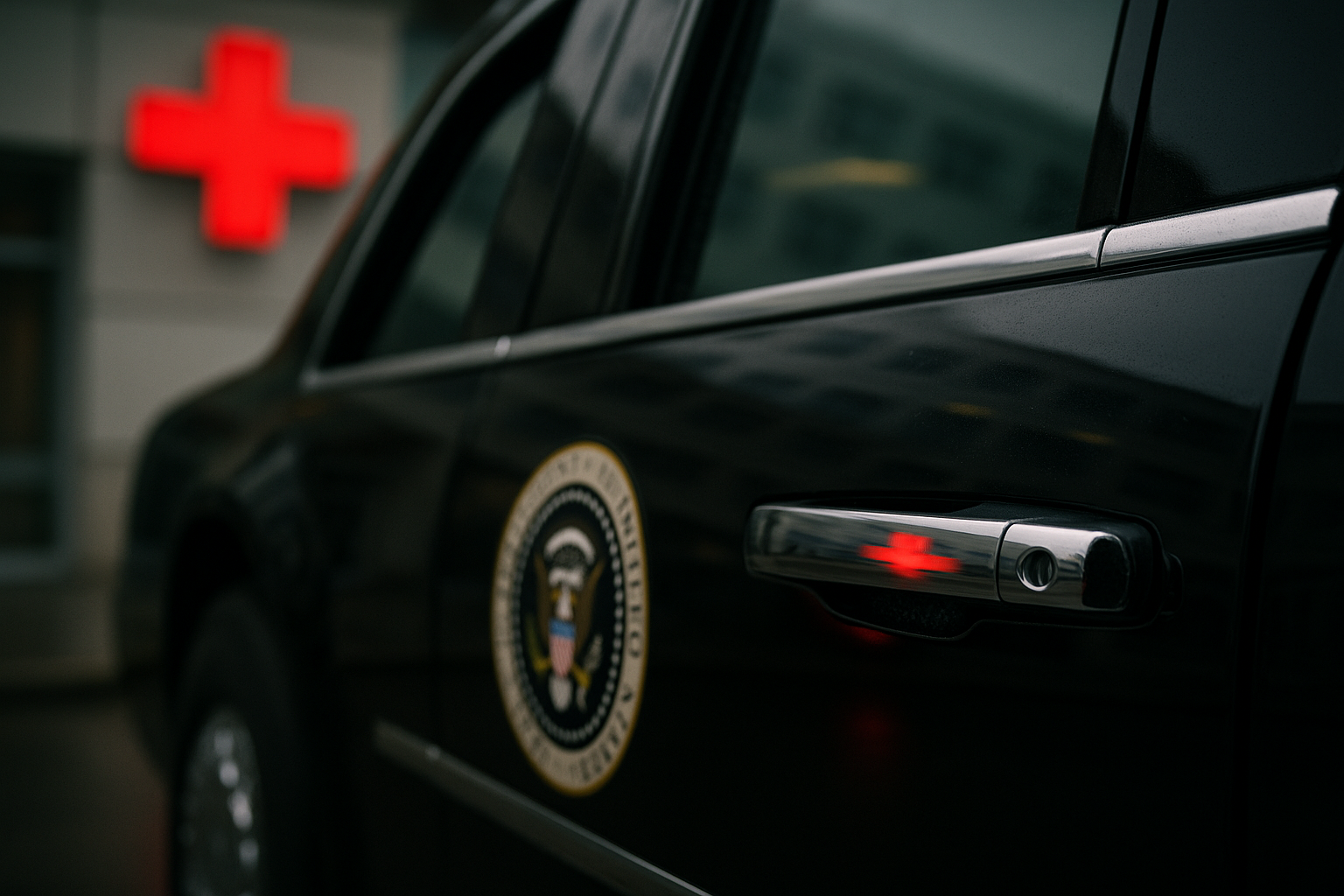
President Donald Trump is scheduled to undergo medical and dental evaluations Tuesday at Walter Reed National Military Medical Center, marking his third visit to the facility in just 13 months. This latest visit has intensified public and political scrutiny surrounding the President’s physical condition, particularly following recent observations of visible bruising and swelling during his public appearances.
"This White House just doesn’t seem to want to acknowledge any physical ailment." — Jonathan Reiner, Former White House Physician
The 79-year-old President's health has become a renewed subject of debate, with photographs from recent events circulating that show bruising on his hands, swelling around his ankles, and red marks along parts of his neck. These visible signs have prompted questions about the White House’s level of transparency regarding presidential health. President Trump previously visited Walter Reed in April 2025 for his annual physical, returning again in October of the same year for what the administration described as a “scheduled follow-up.” The current visit, less than a year after the last, has led critics and some former White House physicians to openly question the completeness of information provided by the administration.
The issue carries significant political weight, especially given President Trump’s consistent emphasis on mental and physical fitness during the 2024 election campaign. During that period, he frequently critiqued then-candidate Joe Biden over concerns related to age and cognitive decline. Recent polling indicates a shift in public perception, with some of these same concerns now beginning to be directed towards President Trump. A Washington Post-ABC News-Ipsos poll, cited in reports, found that only 40% of Americans believe President Trump possesses the necessary mental sharpness to serve, a seven-point decrease since last September. On physical fitness, the numbers were lower, with only 44% of respondents believing President Trump remains physically fit for office.
President Trump has consistently dismissed these health concerns, asserting that he remains in "excellent health" and feels better than he did decades ago. He has offered specific explanations for the visible signs, attributing the bruising on his hands to daily aspirin use, which is known to increase bruising and bleeding risks, particularly in older adults. Additionally, he has denied accusations of appearing to fall asleep during Cabinet meetings or public events, stating instead that he was merely listening intently with his eyes closed.
However, medical experts and former White House physicians have voiced frustrations over what they perceive as a lack of transparency from the administration. Jonathan Reiner, a prominent medical professional, stated, "This White House just doesn’t seem to want to acknowledge any physical ailment." He added, "There just seems to be a lack of candor from the White House." Similarly, former presidential physician Jeffrey Kuhlman criticized the administration for not releasing more precise information regarding President Trump’s condition. Kuhlman remarked, "After a decade of delusion, deceit, denial or delay from the administrations and White House physicians regarding presidential evaluations, my expectation bar is pretty low."
Conversely, President Trump’s health team and allies have continued to defend his condition vigorously. Health Secretary Robert F. Kennedy Jr. recently claimed, according to the Daily Mail, that television personality Mehmet Oz reviewed President Trump’s medical records and concluded that the President exhibits unusually high testosterone levels for a man over 70. The White House has also actively pushed back against various online rumors concerning President Trump’s health in recent months. Earlier this year, viral speculation falsely claimed the President had been urgently rushed to Walter Reed amidst Middle East tensions. At that time, the administration accused critics and media outlets of propagating conspiracy theories, asserting that President Trump was conducting national security operations from the White House Situation Room.
Despite these defenses and rebuttals, the scheduled hospital visit and the ongoing circulation of visible physical concerns suggest that scrutiny surrounding President Trump’s health is likely to persist.

