

Breaking
Sponsor Advertisement
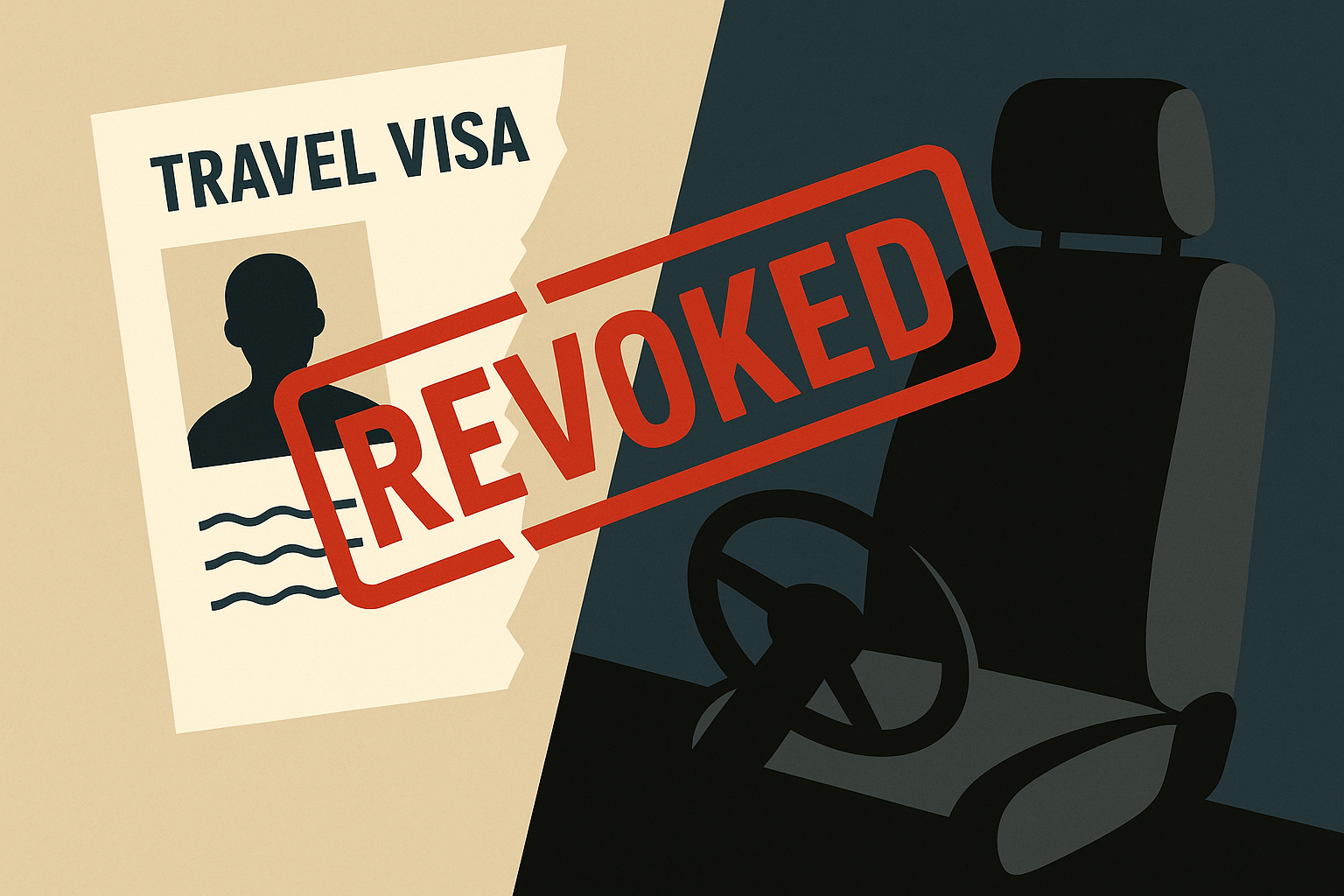
State Department Revokes Visas After DUI Arrests
Image for: State Department Revokes Visas After DUI Arrests

State Department Revokes Visas After DUI Arrests

The State Department has revoked the visas of five foreign nationals following their arrests for alleged impaired-driving offenses and other criminal conduct, citing public safety concerns. This action aligns with President Donald Trump's administration's expanded scrutiny of foreign nationals.
Jump to The Flipside Perspectives

The U.S. State Department has revoked the visas of five foreign nationals arrested in connection with alleged impaired-driving offenses and other criminal conduct on U.S. roads. The department cited concerns about public safety and violations of visa requirements as the basis for these actions, which took place in late July 2026.

"We will not allow foreign nationals who violate the terms of their visa, break our laws, and endanger American citizens to remain in the United States." — Tommy Pigott, State Department Spokesman

State Department spokesman Tommy Pigott stated that the visa holders' alleged conduct endangered Americans and violated the conditions under which they were permitted to enter or remain in the United States. "These five foreign nationals disregarded our laws and put our citizens at risk through their dangerous and reckless actions on the road," Pigott told The Daily Signal. "We will not allow foreign nationals who violate the terms of their visa, break our laws, and endanger American citizens to remain in the United States."

The revocations are part of President Donald Trump's administration's broader effort to increase scrutiny of foreign nationals seeking to enter or remain in the United States. Since the start of the administration, there has been an expansion of visa screening and vetting policies, with a greater emphasis on identifying visa holders accused of criminal activity or conduct officials deem a public-safety concern.

The State Department announced details of some of the cases on social media, highlighting the varied nature of the alleged offenses. One foreign national was arrested on allegations including disorderly conduct, resisting arrest with violence, driving under the influence (DUI), and domestic violence. The department confirmed that this individual's visa was revoked following the arrest.

Another case involved a foreign national arrested for aggravated DUI. Authorities reportedly found the driver had a blood alcohol level nearly twice the legal limit while a minor was present in the vehicle. Officials noted that these alleged circumstances posed a risk to both the child and other road users.

A third foreign national faced arrest for DUI, with a reported blood alcohol level exceeding three times the legal limit. The State Department stated that this individual later appeared intoxicated at a court-ordered DUI program, leading to the revocation of their visa. Officials emphasized that foreign visitors who endanger others would not be granted additional opportunities to remain in the country under their existing visa status.

Additionally, the department identified a foreign national whose visa was revoked after an arrest for DUI following an incident where they allegedly caused injuries to another person. The fifth individual had their visa revoked after authorities reportedly discovered heroin in their vehicle and recorded a blood alcohol level exceeding three times the legal limit.

State Department guidance permits visa revocation in several circumstances, including when officials determine that a visa holder is no longer eligible for their specific visa classification. Federal guidance also provides specific authority to revoke certain visas based on arrests or convictions involving DUI, driving while intoxicated (DWI), or similar offenses that have occurred within the previous five years.

To identify such cases, the State Department conducts continuous vetting of visa holders. This process aims to uncover information that could affect a person's eligibility or raise public-safety concerns. Spokesman Pigott affirmed the department's commitment to using this ongoing vetting to take action against foreign nationals whose conduct is determined to pose a danger to Americans. "The State Department will always put the safety of Americans first," Pigott said. "That’s why the State Department conducts continuous vetting of visa holders to ensure that foreign nationals don’t present a danger to the American people."

These five cases serve as recent illustrations of the Trump administration's approach to visa enforcement. Officials consistently emphasize that an arrest involving impaired driving or other alleged criminal conduct can trigger a thorough review of a foreign national’s visa status, potentially leading to revocation and denial of further travel to the United States. The State Department reiterated this stance via a social media post on July 29, 2026, stating, "The Trump Administration is keeping reckless foreign drivers off our streets by revoking visas and denying further travel to the United States. The State Department is keeping our streets safe from foreign nationals who drive impaired, disregard laws, and endanger Americans."

Advertisement

The Flipside: Different Perspectives

Progressive View

While ensuring public safety is a shared goal, a progressive viewpoint might raise concerns about the proportionality of these actions and the potential for due process issues. The immediate revocation of visas based on arrests, rather than convictions, could be seen as a harsh measure that bypasses the full legal process. Individuals are presumed innocent until proven guilty, and revoking a visa based solely on an allegation, even a serious one, might preempt a fair legal defense.

Furthermore, a progressive analysis would consider the broader context of immigration and the potential for such enforcement to disproportionately affect certain communities or create a climate of fear. While impaired driving is unequivocally dangerous, focusing solely on the "criminal" aspect without considering factors like potential for rehabilitation, the specific circumstances of each case, or the potential for bias in arrests, could lead to unjust outcomes. Progressive thought often emphasizes the importance of comprehensive immigration reform that balances enforcement with humanitarian considerations, pathways to legal status, and a focus on root causes rather than solely punitive measures. There's also a concern that such actions, while framed as public safety, contribute to a broader anti-immigrant narrative that can dehumanize foreign nationals and ignore their contributions to American society.

Conservative View

From a conservative perspective, the State Department's actions reflect a firm commitment to national sovereignty, the rule of law, and public safety. The revocation of visas for foreign nationals arrested for alleged impaired driving and other criminal acts underscores the principle that entry into the United States is a privilege, not a right, and that privilege comes with responsibilities. When individuals violate U.S. laws and endanger citizens, the government has a duty to act decisively to protect its populace and uphold its legal framework.

This move aligns perfectly with the Trump administration's broader immigration enforcement agenda, which prioritizes securing borders and ensuring that those within the country respect its laws. By revoking visas, the administration sends a clear message that criminal conduct by foreign nationals will not be tolerated and will have immediate consequences. This approach emphasizes personal responsibility; individuals are expected to abide by the terms of their visas and the laws of the land. It also reduces the burden on the American justice system and taxpayers, as individuals who commit crimes are swiftly removed rather than remaining to potentially re-offend or consume public resources. This policy reinforces the idea of limited government by ensuring that federal agencies are efficiently enforcing existing statutes to maintain order and security.

Common Ground

Despite differing perspectives on immigration enforcement, there is common ground regarding the fundamental importance of public safety and the need for all individuals residing in the United States, regardless of nationality, to adhere to the law. Both conservatives and progressives agree that driving under the influence is a serious offense that poses a direct threat to the lives and well-being of others on the road. There is a shared interest in preventing impaired driving and ensuring that legal mechanisms are in place to address such dangerous behavior.

Furthermore, there is bipartisan support for the idea that visas are granted with certain conditions and that egregious violations of those conditions, especially those endangering public safety, should have consequences. The discussion can shift towards ensuring that these consequences are applied fairly, transparently, and with appropriate due process, even if the definition of "appropriate" differs. Efforts to enhance road safety through education, prevention, and enforcement can be a collaborative area, as can discussions on how to manage immigration in a way that is both secure and humane, ensuring that legal processes are clear and accessible while maintaining national security.

What's your view on this story? Share your thoughts and remember to consider multiple perspectives and being respectful when forming and voicing your opinion. "If you resort to personal attacks, you have already lost the debate..."

Advertisement

Contact Us About This Article

Have a question or comment about this article? We'd love to hear from you.

About Fair Side News

At Fair Side News, we believe in presenting news with perspectives from both sides of the political spectrum. Our goal is to help readers understand different viewpoints and find common ground on important issues.