


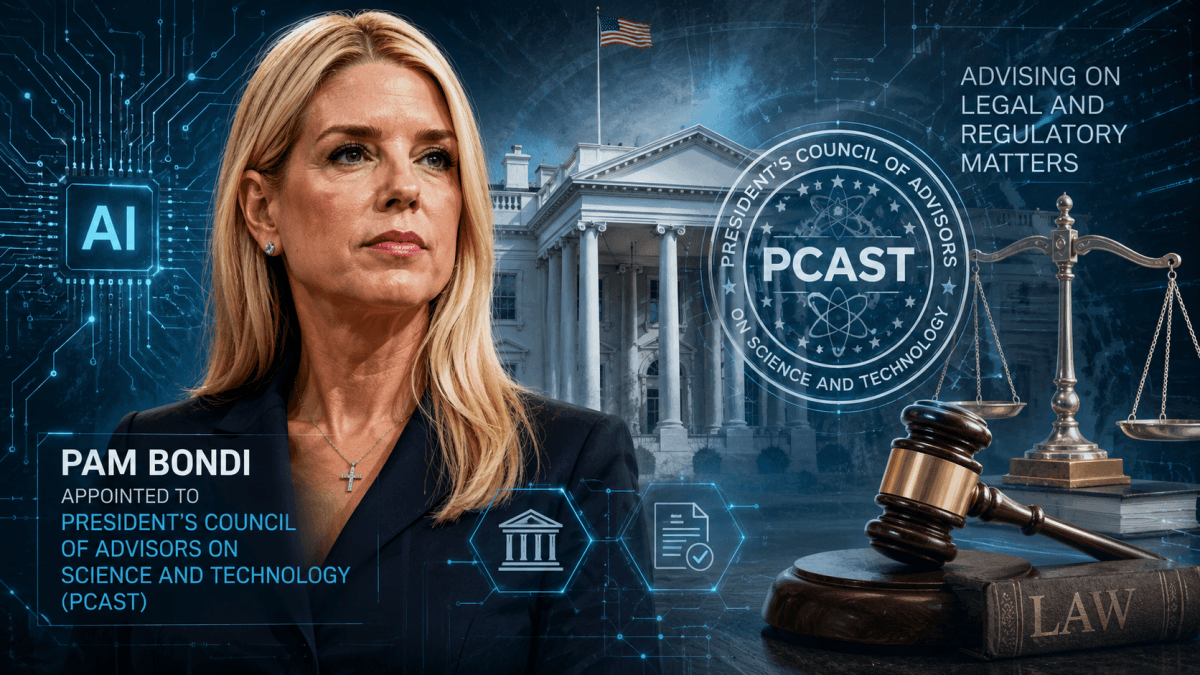
President Donald Trump has appointed former Attorney General Pam Bondi to the President’s Council of Advisors on Science and Technology (PCAST), a crucial White House advisory panel. The appointment, announced weeks after Bondi's departure from the Department of Justice, places her among influential business and technology leaders, tasked with advising the President on matters concerning science, technology, innovation, and emerging industries, particularly artificial intelligence.
"President Trump understands that unnecessary regulation is the biggest threat to innovation in America." — David Sacks, PCAST Co-Chair
Bondi's new role comes as she continues her recovery following treatment for thyroid cancer, according to reports. Vice President J.D. Vance lauded the decision, emphasizing Bondi's continued importance within the Trump administration. “Pam has been an enormously valuable asset to the president’s team, and I’m thrilled for her and for all of us that she’s going to remain involved in confronting some of the most important issues the administration faces,” Vance stated.
The President’s Council of Advisors on Science and Technology is designed to furnish the President with external counsel on significant issues spanning scientific advancement, technological innovation, and new industrial sectors. David Sacks, who co-chairs PCAST alongside Michael Kratsios, highlighted the particular value of Bondi’s legal background. Sacks noted that her expertise would be instrumental as the administration navigates complex regulatory questions surrounding nascent technologies. “No one is better positioned to support PCAST and to advise the president on legal and regulatory matters,” Sacks wrote on X, further adding, “President Trump understands that unnecessary regulation is the biggest threat to innovation in America.” Sacks also remarked on the strategic imperative, stating, “Winning the AI race means not only beating China but also clearing bureaucratic hurdles thrown up by state legislatures and woke politicians in DC.”
The panel includes a roster of prominent figures from the technology sector, such as Jensen Huang, Mark Zuckerberg, Larry Ellison, and Marc Andreessen, reflecting the administration's engagement with industry leaders on these critical issues. Beyond her role on PCAST, Bondi will also assume a newly established advisory position focused on national infrastructure, further expanding her influence within the administration's strategic initiatives.
Bondi’s appointment arrives at a pivotal juncture for the administration’s artificial intelligence strategy. The White House is actively engaged in debates concerning the appropriate level of federal government regulation for the rapidly expanding AI industry. President Trump recently postponed a planned executive order pertaining to artificial intelligence testing, citing reservations about specific provisions within the proposal. The draft order, as reported by The Hill, would have established a framework for AI companies to voluntarily submit their systems for government testing for up to 90 days prior to public release. However, President Trump conveyed to reporters that he “didn’t like certain aspects” of the order, expressing apprehension that additional regulations could impede American companies in their competitive efforts against China.
This ongoing debate within the administration underscores a broader divergence in perspectives regarding the United States' approach to artificial intelligence development. Some officials advocate for the implementation of more stringent safeguards, citing concerns over cybersecurity risks and the potential implications of increasingly sophisticated AI models. Conversely, others within President Trump’s inner circle, including figures like David Sacks, contend that excessive regulatory burdens could stifle American innovation and enable foreign competitors to gain a strategic advantage. Sacks has been a vocal proponent of a more streamlined regulatory approach, prioritizing the acceleration of U.S. technological dominance.
Pam Bondi’s new position on PCAST and her advisory role on national infrastructure place her directly at the nexus of these critical discussions, where she will contribute to shaping future policies related to artificial intelligence, cybersecurity, and emerging technologies. Her legal acumen and experience are expected to play a significant part in balancing the imperatives of innovation with the need for effective governance in these rapidly evolving sectors.

