

Breaking
Sponsor Advertisement
Trump Sued Over Truth Social Paid Access Service
Image for: Trump Sued Over Truth Social Paid Access Service

Trump Sued Over Truth Social Paid Access Service

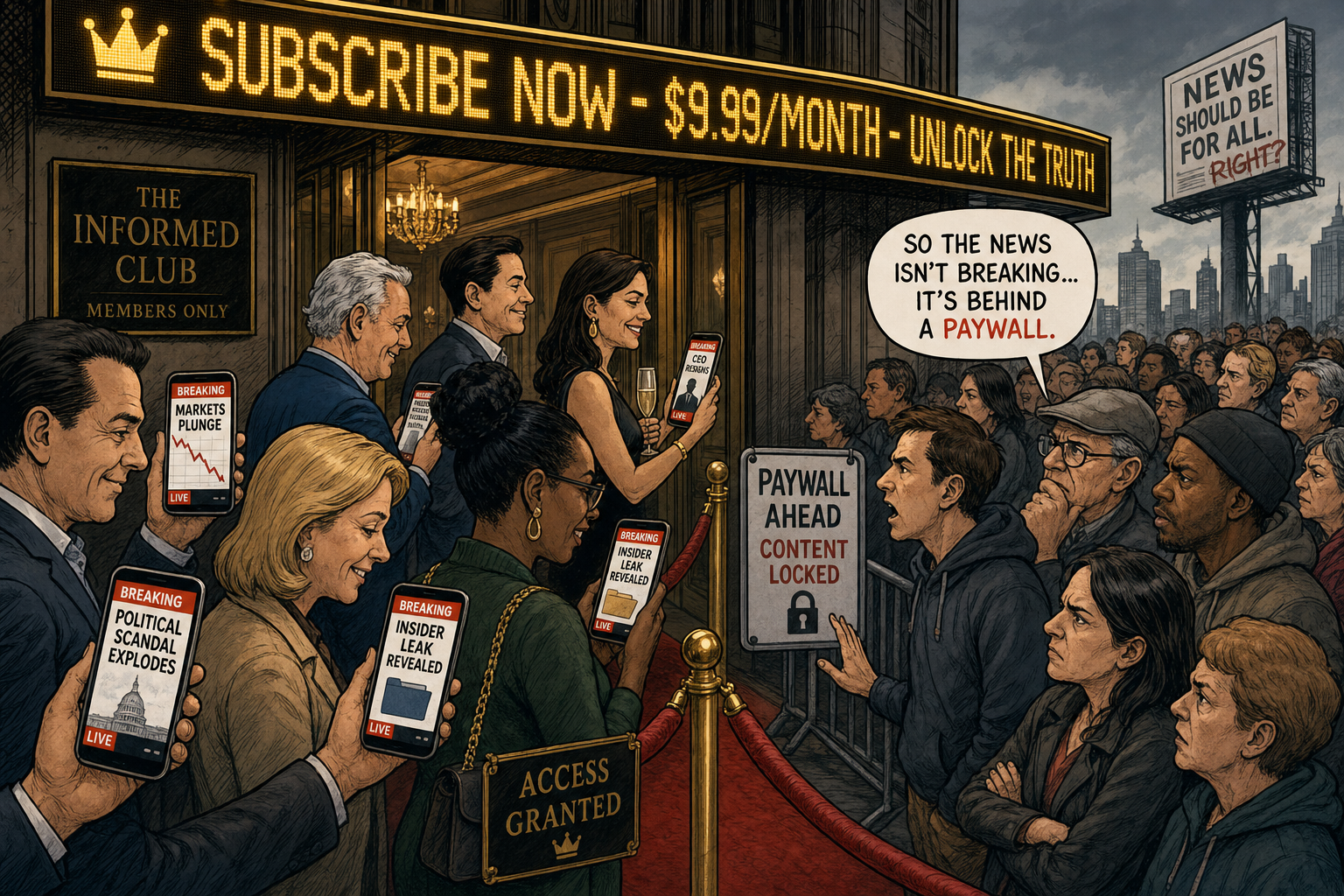
President Donald Trump and Trump Media & Technology Group face a federal lawsuit concerning a new subscription service offering early access to the President's Truth Social posts.
Jump to The Flipside Perspectives

President Donald Trump and his media company, Trump Media & Technology Group, were sued in federal court Wednesday over a newly launched service that provides paying customers with faster access to the President's Truth Social posts. The lawsuit, filed in the Southern District of New York, seeks to halt Trump and Trump Media from offering subscribers preferential access to posts that could influence financial markets and United States policy.

"A president selling priority access to news he himself generates for the benefit of a private company he controls is so blatantly corrupt and unconstitutional that it would have been hard to even fathom just a few years ago." — Seth Stern, Chief of Advocacy, Freedom of the Press Foundation

The Freedom of the Press Foundation and news organization The Intercept initiated the legal challenge, contending that the arrangement infringes upon the First and Fifth Amendments of the U.S. Constitution. The core of their argument is that presidential announcements, especially those concerning government policies, should be equally available to the press and the general public.

Trump Media recently introduced Truth API, an application programming interface that provides rapid, machine-readable access to content published on Truth Social. This service is reportedly marketed, in part, to Wall Street firms seeking immediate access to information that could impact markets. According to the Associated Press, the monthly cost for this premium access can be as high as $100,000.

Plaintiffs argue that President Trump frequently utilizes Truth Social to announce or discuss administration policies, including tariffs and other economic measures. They assert that allowing paying customers to receive these statements faster could grant traders an unfair advantage over individuals relying on standard public access. "A president selling priority access to news he himself generates for the benefit of a private company he controls is so blatantly corrupt and unconstitutional that it would have been hard to even fathom just a few years ago," stated Seth Stern, Chief of Advocacy for the Freedom of the Press Foundation.

The lawsuit also highlights a separate agreement between President Trump and Trump Media, which grants Truth Social six hours of exclusive access to his posts before they can be distributed on other platforms. The plaintiffs are asking the court to terminate both the Truth API paid-access arrangement and President Trump's exclusive posting agreement with Truth Social, arguing that these deny equal access to presidential communications. They also allege a Fifth Amendment violation, characterizing the conditions imposed on access to a government benefit as unreasonable.

Trump Media & Technology Group has vehemently rejected the accusations. The company maintains that providing paid access to data through APIs is a common practice across various industries. A statement from Trump Media asserted, "Information from President Trump is disseminated by countless platforms and news outlets, many of which offer subscription APIs." The company further accused the plaintiffs of attempting to use the courts to censor President Trump and inflict damage upon the company's shareholders. Trump Media reports having signed more than 10 customers for Truth API since its launch.

The legal action unfolds as Trump Media continues its efforts to diversify revenue streams beyond its flagship Truth Social platform. The publicly traded company has faced significant financial losses, and its stock value has declined considerably since its initial public offering, according to AP reports. This lawsuit adds another layer of scrutiny to the ongoing discussions surrounding the intersection of President Trump's public office and his private business ventures. Critics have previously raised concerns regarding President Trump's cryptocurrency initiatives and other business dealings, while President Trump and his allies have consistently refuted claims of improperly profiting from his presidency, as reported by the New York Post.

In addition to President Trump and Trump Media, the lawsuit names White House deputy chief of staff Daniel Scavino and presidential executive assistant Natalie Harp as defendants. The plaintiffs are seeking a court order to cease the challenged arrangements, emphasizing the need for transparent and equal access to information originating from the President. The allegations in the lawsuit have not yet been adjudicated, and no court has issued a ruling on whether President Trump or Trump Media have violated the Constitution.

Advertisement

The Flipside: Different Perspectives

Progressive View

From a progressive viewpoint, the lawsuit against President Trump and Trump Media raises serious ethical and constitutional concerns regarding equal access to information and potential market manipulation. The core issue is the fairness and transparency of a sitting President monetizing official or semi-official communications through a private company he controls. When a President uses a platform to announce policies that can immediately affect financial markets, providing early access to paying subscribers creates an unfair advantage for those wealthy enough to afford it. This undermines the principle of an equitable playing field and can lead to systemic inequality.

The argument that this practice violates the First Amendment, by denying equal access to the press and public, and the Fifth Amendment, by imposing unreasonable conditions on access to a government benefit, resonates deeply with progressive values. Government information, especially from the highest office, should be universally and simultaneously accessible to all citizens, not a commodity to be sold for private profit. This situation highlights the potential for conflicts of interest when a President maintains significant business interests while in office. It underscores the need for clear ethical guidelines and robust oversight to prevent the exploitation of public office for personal gain, ensuring that the government serves the collective good rather than enriching a select few.

Conservative View

From a conservative perspective, this lawsuit appears to be an overreach into the private sector and an attempt to stifle free enterprise. Trump Media, as a private company, should have the liberty to develop and offer services, including subscription-based data access, in line with market demand. The concept of an API providing rapid data access is standard practice in the technology and financial industries, where many news organizations and data providers offer similar services for a fee. To argue that President Trump, as a private citizen and businessman, cannot monetize his own platform or the content he generates on it, even while in office, infringes upon his individual economic freedom.

Furthermore, the lawsuit's attempt to dictate how a private company disseminates information, especially when that information is widely available through other means, can be seen as a form of government interference in the free market. Conservatives often champion limited government and oppose regulations that impede business innovation or contractual agreements between private parties. The claim of constitutional violations seems tenuous when the information is ultimately public, even if a premium service offers faster access. The focus should remain on ensuring transparency and the free flow of information, which is not inherently undermined by a private entity offering a value-added service. This legal action could be perceived as an effort to politically target President Trump and his business, rather than addressing a legitimate constitutional concern.

Common Ground

Despite differing perspectives on the lawsuit, there are areas of common ground regarding the importance of transparency and ethical conduct in public office. Both conservatives and progressives can agree that the public deserves timely and accurate information from their government. There is a shared interest in preventing market manipulation and ensuring that all participants in financial markets operate on a level playing field, even if disagreements exist on how to achieve that.

Furthermore, both sides can acknowledge the importance of clear rules and guidelines for how public officials, particularly a President, manage their private business interests while in office. While conservatives might emphasize individual liberty and contractual freedom, and progressives might prioritize social equity and systemic fairness, both can agree that the perception of corruption or unfair advantage erodes public trust in institutions. A constructive approach could involve exploring clearer, bipartisan standards for how official communications are disseminated, balancing the rights of private entities with the public's right to information, without necessarily resorting to broad prohibitions on all private enterprise activities by public figures. The goal should be to foster an environment where government actions are perceived as fair and unbiased.

What's your view on this story? Share your thoughts and remember to consider multiple perspectives and being respectful when forming and voicing your opinion. "If you resort to personal attacks, you have already lost the debate..."

Advertisement

Contact Us About This Article

Have a question or comment about this article? We'd love to hear from you.

About Fair Side News

At Fair Side News, we believe in presenting news with perspectives from both sides of the political spectrum. Our goal is to help readers understand different viewpoints and find common ground on important issues.