

Breaking
Sponsor Advertisement
White House Gunman Identified, Had History of Mental Illness
Image for: White House Gunman Identified, Had History of Mental Illness

White House Gunman Identified, Had History of Mental Illness

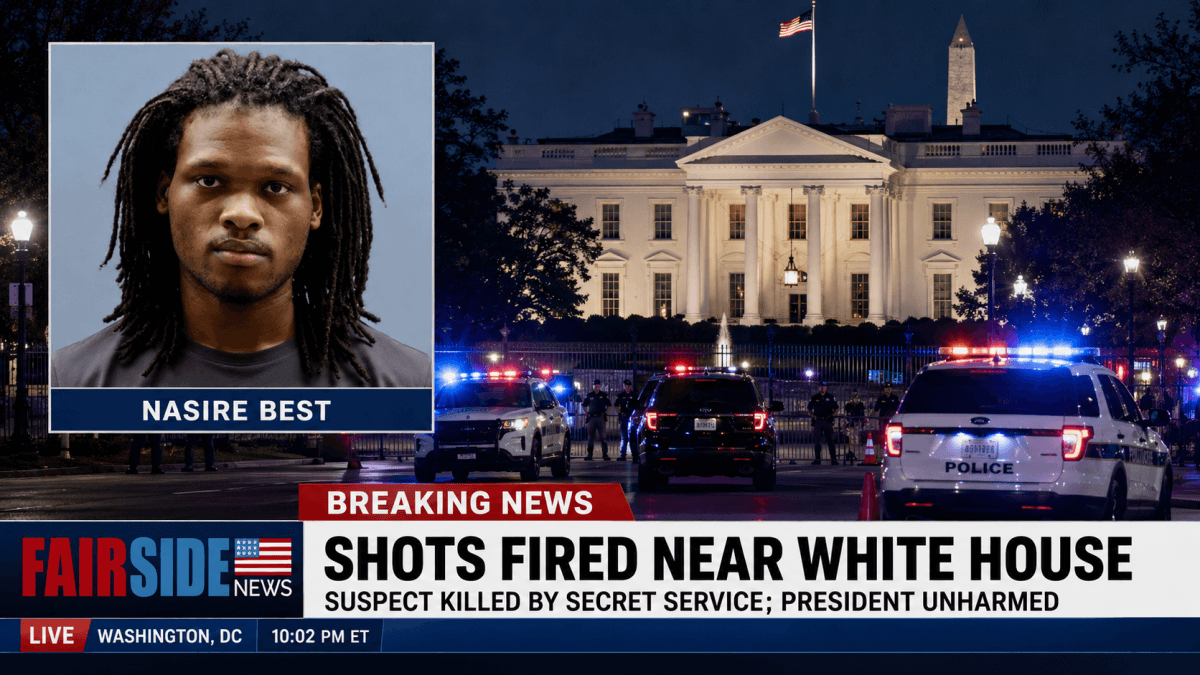
A 21-year-old man identified as Nasire Best, with a history of severe mental illness and prior Secret Service confrontations, opened fire near the White House on Saturday and was killed by agents. President Trump was inside the White House at the time and was not injured.
Jump to The Flipside Perspectives

A gunman killed after opening fire near the White House on Saturday evening has been identified by authorities as 21-year-old Nasire Best, a man with a documented history of severe mental illness and repeated confrontations with the Secret Service. President Donald Trump was inside the White House at the time of the incident but was not injured.

"Thank you to our great Secret Service and Law Enforcement for the swift and professional action taken this evening against a gunman near the White House." — President Donald Trump, Truth Social

The event unfolded when Best approached a Secret Service checkpoint near the White House complex. According to multiple reports, he suddenly produced a revolver from a bag and began firing at officers guarding the perimeter. Witnesses in the vicinity reported hearing what sounded like dozens of gunshots, leading to immediate chaos and a lockdown around the White House. Secret Service agents quickly engaged Best, exchanging gunfire near the White House gates before ultimately shooting and killing him.

Authorities confirmed that no federal agents sustained injuries during the confrontation. However, one civilian was seriously injured during the shooting. Investigators are currently working to determine whether the civilian was struck by the suspect's gunfire or caught in the crossfire between Best and the Secret Service agents.

Details emerging from the investigation indicate that Best's concerning behavior had been escalating for nearly a year prior to Saturday's deadly confrontation. Reports reveal that Best had been detained by Secret Service agents multiple times in 2025 due to erratic and threatening actions around the White House complex. During one notable incident in June 2025, Best allegedly blocked an entry lane outside the White House, making bizarre statements where he claimed to be "God." Following this encounter, authorities detained him and reportedly transferred him to the Psychiatric Institute of Washington for a mental health evaluation.

Just weeks after the June 2025 incident, Best was again arrested after attempting to enter another restricted area of the White House grounds. A judge subsequently issued an order requiring Best to stay away from the White House entirely. Law enforcement officials have stated that in the months leading up to the shooting, Best repeatedly referred to himself as Jesus Christ and was believed to be suffering from severe mental health issues, as reported by the Daily Mail.

Moments before the attack, witnesses observed Best pacing back and forth along 17th Street Northwest, near the White House perimeter. Authorities believe he then approached the checkpoint and abruptly opened fire. ABC News correspondent Selina Wang, who was recording outside on the White House North Lawn when the gunfire erupted, captured video footage showing reporters ducking for cover as Secret Service agents shouted warnings and rushed journalists into secure areas.

Following the shooting, President Trump took to Truth Social to commend the Secret Service's rapid response and professionalism. "Thank you to our great Secret Service and Law Enforcement for the swift and professional action taken this evening against a gunman near the White House," President Trump wrote. He also noted that the suspect had a "violent history and possible obsession with our Country’s most cherished structure," appearing to reference the White House itself.

The incident marks another significant security scare for President Trump, who has faced multiple alleged assassination threats throughout his political career. The ongoing investigation aims to fully understand Best's motives, the specifics of the civilian injury, and any potential gaps in the system that allowed an individual with a documented history of severe mental illness and prior threats to approach the White House with a firearm.

Advertisement

The Flipside: Different Perspectives

Progressive View

This tragic incident near the White House underscores a profound failure in our societal approach to mental health and violence prevention. The fact that an individual with a documented history of severe mental illness, prior confrontations with the Secret Service, and a judicial stay-away order was still able to acquire a firearm and pose a lethal threat points to systemic shortcomings. We must move beyond simply reacting to crises and instead invest comprehensively in accessible mental healthcare, early intervention programs, and community-based support systems.

A public health approach to violence recognizes that individuals in severe mental distress often need help, not just punitive measures. While law enforcement acted to contain an immediate threat, the larger question remains: why was this individual allowed to escalate to this point? This incident should prompt a critical examination of how we identify, treat, and support individuals with serious mental health conditions, ensuring they receive the care they need to prevent such dangerous escalations. Furthermore, the presence of a firearm in the hands of an individual with such a documented history also raises urgent questions about the efficacy of existing gun violence prevention measures and the need for stronger, more compassionate policies that prioritize collective well-being.

Conservative View

The swift and decisive action by the Secret Service near the White House exemplifies the critical importance of a well-trained and fully supported law enforcement presence in safeguarding national security and protecting the presidency. This incident underscores the ongoing threats faced by our nation's leaders and highlights the necessity of robust security protocols. The immediate neutralization of the threat by Secret Service agents prevented a potentially far more tragic outcome, demonstrating their unwavering commitment to duty and the protection of the President and the White House complex.

While the suspect's reported mental health issues are a concern, this event primarily reinforces the need for strong law enforcement and a clear policy that individuals posing a threat, especially those with a history of documented dangerous behavior, must be prevented from accessing restricted areas. The focus should remain on empowering law enforcement to act decisively when faced with imminent danger and ensuring that legal mechanisms, such as stay-away orders, are rigorously enforced. Protecting the symbols of American democracy and the individuals who lead it is a paramount responsibility that requires unwavering support for our national security apparatus and the personnel who serve within it.

Common Ground

Both conservative and progressive perspectives can find common ground in the urgent need to prevent future incidents of violence near critical government facilities and involving individuals with severe mental health issues. There is bipartisan agreement on the necessity of effective law enforcement response to immediate threats and the protection of the President and national landmarks. All sides can acknowledge the bravery and professionalism of the Secret Service in neutralizing a dangerous situation.

Furthermore, a shared concern exists regarding the challenges posed by severe mental illness in society. While approaches may differ, there is a mutual interest in exploring how to improve mental health services, particularly for individuals with a documented history of erratic or threatening behavior. Practical solutions could include enhanced inter-agency information sharing regarding individuals deemed a threat, better coordination between mental health services and law enforcement, and a re-evaluation of how judicial orders designed to protect public safety are monitored and enforced. Preventing such escalations requires a multi-faceted approach that combines robust security with efforts to address underlying societal issues.

What's your view on this story? Share your thoughts and remember to consider multiple perspectives and being respectful when forming and voicing your opinion. "If you resort to personal attacks, you have already lost the debate..."

Advertisement

Contact Us About This Article

Have a question or comment about this article? We'd love to hear from you.

About Fair Side News

At Fair Side News, we believe in presenting news with perspectives from both sides of the political spectrum. Our goal is to help readers understand different viewpoints and find common ground on important issues.