
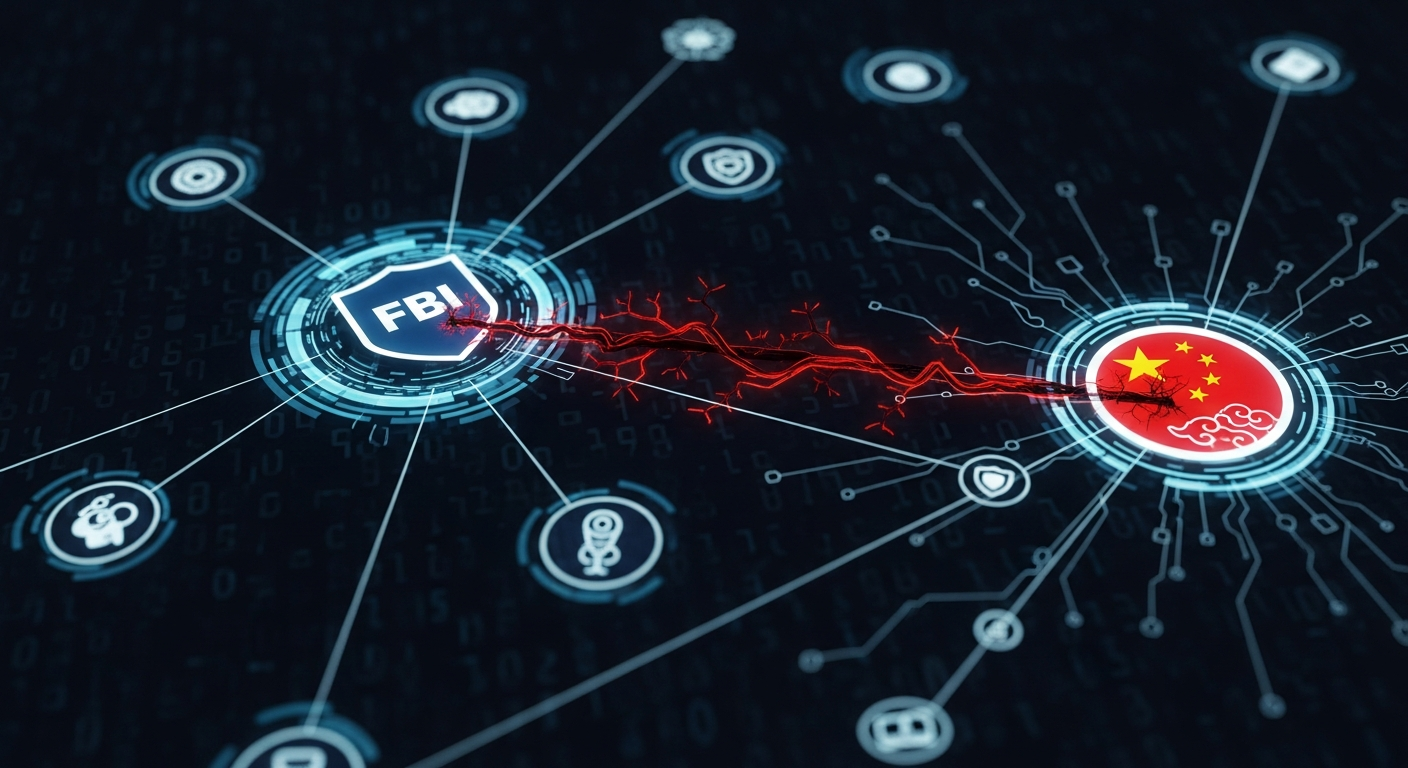
The Federal Bureau of Investigation (FBI) has issued a warning to Congress regarding a major cyberattack attributed to China, which has compromised its internal systems. Officials have characterized the incident as a "major incident" with significant national security implications, prompting immediate concern across U.S. intelligence and law enforcement agencies.
The breach was initially detected in February at FBI offices located in the Virgin Islands. The severity of the intrusion was such that it triggered mandatory disclosure under federal law, a threshold met only when an incident is deemed likely to cause significant harm. This classification immediately elevated the stakes, signaling a serious compromise of sensitive government infrastructure.
"Officials say it could become a serious national security threat." — Officials, Federal Bureau of Investigation
According to statements from officials, the cyberattack appears to have been executed by a sophisticated operation with direct ties to the Chinese government. While the full extent of the damage and data exfiltration remains under investigation, initial assessments indicate that the attackers successfully gained access to sensitive surveillance-related data stored within FBI systems. This data primarily involves information gathered through "pen register" and "trap and trace" tools, which collect metadata about communications rather than their content. This includes critical details such as outgoing and incoming contact information, as well as communication patterns, which are highly valuable in intelligence operations for mapping networks, relationships, and behavioral patterns pertinent to ongoing investigations.
Even more concerning, there are indications that the breach may have exposed personally identifiable information (PII) linked to individuals under FBI investigation. Such exposure presents a major counterintelligence risk, as a foreign adversary could potentially gain insights into who the bureau is targeting, the methodologies employed in building cases, and the specific investigative techniques in use. This level of access could enable adversaries to identify informants, map out surveillance operations, and potentially interfere with active investigations. Furthermore, the long-term damage from such a compromise is considerable, as once this type of information is exposed, it cannot be fully recovered or re-secured, creating enduring vulnerabilities.
The timing of this revelation adds another layer of complexity to U.S.-China relations. The breach comes as President Donald Trump is preparing for a diplomatic trip to China, a visit that had previously been delayed due to ongoing conflicts in Iran. Addressing these high-level diplomatic discussions while simultaneously grappling with a confirmed Chinese-linked cyber intrusion places the current administration in a more challenging and delicate negotiating position.
While cyberattacks linked to China targeting U.S. interests are not unprecedented, this particular incident stands out due to its target: the FBI. As the central agency for domestic intelligence and law enforcement in the United States, a successful breach of the FBI's internal systems represents a significant vulnerability at a critical level of national security. Officials have not yet disclosed the duration of the hackers' access or the precise range of systems that were compromised. However, the classification of the incident as "major" suggests that the breach was not quickly contained or limited in scope, as reported by the Western Journal.
In response to the formal notification, Congress is expected to initiate rigorous oversight. Congressional committees will likely push for comprehensive answers, demanding investigations into how the attackers gained access, what specific security gaps were exploited, and whether similar vulnerabilities might exist within other critical government systems. The FBI, for its part, will need to conduct a thorough assessment of the operational impact. This includes reviewing all affected investigations, precisely identifying all compromised data, and evaluating whether any individuals or assets are now at heightened risk due to the breach.
This incident serves as a stark reminder of the ongoing nature of cyber warfare, underscoring that foreign adversaries are actively and increasingly targeting U.S. government systems with sophisticated methods. When such attacks successfully penetrate agencies like the FBI, the repercussions extend far beyond a singular data breach, impacting intelligence gathering, law enforcement capabilities, and the broader framework of national security simultaneously.