


Breaking
Sponsor Advertisement
Trump, Pope Leo XIV Clash Amid Political Allegations
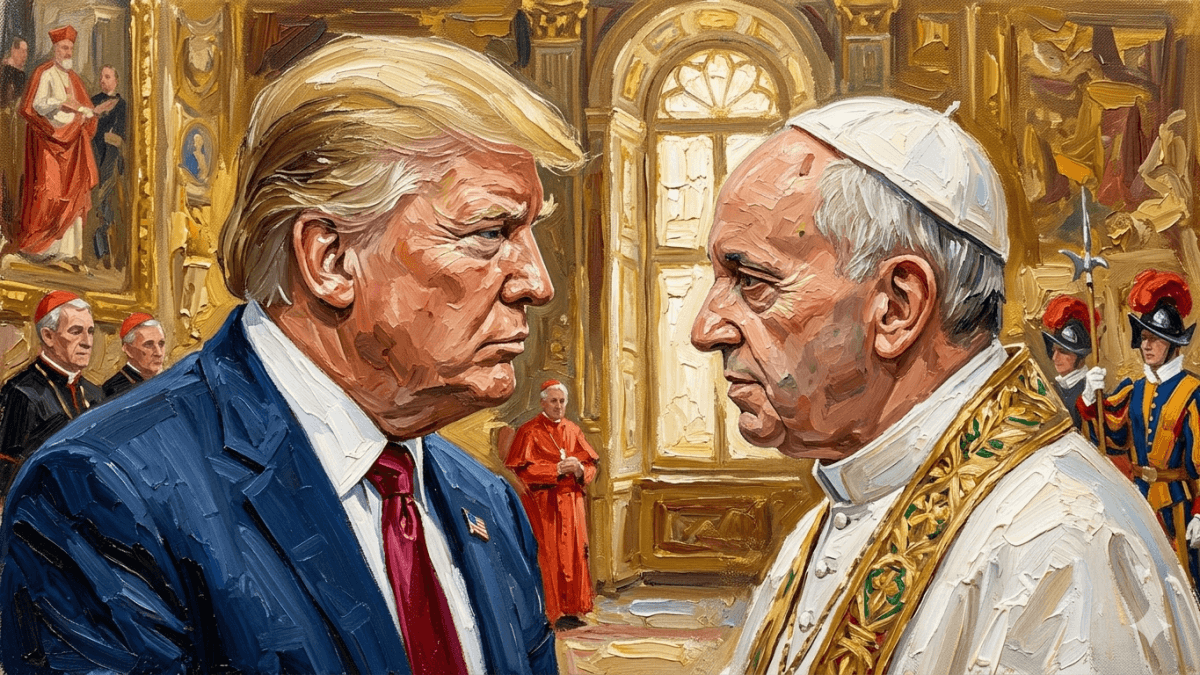
AI generated image: face to face of Doanld Trump and Pop Leo

Trump, Pope Leo XIV Clash Amid Political Allegations

President Donald Trump and Pope Leo XIV are engaged in a public dispute following the pontiff's criticism of U.S. military actions, while a financier recently alleged a coordinated effort to influence Catholic voters.
Jump to The Flipside Perspectives

A rare public dispute has erupted between President Donald Trump and Pope Leo XIV, the leader of the world’s 1.4 billion Catholics, intensified by the pontiff’s recent criticism of American military actions. The confrontation escalated further this week when a financier on live television presented a theory alleging political coordination against the President.

"I have no fear of the Trump administration, or speaking out loudly of the message of the gospel, which is what I believe I am here to do, what the Church is here to do." Pope Leo XIV, Head of the Catholic Church

The friction traces back to Pope Leo XIV’s public remarks regarding the American military offensive against Iran. While the pontiff did not directly name President Trump or Washington, his statements left little ambiguity about their target. President Donald Trump responded forcefully on Sunday, using his Truth Social platform to declare Pope Leo XIV "weak" and a "captive of the 'Radical Left'." President Trump also asserted that the Pope owed his entire papacy to Trump himself. "He wasn’t on any list to be Pope," President Trump wrote, "and was only put there by the Church because he was an American, and they thought that would be the best way to deal with President Donald J Trump." President Trump further claimed that without his presence in the White House, Pope Leo XIV would not be occupying the Vatican. He also noted his view on the Pope’s brother, Louis, describing him as "all MAGA" and adding, "He gets it, and Leo doesn’t."

Pope Leo XIV, responding from aboard a flight to Algeria, addressed the White House pressure directly. He told reporters traveling with him that he intends to continue speaking regardless of the administration's stance. "I have no fear of the Trump administration, or speaking out loudly of the message of the gospel, which is what I believe I am here to do, what the Church is here to do," the Pope stated. He also indicated a desire to avoid a personal debate with President Trump, adding, "Too many people are suffering in the world today. Too many innocent people are being killed. And I think someone has to stand up and say: there’s a better way to do this."

Adding another layer of complexity to the already strained relationship, three Catholic cardinals separately went public with criticism of U.S. immigration policy during the same period.

Amid this volatile atmosphere, Hal Lambert, chief of Point Bridge Capital and a vocal supporter of President Trump, appeared on CNN’s NewsNight with Abby Phillip on Monday. Lambert presented a theory that he alleged explained the Pope's actions, leading to a noticeable reaction from the panel. Lambert claimed that Pope Leo XIV, former President Barack Obama, and CNN chief political analyst David Axelrod—all of whom are Chicago natives—are coordinating efforts to sway Catholic voters away from President Trump and Republican candidates ahead of the upcoming midterm elections.

"This is 100 percent political, ok? This is all about trying to hurt President Trump’s Catholic vote during the midterms and Republicans in the midterms," Lambert told the CNN panel. He highlighted a reported visit Axelrod made to the Pope the previous week and mentioned ongoing conversations about former President Obama making his own visit to Pope Leo XIV. Lambert asserted, "All of a sudden, now, Pope Leo is out attacking Trump and the policies of the United States and Israel. You have three cardinals come out today, attacking the immigration policy. This is all about trying to get the Catholic vote against Trump."

CNN host Abby Phillip challenged Lambert's argument, stating it carried "a lot of flaws." Lambert immediately pushed back, declaring, "There’s no flaws." He questioned the Pope's claim of being non-political while meeting with Axelrod, who served as a chief strategist for both of Obama’s campaigns and in the White House. CNN commentator Bakari Sellers offered a simpler explanation, suggesting the Pope might be meeting with people from Chicago due to his own origins in the city. Phillip also reminded Lambert that one of the late Pope Francis’s very last meetings before his death in April 2025 was with Vice President JD Vance. Lambert countered by noting that Vance holds the office of Vice President of the United States.

This exchange highlighted the broader historical context of papal-White House relations. Pope Francis, who died in April 2025, had also drawn White House anger during President Trump’s previous term after calling Trump-era migrant deportations a "major crisis." At that time, border czar Tom Homan publicly told Francis to "stick to the Catholic Church." Critics had often labeled Pope Francis as anti-American, a label observers say does not typically apply to Pope Leo XIV, given his birth in the United States.

Historically, American presidents have navigated their interactions with papal figures cautiously, acknowledging the significant political weight held by Catholic voters. President Trump’s aggressive public posture toward Pope Leo XIV represents a sharp departure from this tradition, one with no clear modern precedent. For example, Pope John Paul II notably opposed the 2003 invasion of Iraq, yet no sitting American president at the time responded with personal public attacks against him. The ultimate impact of President Trump’s current stance on his base and on Catholic voters will be a key factor observed in the upcoming midterms.


Advertisement

The Flipside: Different Perspectives

Progressive View

From a progressive viewpoint, Pope Leo XIV's critique of the U.S. military offensive against Iran is seen as a moral imperative, consistent with the Catholic Church's long-standing advocacy for peace, social justice, and the protection of innocent lives. Progressives emphasize the Church's role in speaking truth to power and holding political leaders accountable for actions that could lead to widespread suffering or instability. The Pope's statement, "Too many people are suffering in the world today. Too many innocent people are being killed. And I think someone has to stand up and say: there’s a better way to do this," aligns with progressive values that prioritize diplomacy, humanitarian concerns, and a critical examination of military interventions.

The aggressive response from President Donald Trump, including personal attacks and claims about the Pope's legitimacy, is viewed by progressives as an attempt to silence dissenting voices and suppress moral critiques of government policy. They would argue that the Church has a legitimate role in commenting on issues of war, peace, and human rights, which transcend national borders and political ideologies. Furthermore, the theory proposed by Hal Lambert, suggesting a political conspiracy, is often dismissed by progressives as speculative and distracting from the substantive issues at hand. They would likely point to the historical precedent of religious leaders engaging with political figures across the spectrum, viewing such interactions as normal dialogue rather than clandestine coordination aimed at electoral interference.

Conservative View

From a conservative perspective, the public dispute between President Donald Trump and Pope Leo XIV raises important questions about national sovereignty and the appropriate role of religious leaders in geopolitical affairs. Conservatives often prioritize a strong national defense and the President's authority to conduct foreign policy to protect American interests. Pope Leo XIV's criticism of the U.S. military offensive against Iran, while framed in moral terms, can be seen as an intervention into sovereign policy decisions, potentially undermining the President's ability to act decisively.

The theory presented by Hal Lambert, alleging coordination between Pope Leo XIV, former President Barack Obama, and David Axelrod to influence Catholic voters, resonates with conservative concerns about political manipulation and the potential for external forces to interfere with domestic elections. For many conservatives, such an alleged effort would represent an inappropriate blurring of lines between religious authority and partisan politics, particularly if aimed at disadvantaging a sitting President. The focus remains on individual liberty and the right of citizens to make informed political choices without undue influence from powerful non-governmental actors. Conservatives would argue that while religious leaders have a right to free speech, their pronouncements should not be used as tools for partisan political ends, especially when it involves questioning the legitimate actions of a democratically elected government in defending its national security.

Common Ground

Despite the evident friction, areas of common ground may exist in the broader discussion between religious and political spheres. Both sides can acknowledge the importance of religious freedom and the right of individuals and institutions to express their beliefs publicly. While disagreements may arise over the scope of political commentary, the principle of free speech for religious leaders is widely accepted. There is also a shared interest in global stability and addressing humanitarian crises, even if the proposed methods differ. Dialogue between the White House and the Vatican, regardless of specific policy disagreements, can serve as a crucial channel for understanding and potentially finding common solutions to international challenges.

Both President Donald Trump's administration and the Catholic Church express concern for the well-being of their respective constituencies, whether defined as citizens or congregants. A constructive approach could involve open discussions on how to mitigate civilian casualties in conflicts, manage migration flows humanely, and foster international peace. While President Trump's strong stance reflects a commitment to national interests, and Pope Leo XIV's statements reflect a commitment to universal moral principles, finding practical ways to protect human life and promote stability, particularly in regions like the Middle East, could be a shared objective that transcends immediate political disputes.

What's your view on this story? Share your thoughts and remember to consider multiple perspectives and being respectful when forming and voicing your opinion. "If you resort to personal attacks, you have already lost the debate..."

Advertisement

Contact Us About This Article

Have a question or comment about this article? We'd love to hear from you.

About Fair Side News

At Fair Side News, we believe in presenting news with perspectives from both sides of the political spectrum. Our goal is to help readers understand different viewpoints and find common ground on important issues.