


Breaking
Sponsor Advertisement
President Trump Urges FISA Section 702 Extension Amid Deadline
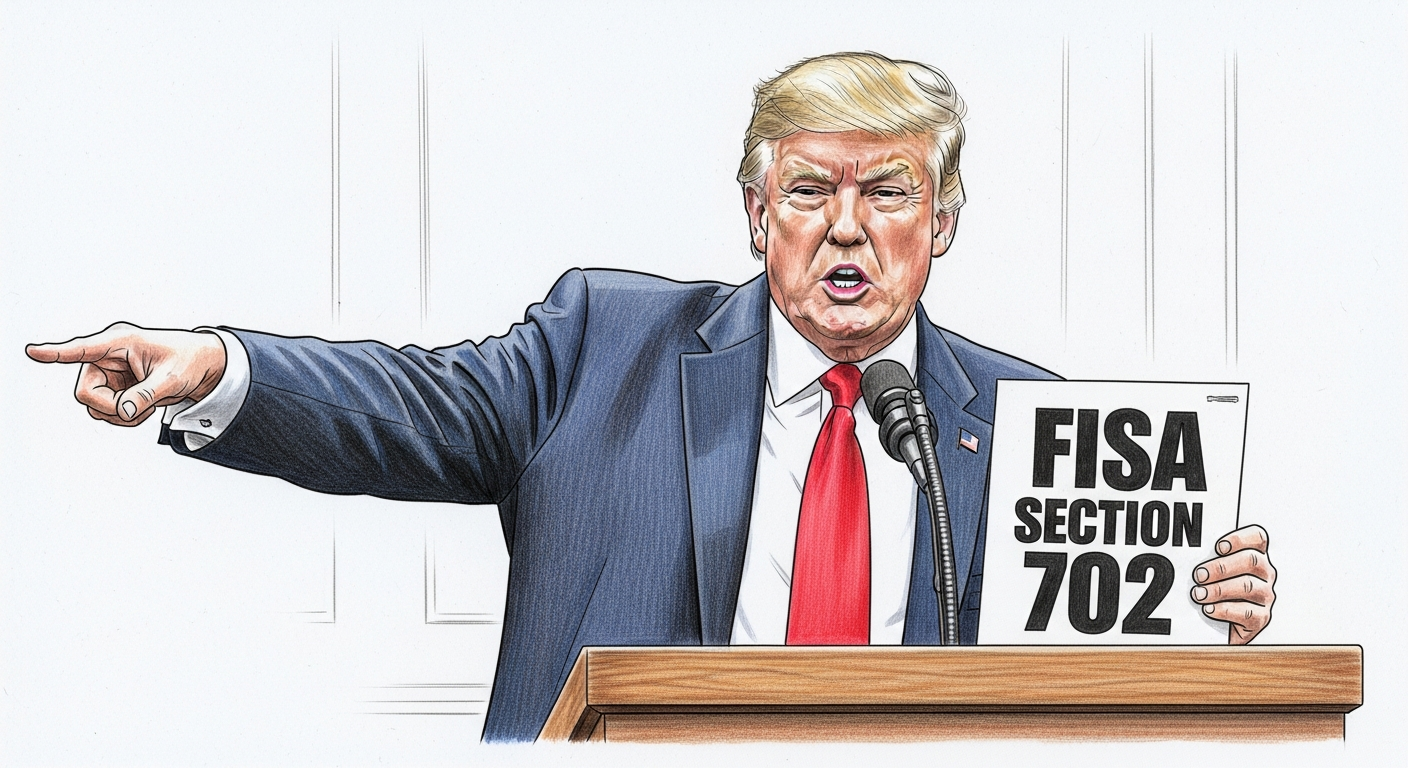
AI-generated image for: President Trump Urges FISA Section 702 Extension Amid Deadline

President Trump Urges FISA Section 702 Extension Amid Deadline

President Donald Trump has called on Republicans to unify and support an 18-month extension of Section 702 of the Foreign Intelligence Surveillance Act, reversing his previous stance against the authority.
Jump to The Flipside Perspectives

President Donald Trump urged Republican lawmakers on Tuesday to support an 18-month extension of Section 702 of the Foreign Intelligence Surveillance Act (FISA), signaling a significant shift in his position on the controversial surveillance authority. The call comes as Congress faces an April 20 deadline to reauthorize the measure, which is widely utilized by U.S. intelligence agencies for foreign intelligence collection. President Trump stated he has been collaborating with House Speaker Mike Johnson and other GOP members to secure a "clean extension" through the House this week.

"The fact is, whether you like FISA or not, it is extremely important to our Military." — President Donald Trump.

Section 702, originally enacted in 2008, authorizes the U.S. government to collect communications from foreign nationals located outside the United States, with the cooperation of electronic service providers. This authority allows intelligence collection without requiring an individualized warrant for each target, a distinction from traditional surveillance requests. Federal officials have consistently maintained that this tool is vital for tracking foreign adversaries, preventing terrorist attacks, and countering cyber threats.

However, the program has drawn substantial criticism over concerns regarding the privacy of American citizens. Intelligence agencies have acknowledged that communications involving U.S. persons can be "incidentally gathered" when those citizens communicate with foreign individuals who are legitimate targets of Section 702 surveillance. These incidentally collected communications are then stored in government databases.

A notable disclosure by the FBI revealed that between 2020 and 2021, agents conducted approximately 278,000 improper or "unintentional" database searches involving private communications of Americans collected under Section 702. These searches included checks related to individuals involved in the January 6 Capitol demonstrations, political campaign donors, and Black Lives Matter protesters. Such revelations have fueled bipartisan calls for reforms and intensified scrutiny of the program. Republican lawmakers, including Senators Josh Hawley of Missouri and Mike Lee of Utah, have been vocal critics of the surveillance program following these disclosures.

President Trump's current stance marks a departure from his previous position during the 2024 campaign cycle, when he had advocated for ending FISA authorities. In his Tuesday statement, President Trump explained his reasoning for the shift, distinguishing between Section 702 and FISA Title I, which governs domestic surveillance. He referenced his own experience, stating, "When the Dirty Cop, James Comey, the failed Head of the FBI, went after me, he was using FISA Title I, the Domestic Collection, not FISA 702, the Foreign Collection, which needs to be extended to." He was referring to surveillance tied to the FBI’s Crossfire Hurricane investigation into members of his 2016 campaign, during which the FBI obtained court approval to monitor former campaign adviser Carter Page under FISA Title I. The Department of Justice inspector general later identified "17 significant inaccuracies and omissions" in applications related to Page.

Despite his personal experience with alleged misuse of surveillance powers, President Trump emphasized the critical importance of Section 702 for national defense. He stated he understands the potential for misuse but is "willing to risk that as a Citizen in order to do what is right for our Country." He further asserted that military leaders consider Section 702 essential for national security, citing its role in battlefield success concerning Venezuela and Iran. "The fact is, whether you like FISA or not, it is extremely important to our Military," President Trump said. "I have spoken to many Generals about this, and they consider it VITAL."

The House Rules Committee advanced legislation providing for a clean 18-month extension of Section 702 on Tuesday, clearing the path for a floor vote ahead of the expiration deadline. However, even with President Trump's endorsement, passage is not assured. Reports indicate that several Republican lawmakers intend to vote against the extension, complicating efforts by Speaker Johnson and House leadership to secure the necessary votes. If Congress fails to act before April 20, Section 702 would lapse, effectively removing a key intelligence-gathering tool that U.S. agencies rely on for monitoring foreign adversaries. The debate highlights the ongoing tension between national security imperatives and civil liberties concerns in the realm of government surveillance.


Advertisement

The Flipside: Different Perspectives

Progressive View

Progressive viewpoints on Section 702 emphasize the critical importance of civil liberties and privacy, particularly in light of documented abuses. The revelation of 278,000 improper searches involving Americans, including those related to political activities like the January 6 demonstrations and Black Lives Matter protests, highlights a systemic problem of government overreach. Progressives argue that a "clean extension" of Section 702, without meaningful reforms, is unacceptable. They contend that the "incidental collection" of American data is not truly incidental when it leads to widespread searches without warrants, effectively turning a foreign intelligence tool into a domestic surveillance mechanism. President Trump's shift in stance, from opposing FISA to advocating for its extension, is viewed with skepticism, especially given his past claims of being a victim of surveillance abuse. Critics argue that this reversal prioritizes national security apparatus over the constitutional rights of citizens. The progressive stance calls for robust oversight, judicial review, and stricter safeguards to prevent the abuse of surveillance powers, ensuring that the government cannot infringe upon the privacy of Americans under the guise of foreign intelligence gathering. Without such reforms, a mere extension perpetuates a system prone to violating fundamental rights.

Conservative View

From a conservative perspective, President Trump's endorsement of Section 702's extension underscores the paramount importance of national security in a complex global landscape. The primary duty of the government is to protect its citizens from foreign threats, and intelligence tools like Section 702 are deemed indispensable for this purpose. While concerns about government overreach and privacy are legitimate, conservatives often prioritize the effective functioning of intelligence agencies to preempt terrorist attacks, counter espionage, and address cyber warfare originating from hostile foreign powers. The distinction President Trump draws between FISA Title I (domestic collection) and Section 702 (foreign collection) is crucial, suggesting that abuses associated with domestic surveillance do not negate the necessity of foreign intelligence gathering. Extending Section 702, even without immediate reforms, is viewed as a pragmatic decision to ensure continuity in vital intelligence operations. Delaying or allowing the authority to lapse would create a dangerous gap in national defense capabilities, potentially jeopardizing American lives and interests. This approach emphasizes that while individual liberties are fundamental, they must be balanced against the collective security of the nation, particularly when dealing with foreign adversaries who do not adhere to American constitutional protections.

Common Ground

Despite divergent views on the specifics of Section 702, there is common ground regarding the underlying principles. Both conservatives and progressives acknowledge the necessity of effective intelligence gathering to protect national security and safeguard the nation from foreign threats, whether from terrorism, espionage, or cyberattacks. There is also a shared concern about government overreach and the potential for surveillance tools to infringe upon the civil liberties and privacy rights of American citizens. The bipartisan criticism that emerged after disclosures of the FBI's improper database searches demonstrates a consensus that abuses of power are unacceptable and must be addressed. Future discussions could focus on implementing reforms that enhance transparency and oversight without compromising essential intelligence capabilities. Potential areas for agreement might include more stringent reporting requirements for U.S. person queries, improved judicial review mechanisms, and clearer guidelines for data retention and access. The shared goal is to strike a balance where national security is robustly defended while constitutional protections for individuals are scrupulously upheld.

What's your view on this story? Share your thoughts and remember to consider multiple perspectives and being respectful when forming and voicing your opinion. "If you resort to personal attacks, you have already lost the debate..."

Advertisement

Contact Us About This Article

Have a question or comment about this article? We'd love to hear from you.

About Fair Side News

At Fair Side News, we believe in presenting news with perspectives from both sides of the political spectrum. Our goal is to help readers understand different viewpoints and find common ground on important issues.