
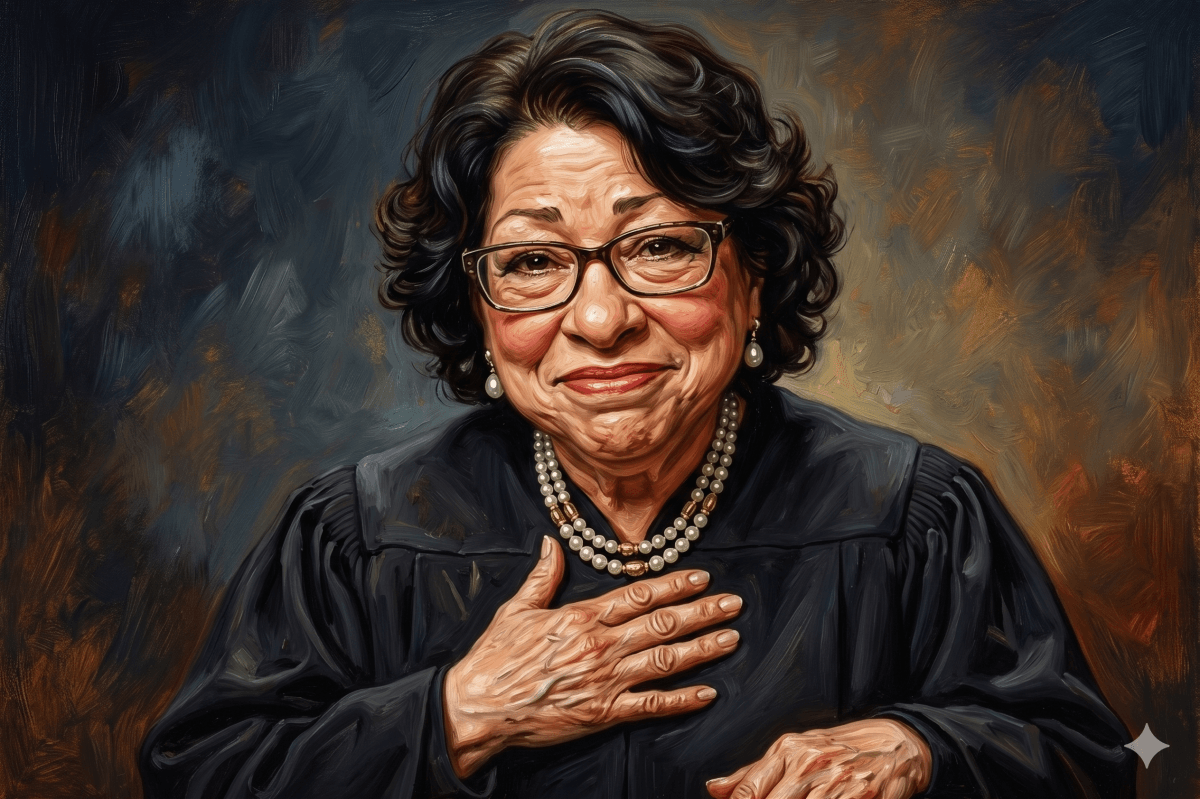
Supreme Court Justice Sonia Sotomayor issued a rare public apology on Wednesday for comments she made about fellow Justice Brett Kavanaugh, acknowledging her remarks were "inappropriate" and "hurtful." The unusual admission has brought renewed attention to the internal dynamics of the Supreme Court, where justices often maintain that professional disagreements do not extend to personal attacks.
"I regret my hurtful comments. I have apologized to my colleague." — Justice Sonia Sotomayor, Supreme Court
In a statement released through the court, Justice Sotomayor confirmed she had privately apologized to Justice Kavanaugh. "At a recent appearance… I made remarks that were inappropriate," she stated, as reported by Just the News. "I regret my hurtful comments. I have apologized to my colleague." This apology followed criticism from legal observers who contended that Sotomayor's public statements had crossed a line from judicial critique into personal territory.
The incident originated from comments Justice Sotomayor made at the University of Kansas School of Law, where she discussed Justice Kavanaugh's background while referencing a prior immigration case. She reportedly remarked on his parents being "professionals" and suggested that he likely lacked personal experience with Americans who work hourly jobs. These comments drew attention for appearing to question his understanding of working-class realities rather than solely addressing legal reasoning or judicial philosophy.
The underlying dispute traces back to a Supreme Court decision that allowed the Trump administration to proceed with expanded immigration enforcement efforts in Southern California. Justice Kavanaugh joined the majority opinion in the case, also writing a concurring opinion that emphasized specific limitations on how such enforcement should be carried out. In his concurrence, he clarified, "To be clear, apparent ethnicity alone cannot furnish reasonable suspicion," while also noting that ethnicity may be considered in conjunction with other relevant factors. He further stressed that these encounters are intended to be temporary and narrowly focused on determining immigration status.
Justice Sotomayor strongly dissented from the ruling, aligning with Justices Elena Kagan and Ketanji Brown Jackson. In her written dissent, she warned that the decision could potentially pave the way for sweeping enforcement practices, a concern also reported by ABC News. She wrote, "We should not have to live in a country where the Government can seize anyone who looks Latino, speaks Spanish, and appears to work a low-wage job," arguing that the ruling carried the risk of eroding established constitutional protections. Her dissent highlighted concerns about potential racial profiling and the impact on communities.
This episode has garnered additional attention due to the Supreme Court's long-standing tradition of fostering respect among its members, even amidst profound ideological divisions. Justice Clarence Thomas, speaking separately on the court's internal culture, reflected on its evolution. "I joined the court that dealt with differences as friends, as we respected each other… That’s civility," Justice Thomas said, adding that restoring such an environment might prove challenging in the current political climate. His remarks underscore a perceived shift in collegiality over time.
Justice Sotomayor herself has previously emphasized the importance of professionalism among the justices. In another recent public appearance, she noted that relationships on the court generally remain "civil," even if they are not always "friendly." Her recent apology, however, underscores how quickly public remarks can intensify scrutiny regarding decorum at the highest level of the judiciary. The incident prompts questions about the balance between expressing judicial disagreement and maintaining institutional respect.
The Supreme Court is scheduled to reconvene for its April session of oral arguments in the coming days. The apology and the preceding comments are likely to remain part of the broader conversation surrounding the court's internal dynamics, public perception, and the ongoing efforts to maintain institutional credibility amidst deeply divided legal and political landscapes. The incident highlights the delicate balance required of justices who serve as both legal interpreters and public figures.