
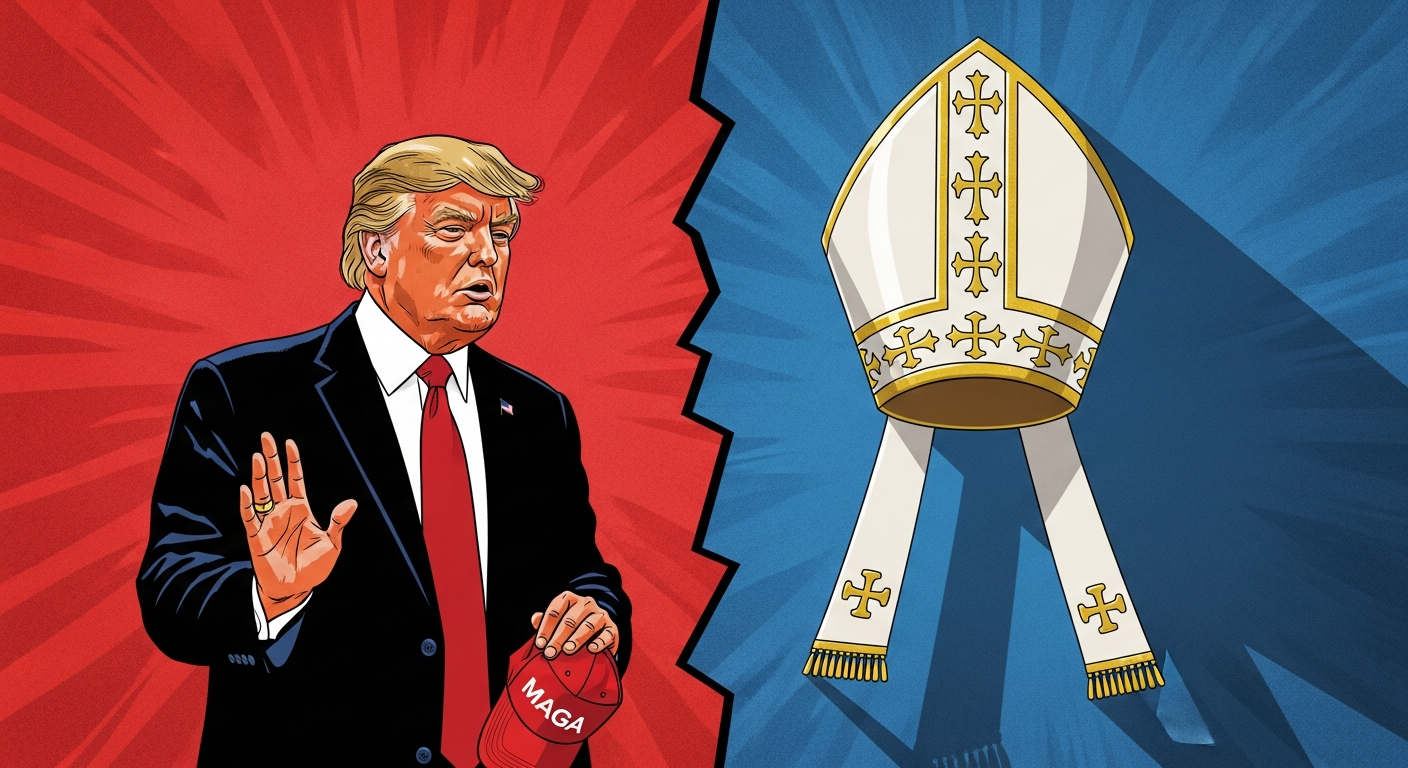
A recent public disagreement between President Donald Trump and Pope Leo XIV has highlighted a significant political divide in the United States, with new polling data indicating strong partisan alignment in public support for both figures. A Daily Mail/JL Partners poll, conducted from April 14-15 among 1,011 registered voters, revealed that Republican voters overwhelmingly back President Trump in the ongoing dispute, while Pope Leo XIV garners stronger national support.
The poll found that 67% of Republicans sided with President Trump in the dispute with Pope Leo. Among President Trump’s own voters, loyalty was even more pronounced, with 81% continuing to approve of the President. This contrasts with the national sentiment, where 41% of Americans supported Pope Leo XIV and 30% sided with President Trump, giving the Pope an 11-point advantage among the general electorate. The survey also indicated a sharp partisan split among Democrats, with 67% backing Pope Leo XIV and only 6% supporting President Trump. These figures suggest that while President Trump’s base remains steadfast, the broader electorate leans towards the religious leader.
The origins of the dispute trace back to Pope Leo XIV’s criticisms following the recent Iran crisis. The Pope condemned threats made during the crisis and denounced attacks on civilian infrastructure. Although he did not directly name President Trump in his comments, they were widely interpreted as a critique of the administration’s rhetoric and military stance. President Trump subsequently responded on Truth Social, attacking Pope Leo XIV. He accused Leo of being “WEAK on crime” and “terrible for Foreign Policy,” asserting that he did not want a pope criticizing him for implementing policies he was elected to carry out.
The disagreement intensified when President Trump posted an AI-generated image depicting himself in white robes with glowing hands, appearing to heal a patient. Many viewers interpreted this image as a comparison of himself to Jesus Christ. President Trump later deleted the post and denied that interpretation, stating the image was intended to portray him as a doctor helping people. Despite this explanation, the image drew significant criticism from a diverse group, including religious leaders, Catholics, independents, and some conservative voters.
The Daily Mail/JL Partners poll further explored public reaction to this image, finding that 49% of Americans considered it “deeply offensive.” Only a small minority viewed the image positively or as harmless humor. Notably, even President Trump’s supporters largely rejected any comparison between the President and Jesus. The poll revealed that 85% of Americans, including 83% of President Trump’s 2024 voters, stated that President Trump is not comparable to Jesus. This indicates a clear distinction drawn by many supporters between political loyalty and religious symbolism.
The survey also delved into the broader question of the role of religious leaders in political discourse. It found a near even split on whether religious leaders should criticize politicians: 49% of respondents believed religious leaders should avoid directly criticizing political figures, while 39% asserted they have a right or duty to speak out on moral and political issues. This division reflects an ongoing cultural debate within the United States concerning the intersection of faith and politics.
For President Trump, the poll results underscore the unwavering support of his political base, even amidst controversy involving a prominent religious figure. For Pope Leo XIV, the feud has rapidly increased his visibility and involvement in American political debates. What began as a series of criticisms regarding the Iran crisis and a controversial digital image has quickly evolved into a broader discussion about religious authority, political leadership, and the boundaries of public messaging. With neither President Trump nor Pope Leo XIV showing signs of retreating, the dispute is poised to continue influencing national headlines and political discourse.