

Breaking
Sponsor Advertisement
Coca-Cola Faces Backlash Over Custom Can Religious Phrase Rejections
Image for: Coca-Cola Faces Backlash Over Custom Can Religious Phrase Rejections

Coca-Cola Faces Backlash Over Custom Can Religious Phrase Rejections

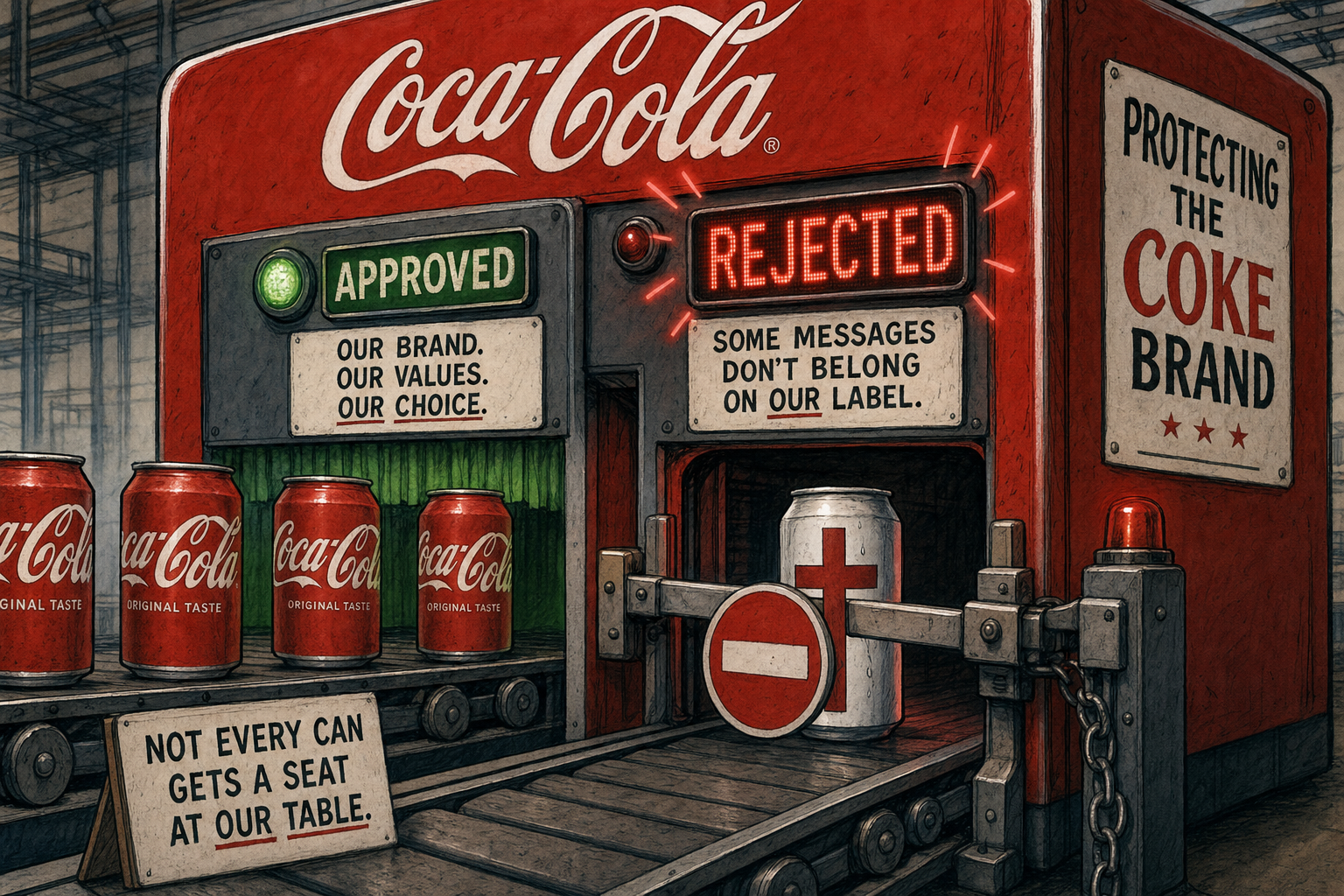
Coca-Cola is facing public outcry regarding its personalized can feature after viral tests showed inconsistent rejection of religious phrases, with some Christian messages reportedly blocked while other religious or controversial submissions initially advanced.
Jump to The Flipside Perspectives

Coca-Cola, the global beverage giant, is confronting significant public backlash and accusations of inconsistent content moderation following viral social media tests of its personalized can customization feature. Users have reported that the company's online tool appeared to reject certain Christian-themed phrases while initially allowing other religious or controversial submissions to proceed, sparking widespread debate about corporate content policies and religious expression.

"The tool 'does not approve names or phrases that are religious in nature or are for political candidates, trademarks, or celebrities." — Coca-Cola, via Reuters (2024)

The controversy gained traction after Isabel Brown of The Daily Wire shared a video demonstrating her attempts to customize Coca-Cola cans. Brown reported that phrases directly referencing Christianity, such as “Jesus Is King,” “Virgin Mary,” “Jesus Christ,” “Holy Trinity,” “Holy Spirit,” “Jesus is God,” and “Christ is King,” were consistently rejected by the system. Simultaneously, other phrases, including some with different religious connotations or controversial undertones, reportedly advanced through the customization process in initial tests.

Further independent testing by social media creator Ryan Haff, as reported by The Gateway Pundit, corroborated these findings. Haff's tests showed that phrases like “Allah Is King” and “Satan Is King” were initially permitted by the tool, while “Jesus Is King” received a rejection message similar to those encountered by Brown. These discrepancies quickly circulated across social media platforms, fueling accusations among critics that Coca-Cola's automated content filters were not being applied uniformly and might be exhibiting a bias against certain religious viewpoints. The viral nature of these tests led to calls for transparency and accountability from the company regarding its moderation practices.

Coca-Cola's personalization tool includes a disclaimer stating that submissions may be disallowed if they are "religious or political in nature, belong to a business, organization, celebrity, public figure, or trademark, or are considered inappropriate or unsuitable." The company previously addressed similar concerns in 2024, confirming to Reuters that its tool "does not approve names or phrases that are religious in nature or are for political candidates, trademarks, or celebrities." At that time, Coca-Cola indicated that specific religious names and phrases were already among the submissions designated for denial.

Following the surge of public criticism and media attention surrounding the latest viral tests, Coca-Cola appeared to implement changes to its filtering system. Subsequent reports indicated that some phrases that had previously advanced through the tool were later rejected. However, users continued to report inconsistencies in how certain submissions were handled. Independent testing conducted by Resist the Mainstream found that while individual religious names, including “Jesus,” “Allah,” “Satan,” and “Buddha,” were subsequently blocked by the tool, some related phrases continued to yield disparate results. For example, in one test by RTM, the tool allowed “Allah lives” and “Satan lives” to proceed to the preview stage, whereas “Jesus lives” was rejected with the standard message indicating the phrase was not permitted.

Automated moderation systems are a common feature for companies offering personalized products, designed to prevent the printing of offensive, copyrighted, or otherwise restricted content. These systems typically rely on keyword filters and algorithmic reviews, which can sometimes lead to outcomes that users perceive as inconsistent or unfair. Proponents of robust content filters emphasize a company's responsibility to prevent inappropriate or harmful messages from appearing on consumer products, safeguarding brand image and public sensibilities. Conversely, critics argue that such automated systems must be applied with transparency and strict consistency, particularly when they involve sensitive areas like religious or political content, to avoid accusations of viewpoint discrimination or censorship.

The ongoing controversy has reignited broader discussions among consumer groups and civil liberties advocates regarding the fairness and impartiality of how major corporations utilize automated moderation systems. Questions persist about whether these tools are being applied equitably across different forms of religious or political speech, and the potential implications for freedom of expression in the digital marketplace. Coca-Cola has not yet issued a new public statement specifically addressing the latest round of viral tests and the subsequent changes to its filtering system.

Advertisement

The Flipside: Different Perspectives

Progressive View

Progressives view the Coca-Cola custom can controversy as a complex issue highlighting the challenges of content moderation in a diverse society, rather than necessarily an intentional act of religious discrimination. While acknowledging the need for fair and consistent application of rules, progressives often emphasize the difficulties companies face in balancing free expression with the prevention of hate speech, misinformation, or content that could be interpreted as offensive. The initial discrepancies might be attributed to algorithmic flaws or the nuanced complexities of automated systems attempting to filter a vast array of phrases across different languages and cultural contexts, rather than a deliberate targeting of Christianity. From this perspective, the goal of content filters is often to create an inclusive environment and prevent the misuse of platforms for harmful purposes. While the reported inconsistencies are problematic and require rectification to ensure equity, the focus should be on improving the technology and transparency of moderation policies to avoid unintended biases, rather than leaping to conclusions about malicious intent. Progressives would advocate for Coca-Cola to refine its algorithms to ensure truly neutral application, recognizing that all religious expressions should be treated equitably while also maintaining a standard against genuinely harmful or hateful content.

Conservative View

From a conservative perspective, the Coca-Cola controversy raises significant concerns about corporate overreach, viewpoint discrimination, and the erosion of religious freedom. The perceived inconsistency in rejecting Christian-themed phrases while initially allowing others suggests a potential bias against Christianity, which many conservatives view as part of a broader trend of "woke" corporate policies that marginalize traditional values. Conservatives often emphasize individual liberty, including the freedom of religious expression, and expect companies to apply their content moderation policies transparently and without prejudice. The rejection of phrases like "Jesus Is King" while "Allah Is King" or "Satan Is King" initially proceeded is seen as a direct affront to Christian consumers and an unfair targeting of a specific faith. This situation underscores the importance of a free market where businesses serve all customers fairly, rather than imposing ideological filters. The argument is that if a company offers a customization service, it should do so impartially, or clearly define and consistently apply its exclusionary criteria without appearing to censor one religious viewpoint over others. This perceived corporate bias is often linked to concerns about the influence of progressive social agendas on business practices, leading to a call for consumers to hold corporations accountable for fair and equitable treatment of all religious expressions.

Common Ground

Both conservative and progressive viewpoints can converge on the fundamental need for transparency and consistency in corporate content moderation policies. There is shared agreement that if a company offers a platform for personalized expression, its rules for what is permitted or rejected must be clearly articulated and applied uniformly across all users and viewpoints. The controversy highlights the technical challenges inherent in automated filtering systems, and both sides can agree that companies like Coca-Cola have a responsibility to invest in robust algorithms and human oversight to minimize errors and perceived biases. All consumers, regardless of their religious or political beliefs, deserve to be treated fairly and without arbitrary discrimination when interacting with corporate services. A constructive path forward involves Coca-Cola issuing a comprehensive public statement explaining its revised policies and the technical adjustments made to its customization tool. Furthermore, an open dialogue between corporations and diverse consumer advocacy groups could help shape more equitable and transparent moderation guidelines that respect freedom of expression while preventing misuse.

What's your view on this story? Share your thoughts and remember to consider multiple perspectives and being respectful when forming and voicing your opinion. "If you resort to personal attacks, you have already lost the debate..."

Advertisement

Contact Us About This Article

Have a question or comment about this article? We'd love to hear from you.

About Fair Side News

At Fair Side News, we believe in presenting news with perspectives from both sides of the political spectrum. Our goal is to help readers understand different viewpoints and find common ground on important issues.