


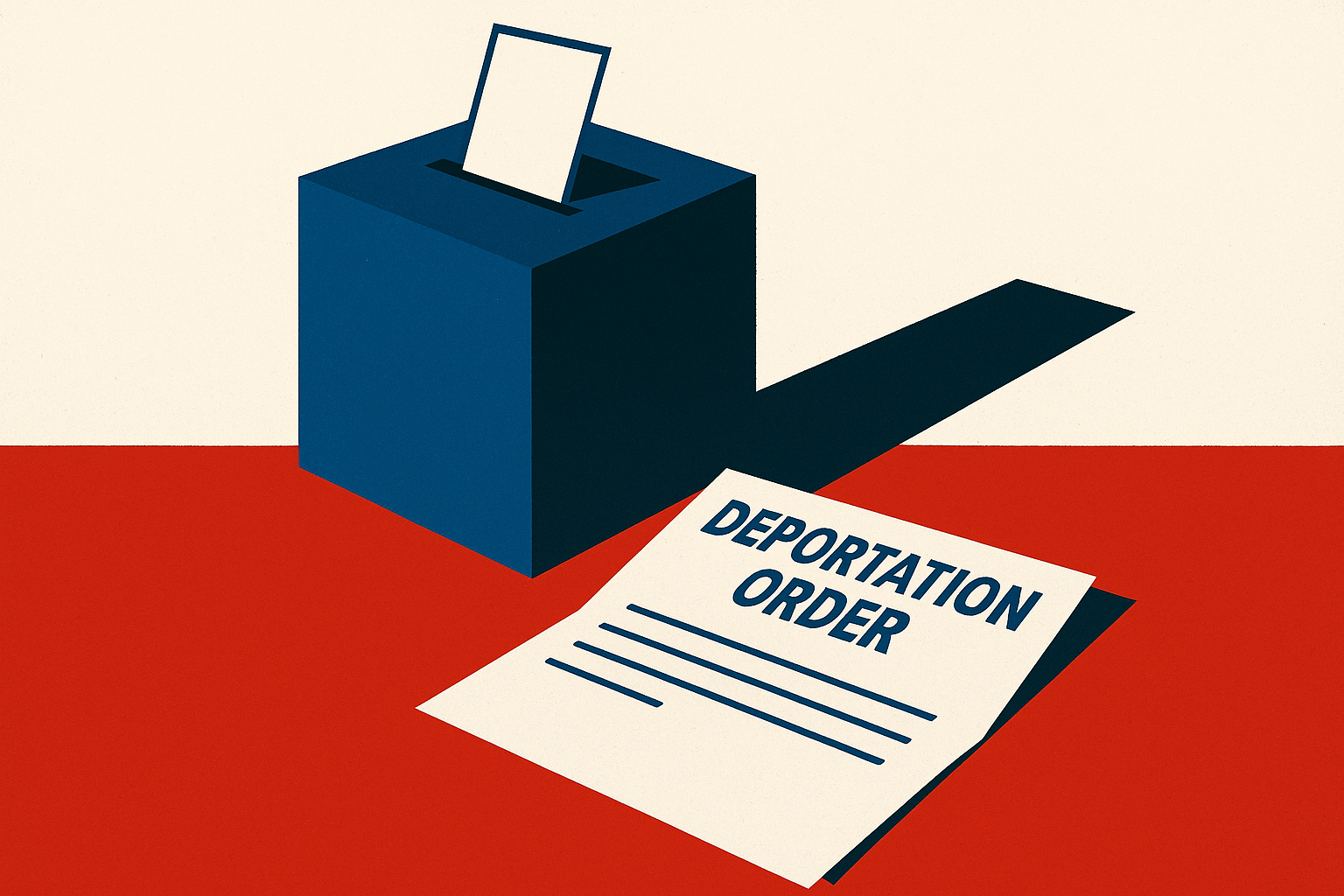
The Department of Homeland Security (DHS) has issued new guidance directing U.S. Immigration and Customs Enforcement (ICE) attorneys to prioritize removal proceedings against non-citizens suspected of illegally voting in U.S. elections. This directive represents an expansion of how existing immigration statutes related to election-related violations are enforced, aiming to standardize the application of federal immigration law in such cases. The policy allows for administrative removal proceedings to advance without requiring a criminal conviction, relying instead on administrative records and documentation.
"safeguarding election processes includes ensuring that participation is limited to eligible voters under federal law." — President Donald Trump, cited by DHS General Counsel James Percival.
Under the leadership of DHS Secretary Markwayne Mullin, the department has continued to implement new enforcement directives designed to strengthen the application of immigration law. The latest guidance, issued by DHS General Counsel James Percival, specifically instructs ICE attorneys to initiate administrative removal proceedings when credible evidence of alleged illegal voting or false claims of U.S. citizenship is available. This evidence can include voter registration files, state election data, and other related documentation compiled through federal review processes.
The legal foundation for this expanded enforcement rests on provisions within the Immigration and Nationality Act. This act classifies unlawful voting and false claims of U.S. citizenship as deportable offenses. DHS officials emphasize that these statutes apply irrespective of whether an individual has been convicted in a criminal court. Consequently, immigration authorities are now empowered to pursue removal based on evidentiary findings within administrative proceedings, rather than being contingent on a criminal prosecution. Officials have characterized this directive as part of a broader effort to enhance enforcement consistency in cases involving violations related to elections.
DHS General Counsel James Percival articulated that the policy reflects the administration's stance that violations of voting law by non-citizens undermine confidence in electoral systems and should, therefore, carry immigration consequences when substantiated by available evidence. Percival cited President Donald Trump, emphasizing that "safeguarding election processes includes ensuring that participation is limited to eligible voters under federal law."
The implementation of this directive is coordinated with Executive Order 14248, which President Donald Trump signed on March 25. This executive order mandates federal agencies to broaden the verification of voter eligibility, enhance coordination between immigration and election-related databases, and strengthen the enforcement of statutes pertaining to non-citizen voting. Furthermore, it calls for increased interagency cooperation to more efficiently identify and investigate potential violations.
Under this new framework, ICE's Office of the Principal Legal Advisor will collaborate with immigration judges to process cases with credible evidence of illegal voting. The goal is to utilize expedited removal proceedings where appropriate, reducing procedural delays. Officials indicate that the objective is to allow cases supported by documentation to move more swiftly through the immigration system once identified, according to The Epoch Times.
Supporters of the policy contend that it reinforces deterrence by ensuring that violations linked to voting eligibility result in clear immigration consequences. They argue that even limited instances of non-citizen voting can erode public confidence in election systems and thus warrant more proactive federal enforcement when evidence is available.
Conversely, critics, including various immigration advocacy groups, express concerns that relying on administrative evidence rather than criminal convictions could significantly broaden the scope of enforcement. They warn that this approach might lead to an increase in the number of individuals subjected to removal proceedings. Additionally, these critics caution that immigration courts, which are already grappling with substantial backlogs, may experience further strain if the volume of cases rises under the new directive, as reported by The Kenya Times.
Federal law has long prohibited non-citizens from voting in federal elections, and the majority of states maintain similar restrictions for state and local races. However, enforcement of these prohibitions has historically been inconsistent, often depending on isolated investigations or referrals rather than systematic immigration consequences directly tied to voting-related violations. DHS asserts that the updated guidance is designed to standardize enforcement practices across jurisdictions. The department aims to ensure that immigration violations involving unlawful voting are treated as a consistent enforcement priority when supported by available evidence. Officials clarify that the policy applies broadly across various immigration categories, including individuals with expired visas, pending asylum claims, or unlawful status, focusing on the enforcement of existing law rather than the creation of new legal standards. Social media commentary highlighted the expedited deportation aspect, with one post stating, "The Trump DHS has just EXPEDITED the DEPORTATION of any foreign citizen who illegally votes in US elections."

