


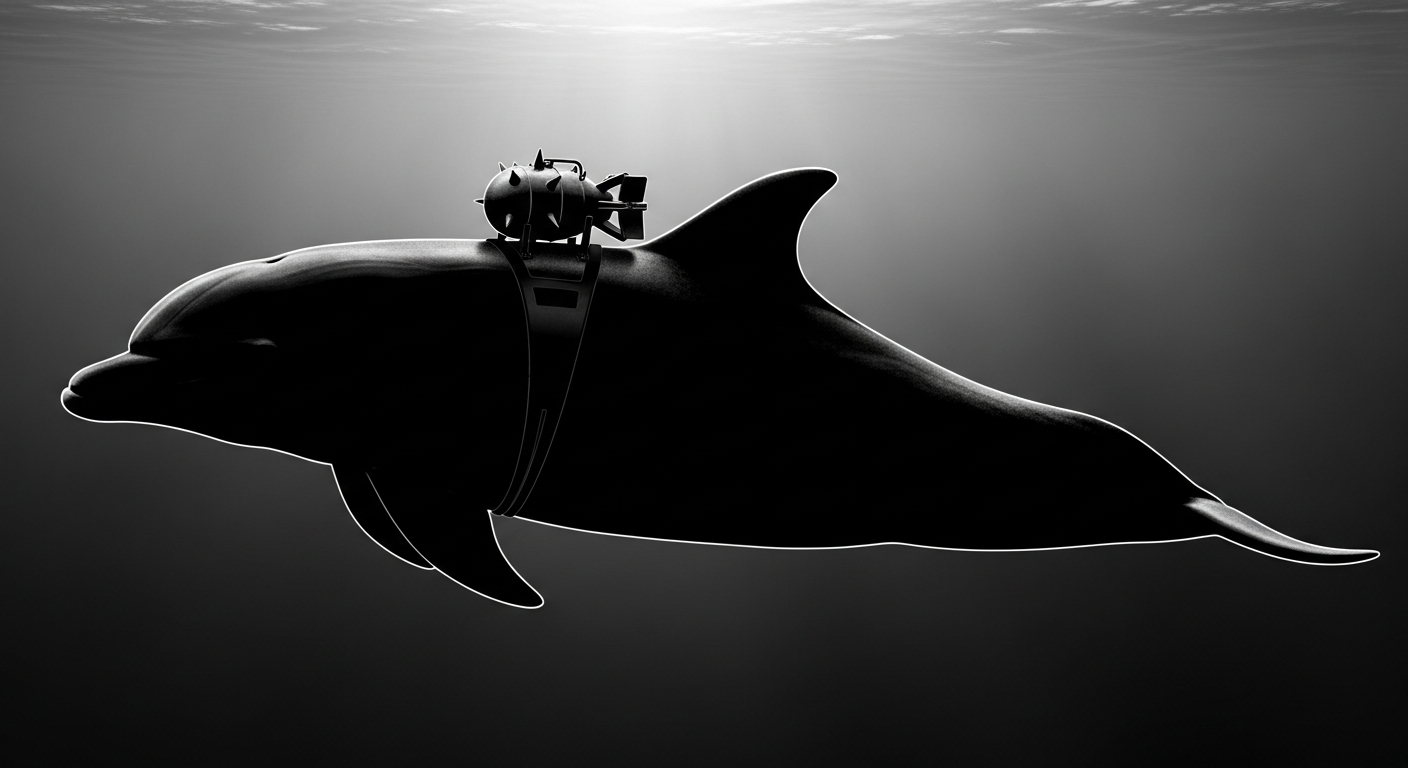
Tehran is reportedly exploring a range of unconventional military options, including the potential deployment of combat dolphins trained to carry mines, as it faces a sustained U.S. military blockade on its oil exports through the Strait of Hormuz. This revelation, citing Iranian officials by the Wall Street Journal, emerges amid heightened tensions in the Persian Gulf, where a technical ceasefire between Washington and Tehran is increasingly strained by economic pressures on the Islamic Republic.
The United States has enforced a weeks-long blockade, effectively sealing off Iran’s crucial oil exports through the Strait of Hormuz. This vital chokepoint, through which a substantial portion of the world's oil transits, has seen its closure send significant economic shockwaves through Iran. Domestically, a powerful bloc of hardline military and political figures within Iran has concluded that the export ban constitutes an act of war, despite the existing ceasefire. These factions are reportedly pressuring Iran’s leadership to respond with force, potentially utilizing weapons that have not been previously deployed in conflict.
Among the options reportedly under consideration is a program involving marine mammals, specifically combat dolphins. Iran acquired these animals from the former Soviet navy in 2000, a transfer first reported by the BBC. The Soviet Union had invested years in conditioning these marine mammals for military operations. The dolphins obtained by Iran were trained for two distinct "kill missions": one involved carrying harpoons strapped to their backs for targeting human divers, while the second was a suicide strike, where the dolphin, equipped with a mine, would ram an enemy vessel and detonate on impact. It is this second, kamikaze-style capability that Iranian officials are reportedly re-evaluating as a potential tool against U.S. Navy ships stationed in the region.
The combat dolphins are not the only unconventional card Iran is reportedly weighing. The Wall Street Journal also detailed that Tehran is considering submarine deployments into the Strait of Hormuz, a move that would significantly heighten the stakes in any confrontation with American forces. Furthermore, the Islamic Revolutionary Guard Corps (IRGC) has issued threats to sever undersea communication cables that run beneath the Strait. Such an action would not merely inconvenience adversaries but could disrupt global internet infrastructure, signaling a broader intent to inflict economic and strategic damage beyond immediate military targets.
On the geopolitical front, Iran’s attempts to leverage the economic impact of the blockade have met resistance. Several Gulf nations have aligned with the United States, effectively undermining Tehran’s earlier strategy to impose transit tolls on shipping navigating the waterway. This alignment further isolates Iran and intensifies the economic squeeze exerted by the blockade.
The Trump administration, for its part, has shown no indications of softening its position. President Trump has publicly lauded the blockade's efficacy and has instructed aides to prepare for an extended enforcement campaign. He has framed the economic stranglehold as a necessary prerequisite and the price Iran must pay before any return to the negotiating table can be considered. This firm stance underscores Washington's commitment to its current strategy of maximum pressure.
Internally, Iran's political landscape has seen a significant shift. The Islamic Revolutionary Guard Corps has reportedly tightened its grip, marginalizing more moderate factions within the country's power structure. Analysts suggest this internal shift has accelerated Iran's trajectory towards confrontation rather than compromise. Hamidreza Azizi, a visiting fellow at SWP, a Berlin-based research institute focused on the Middle East, offered a stark assessment of the current Iranian mindset to the Wall Street Journal. Azizi stated, “The blockade is increasingly viewed in Tehran not as a substitute for war, but as a different manifestation of it. As a result, Iranian decision makers may soon come to see renewed conflict as less costly than continuing to endure a prolonged blockade.” This analysis highlights a critical re-evaluation within Iran, where the calculus of enduring economic hardship is being weighed against the costs of a potential military response.
The Strait of Hormuz, approximately 21 miles wide at its narrowest point, is a critical artery for global commerce. A military exchange in this area, whether conventional or unconventional, would carry profound consequences far beyond the Persian Gulf, impacting global energy markets and international shipping. While the specific deployment of these measures remains unconfirmed, the discussion of options such as submarines, severed communication cables, and Cold War-era "suicide dolphins" indicates a regime that perceives itself as already engaged in a conflict, regardless of formal ceasefire agreements. The contemplation of such measures has drawn attention globally, with CNN reporting, "Iran is contemplating suicide dolphins, dolphins equipped with mines to try to go after U.S. ships. That's not a that's not a measure which projects real strength." This sentiment reflects a broader international concern about the nature of these potential responses and their implications for regional stability.

