


Breaking
Sponsor Advertisement
Trump Considers Germany Troop Reduction Amid Alliance Strain
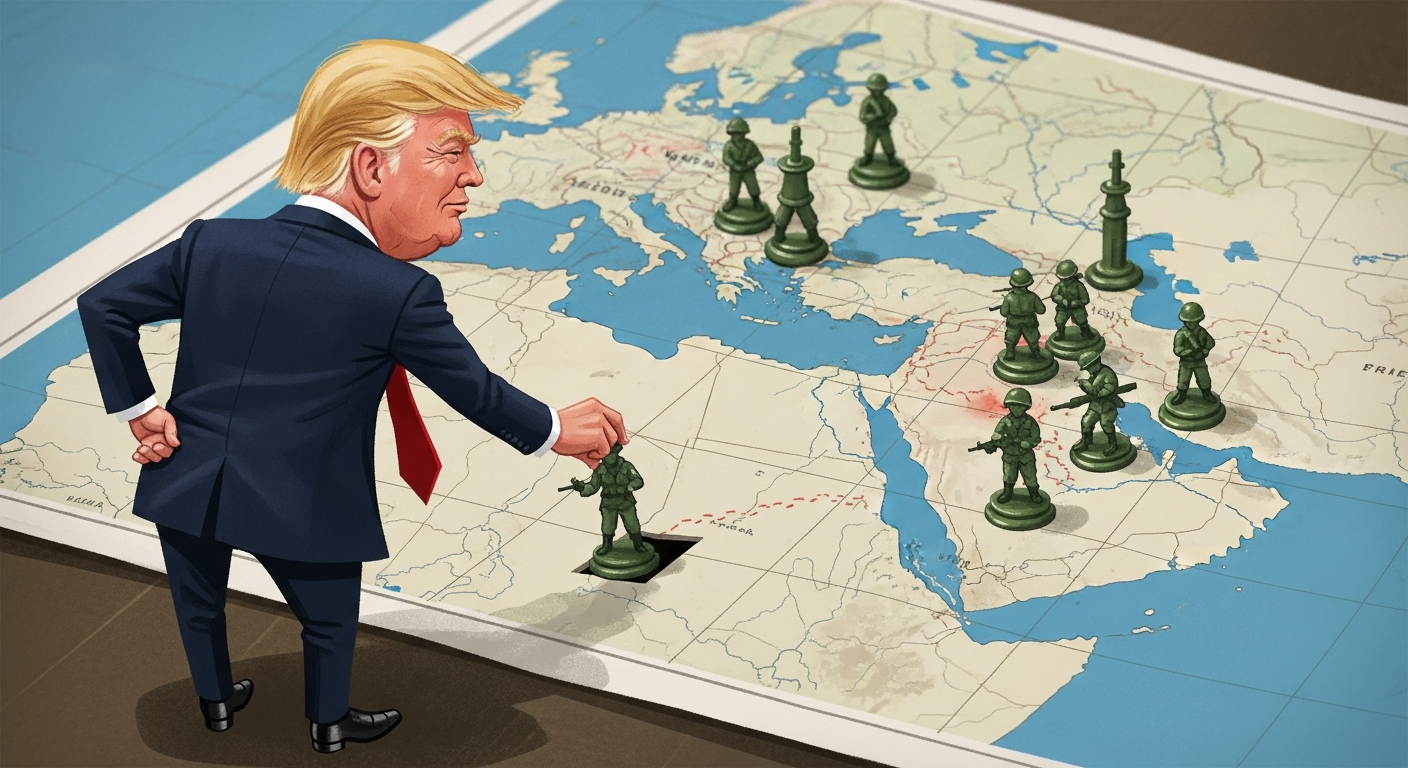
AI-generated image for: Trump Considers Germany Troop Reduction Amid Alliance Strain

Trump Considers Germany Troop Reduction Amid Alliance Strain

President Donald Trump announced Wednesday that the United States is reviewing a possible reduction of American military forces in Germany. This consideration follows a public disagreement between President Trump and German Chancellor Friedrich Merz regarding Iran and defense spending.
Jump to The Flipside Perspectives

President Donald Trump announced on Wednesday that the United States is actively studying and reviewing a potential reduction of American military forces stationed in Germany, a move that could significantly alter the long-standing U.S.-Germany alliance. The announcement, made by President Trump on his Truth Social account, stated that a determination would be made "over the next short period of time," without specifying a timeline or potential troop numbers for the cut.

"The Chancellor of Germany, Friedrich Merz, thinks it’s OK for Iran to have a Nuclear Weapon. He doesn’t know what he’s talking about! If Iran had a Nuclear Weapon, the whole World would be held hostage." — President Donald Trump, Truth Social Post

This declaration follows a period of escalating public tension between President Trump and German Chancellor Friedrich Merz, particularly concerning Iran's nuclear ambitions and Germany's contributions to collective defense. Earlier this week, a blistering public exchange unfolded between the two leaders, highlighting deep divisions on critical foreign policy and security matters.

On Tuesday, President Trump directly criticized Chancellor Merz in a Truth Social post, accusing him of holding a dangerous stance on a volatile security threat. "The Chancellor of Germany, Friedrich Merz, thinks it’s OK for Iran to have a Nuclear Weapon," President Trump wrote. He continued, "He doesn’t know what he’s talking about! If Iran had a Nuclear Weapon, the whole World would be held hostage." President Trump then linked Germany's foreign policy position to its economic performance, adding, "I am doing something with Iran, right now, that other Nations, or Presidents, should have done long ago. No wonder Germany is doing so poorly, both Economically, and otherwise!"

President Trump's comments appeared to be a response to a speech delivered by Chancellor Merz on Monday in Marsberg, Germany. During his address, Merz told students that the United States was being "humiliated by the Iranian leadership" and expressed his hope that the ongoing conflict would end "as quickly as possible." Despite the sharp rhetoric, Chancellor Merz attempted to downplay the severity of the bilateral damage on Wednesday, telling reporters, "From my perspective, my personal relationship with the U.S. President remains good. I simply had doubts from the start about what was begun with the war in Iran. That is why I have made that clear."

The current tensions are not isolated, as President Trump and Chancellor Merz have a documented history of disagreements stretching across both of President Trump’s presidential terms. Disputes over trade tariffs and defense spending, particularly Germany's adherence to NATO's target of spending 2% of its GDP on defense, have repeatedly put Washington and Berlin at odds. The recent conflict in Iran added new fuel to these long-simmering issues earlier this month when Merz publicly stated his belief that NATO should not become involved in the war, a position directly contrasting President Trump's push for allied nations to help secure the Strait of Hormuz.

The potential reduction of U.S. troops in Germany carries significant implications given the current force posture. As of December 2025, more than 36,000 active-duty American service members were stationed in Germany, according to the Defense Manpower Data Center. This figure represents the largest U.S. military presence in any single European country and accounts for the largest share of the approximately 68,000 American troops permanently assigned to bases across Europe at that time.

While substantial, the current U.S. military footprint in Germany is considerably smaller than its Cold War peak. In 1985, at the height of Cold War tensions, approximately 250,000 American troops were based in Germany. Subsequent drawdowns followed the fall of the Berlin Wall and the dissolution of the Soviet Union. During President Trump's first term in office, he pursued plans to remove 12,000 troops from Germany, a proposal that was later halted under the Biden administration.

The Pentagon referred questions regarding President Trump's latest announcement to the White House, which offered no immediate comment. The consideration of a troop drawdown underscores the ongoing strains within the transatlantic alliance and signals a potential shift in the U.S. military's strategic posture in Europe, amidst evolving global security challenges and persistent disagreements between key allies.


Advertisement

The Flipside: Different Perspectives

Progressive View

Progressives view the potential U.S. troop drawdown from Germany with concern, emphasizing the importance of strong alliances, multilateralism, and global stability. From this perspective, the presence of U.S. troops in Germany is a cornerstone of European security, a deterrent against aggression, and a symbol of transatlantic solidarity that has fostered decades of peace and cooperation. Unilateral decisions to reduce forces, especially amid public disputes, risk destabilizing established partnerships and potentially emboldening adversarial nations. Progressives advocate for diplomacy and international collaboration to address complex issues like Iran's nuclear program, rather than through confrontational rhetoric that strains allied relationships. They argue that a withdrawal could undermine collective security frameworks like NATO, weaken the ability to respond to shared threats, and create a vacuum that could exacerbate geopolitical instability. The focus is on the collective well-being and the systemic implications of such a move, highlighting how interconnected global security requires sustained engagement and mutual respect among allies, rather than transactional approaches.

Conservative View

From a conservative perspective, the consideration of drawing down U.S. troops from Germany aligns with principles of national sovereignty, fiscal responsibility, and strategic re-evaluation of alliances. President Trump's "America First" policy prioritizes U.S. national interests, suggesting that military deployments should primarily serve direct American security needs and not be taken for granted by allies. Conservatives often argue that nations like Germany, a prosperous economy, should bear a greater share of the burden for their own defense and contribute more meaningfully to collective security, particularly by meeting NATO's 2% defense spending target. The ongoing disagreements over defense spending and Germany's stance on Iran's nuclear program illustrate a perceived lack of alignment with U.S. strategic priorities. A troop reduction can be viewed as a necessary step to rebalance alliances, encourage greater self-reliance among allies, and ensure American resources are deployed most effectively against pressing threats, rather than subsidizing the defense of wealthy nations that do not fully reciprocate. This approach emphasizes individual liberty through national self-determination and limited government intervention abroad where allies are capable of contributing more.

Common Ground

Despite their differing approaches, both conservative and progressive viewpoints share common ground on the importance of a secure and stable Europe, as well as the need for effective burden-sharing within alliances. There is a bipartisan consensus that allies should contribute adequately to their own defense, even if the methods to achieve this differ. Both sides generally agree on the critical goal of preventing nuclear proliferation, particularly in the case of Iran, acknowledging its potential to destabilize global security. Furthermore, there is a shared understanding of the necessity for strategic reviews of military deployments to ensure they remain relevant and effective in addressing evolving global threats. Both conservatives and progressives can agree on the importance of maintaining open channels of communication and diplomacy to manage disagreements between allied nations, striving for resolutions that uphold mutual security interests while respecting national sovereignty.

What's your view on this story? Share your thoughts and remember to consider multiple perspectives and being respectful when forming and voicing your opinion. "If you resort to personal attacks, you have already lost the debate..."

Advertisement

Contact Us About This Article

Have a question or comment about this article? We'd love to hear from you.

About Fair Side News

At Fair Side News, we believe in presenting news with perspectives from both sides of the political spectrum. Our goal is to help readers understand different viewpoints and find common ground on important issues.