


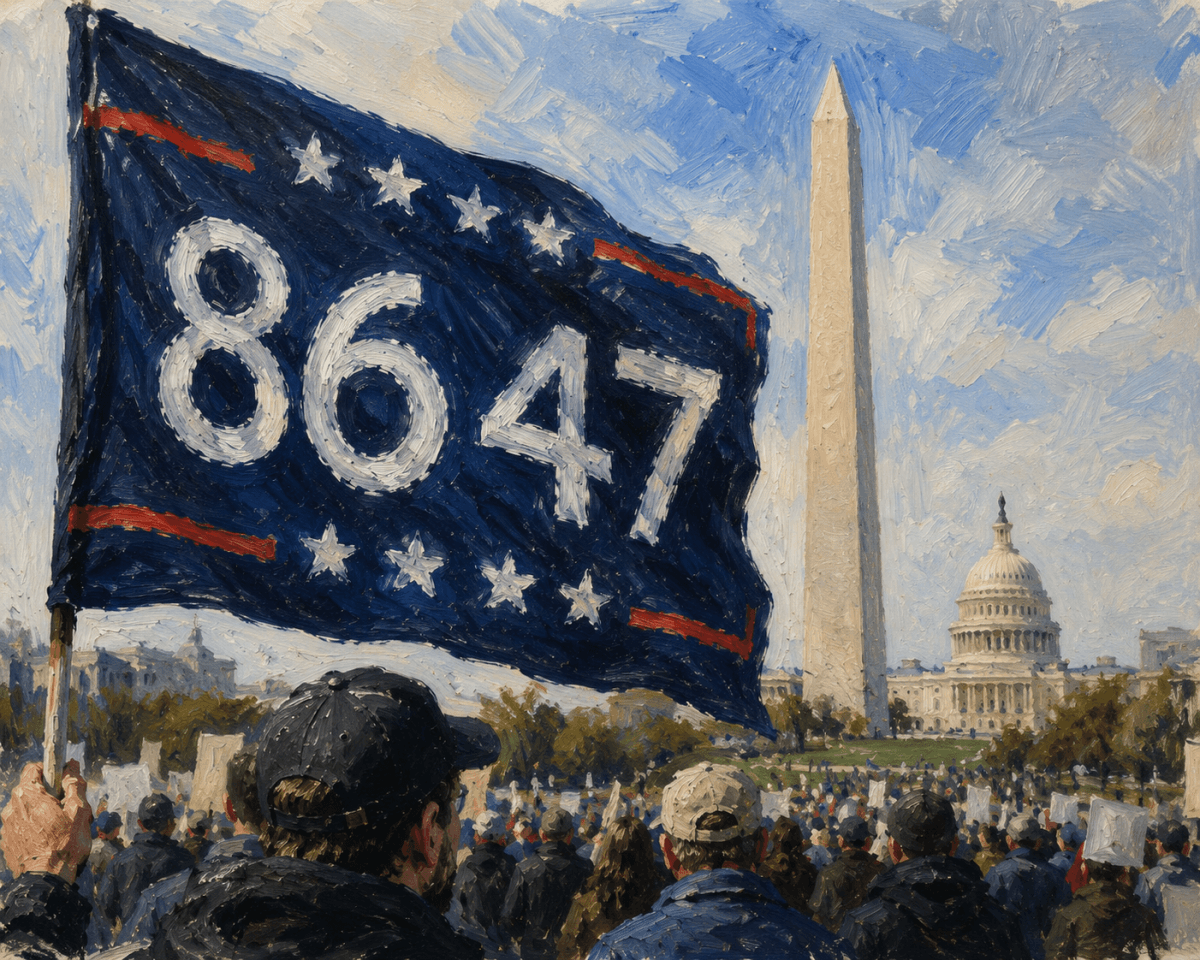
WASHINGTON, D.C. – A federal judge has temporarily barred federal authorities from preventing a progressive advocacy group, Accountability Now USA, from displaying an "86 47" flag near the National Mall. The ruling, issued by U.S. District Judge Randolph Moss, an Obama appointee, determined that the expression constitutes protected political speech under the First Amendment and does not rise to the level of a threat against President Donald Trump.
The decision marks a temporary setback for the Department of Justice (DOJ), which had argued that the slogan could be interpreted as threatening, particularly in the current political climate. Accountability Now USA, a left-leaning activist group, has been conducting demonstrations outside a federal courthouse in Washington, D.C., frequently featuring signage with the phrase "86 47." This slogan has garnered national attention, fueling broader discussions regarding political rhetoric, free speech boundaries, and the acceptable limits of protest messaging.
Judge Moss issued a two-week temporary restraining order, preventing the National Park Service from revoking the group's permit due to the display. In his written opinion, the judge rejected the government’s assertion that the phrase amounted to an unlawful threat. He underscored that constitutional protections extend even to provocative or unpopular political expression. While acknowledging legitimate concerns about political violence, Judge Moss concluded that context is crucial in determining whether speech crosses the legal threshold into a "true threat." He further wrote that, in this specific case, the message more reasonably reflected advocacy for President Trump’s removal from office rather than any intention to incite harm.
A central point of contention in the case revolved around the interpretation of the term "86." Government attorneys contended that recent political tensions had imbued the term with a more dangerous connotation, citing heightened security concerns surrounding public officials. However, the court countered this argument by noting that "86" has a long-standing history in American slang, commonly meaning "to remove" or "to get rid of," and lacks a singular, fixed violent interpretation. Moss referenced historical dictionary definitions, illustrating that the term dates back decades and has been utilized in everyday language in non-violent contexts. He explicitly rejected the argument that recent incidents of political violence should automatically redefine the meaning of established expressions when evaluating protected speech under the Constitution.
The Department of Justice, in presenting its case, cited various recent security incidents and argued that ambiguous political slogans could be perceived as encouraging violence against elected officials. According to reports from Newsmax, officials pointed to the broader threat environment surrounding public figures as justification for restricting the display. Court filings further indicated that Secret Service agents interviewed participants in the demonstration. Those interviewed stated their support for removing President Trump from office but unequivocally denied any intent to promote or encourage violence. One participant, according to ABC News, informed investigators that they viewed the message strictly in political terms and expressed support for impeachment rather than physical harm.
Ultimately, the court determined that the government had not satisfied the stringent constitutional threshold required to restrict political expression based solely on perceived meaning. This ruling reinforces longstanding First Amendment protections that shield even controversial or provocative speech from government suppression, unless it clearly constitutes a direct and credible threat. The temporary restraining order is slated to remain in effect for two weeks as litigation in the case proceeds. This legal development contributes to an ongoing national debate over where courts should delineate the line between protected political speech and unlawful threats in an increasingly polarized political landscape.

