

Breaking
Sponsor Advertisement
President Trump Criticizes Obama Center with Altered Image
Image for: President Trump Criticizes Obama Center with Altered Image

President Trump Criticizes Obama Center with Altered Image

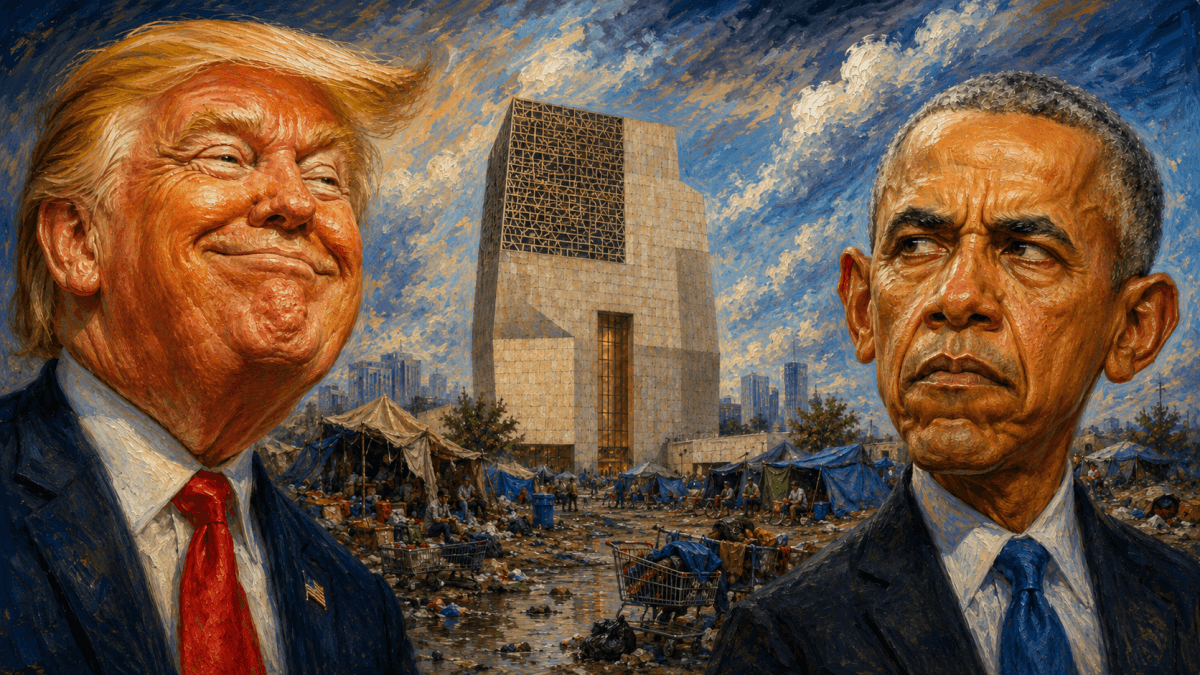
President Donald Trump shared a digitally altered image of the Obama Presidential Center on social media, depicting it surrounded by homeless encampments and trash. The post comes ahead of the center's June 19 opening and marks President Trump's latest criticism of the Chicago project.
Jump to The Flipside Perspectives

President Donald Trump posted an altered image on social media Saturday, criticizing the Obama Presidential Center by depicting the Chicago landmark surrounded by homeless encampments and trash. The digitally generated image, shared on Truth Social, included text that read, "The Barack Hussein Obama Library, in 10 years, when fully matured!" This social media post precedes the scheduled June 19 opening of the Obama Presidential Center on Chicago’s South Side and highlights ongoing political tensions between President Trump and former President Barack Obama.

"Obama repeatedly urged the design team to think bigger and create a structure that would stand as both a civic space and a work of art." — Tod Williams, Architect.

The Obama Presidential Center, located in Jackson Park, is poised to become the headquarters of the Obama Foundation. It is designed to include a museum, a library branch, educational facilities, and spaces for community programming. The project's development has spanned years, overcoming planning complexities and legal challenges related to its placement within the historic park.

Former President Obama was reportedly deeply involved in shaping the center's design, consistently urging architects to adopt a more ambitious vision than initially conceived. Architect Tod Williams, speaking to The New Yorker, stated that Mr. Obama "repeatedly urged the design team to think bigger and create a structure that would stand as both a civic space and a work of art." Williams further noted that Mr. Obama "challenged architects to be bolder during planning sessions, sometimes making changes directly to design concepts." The resulting design features a prominent 225-foot granite-clad tower, which has become a recognizable element of the center.

The architectural design and scale of the center have elicited mixed reactions. Supporters view the project as a modern civic landmark intended to inspire public participation and community engagement. Conversely, critics have raised questions about its appearance and sheer size, with some arguing that it does not harmoniously integrate into Jackson Park’s historic landscape.


Financial aspects of the project have also drawn scrutiny. Initial cost estimates for construction were around $300 million, but more recent figures indicate an overall cost of approximately $850 million. This increase reflects expanded programming, rising construction expenses, and additional design elements incorporated over time. Despite the substantial cost escalation, the Obama Foundation has reported robust fundraising success, with officials stating that fundraising efforts have surpassed $1 billion.

The center's planned offerings are extensive, featuring exhibits detailing former President Obama’s presidency, various community spaces, a teaching kitchen, recording studios, and a "Democracy in Action Lab" aimed at fostering civic engagement. Beyond its physical structure, the center has been closely linked to both Barack and Michelle Obama, who have consistently emphasized youth engagement and community programming as core objectives.

The development has also sparked debate among local residents and housing advocates. Concerns have been voiced by some community leaders that the significant investment associated with the project could inadvertently lead to rising housing costs and displacement of residents in the surrounding neighborhoods, according to reports from the Daily Mail. In response, Obama Foundation officials have affirmed that the center is designed to benefit local residents directly, aiming to create both educational and economic opportunities within the community.

President Trump’s social media post represents his latest critique of the Obama Presidential Center, a project that has faced ongoing public discussion regarding its design, cost, and potential impact on local neighborhoods. As of Saturday, neither former President Obama nor the Obama Foundation had issued an immediate public response to President Trump’s social media criticism. The incident underscores the persistent political divide and differing perspectives between the two presidential administrations and their respective legacies.

Advertisement

The Flipside: Different Perspectives

Progressive View

President Trump's digitally altered image of the Obama Presidential Center, juxtaposing a major civic institution with homelessness, is seen by progressives as a cynical and misleading attempt to undermine a project aimed at community uplift and civic engagement. While acknowledging the persistent issue of homelessness, progressives argue that the center itself is designed to be part of the solution, offering educational resources, job training, and community programming that directly address systemic inequalities. The center's mission to foster youth engagement and civic participation is viewed as crucial for building a more equitable future.

From a progressive standpoint, the Obama Presidential Center represents an investment in collective well-being and social infrastructure. The concerns about rising housing costs and potential displacement in surrounding neighborhoods are valid and demand proactive solutions, but these are issues of urban development that require comprehensive policy responses, not a condemnation of the center itself. The center is intended to be a hub for addressing issues like poverty and lack of opportunity, not a cause of them. The focus should be on ensuring that development benefits all residents, particularly those historically marginalized, through inclusive growth strategies and affordable housing initiatives. Criticizing a project that seeks to inspire and empower communities through a distorted image distracts from the deeper, systemic causes of poverty and homelessness that require sustained, empathetic, and analytical approaches.

Conservative View

The image shared by President Trump, while provocative, highlights legitimate concerns often raised by conservatives regarding large-scale public projects and urban development. The implied visual of homeless encampments surrounding a multi-million-dollar presidential center can be interpreted as a stark commentary on the efficacy of progressive urban policies and the allocation of vast resources. From a conservative perspective, the $850 million cost, despite private fundraising, still represents a significant investment in a non-essential civic structure, raising questions about financial prudence and priorities, especially when basic societal issues like homelessness persist.

Conservatives often emphasize fiscal responsibility and limited government intervention. While the Obama Presidential Center is privately funded, its use of public park land and its scale invite scrutiny regarding its long-term impact on local property values and potential for gentrification, which can displace existing communities. The emphasis on "community engagement" and "civic spaces" is viewed through a lens of individual responsibility and market-based solutions. Critics may argue that such large, centralized projects, regardless of intent, can inadvertently create economic disparities rather than solve them, and that private enterprise and individual initiatives are more effective drivers of true community prosperity and poverty alleviation. The image serves as a powerful reminder of the need to prioritize foundational economic stability and individual well-being over grand symbolic gestures.

Common Ground

Despite differing political interpretations, there are areas of common ground regarding the Obama Presidential Center and the broader issues it touches upon. Both conservatives and progressives can agree on the importance of addressing homelessness and ensuring that urban development projects, whether private or public, genuinely benefit local communities. There is shared concern that large-scale investments should not inadvertently lead to displacement or exacerbate economic disparities for existing residents.

Furthermore, both sides can acknowledge the value of transparent financial management and accountability for projects of this magnitude, regardless of funding source. Ensuring that funds are used efficiently and effectively to achieve stated goals is a bipartisan concern. There is also a mutual interest in fostering educational opportunities and civic engagement, though approaches to achieving these goals may differ. The center's aim to provide educational facilities and community programming presents an opportunity for dialogue on how best to equip individuals with skills and foster responsible citizenship. Ultimately, a shared goal is a thriving community where residents have access to opportunities and a decent quality of life, even if the pathways to achieve that vision are debated.

What's your view on this story? Share your thoughts and remember to consider multiple perspectives and being respectful when forming and voicing your opinion. "If you resort to personal attacks, you have already lost the debate..."

Advertisement

Contact Us About This Article

Have a question or comment about this article? We'd love to hear from you.

About Fair Side News

At Fair Side News, we believe in presenting news with perspectives from both sides of the political spectrum. Our goal is to help readers understand different viewpoints and find common ground on important issues.