


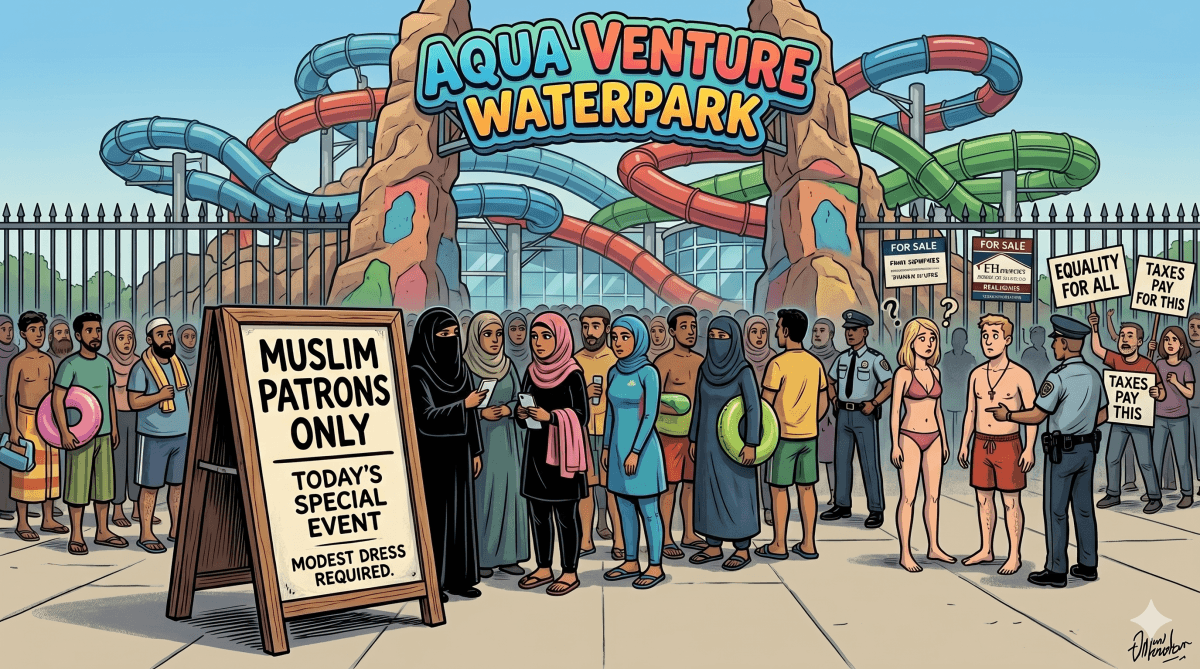
Epic Waters waterpark in Grand Prairie, Texas, has become the center of a public controversy following its announcement of a June 1 event for Eid al-Fitr, initially promoted as a "Muslim Only Event." The taxpayer-funded facility's planned exclusion of non-Muslims has ignited a firestorm of debate across social media, raising questions about religious discrimination at public venues.
"How is a taxpayer-funded, city-owned entity allowed to discriminate against non-Muslims at a public water park? There would be literal riots if Muslims were similarly excluded and we all know that’s 100% accurate." — Dana Loesch, Radio Host and Conservative Commentator
The waterpark, constructed with $88 million in taxpayer funds derived from a sales tax approved by Grand Prairie voters in 2014, distributed promotional materials explicitly identifying the gathering as a "Muslim Only Event." This language quickly drew widespread criticism, with many questioning the legality and fairness of restricting access to a city-owned facility based on religious identity.
According to event marketing, the stated goal of restricting attendance was to cultivate a "family-friendly environment" specifically for Muslim guests. Tickets for the exclusive event were priced starting at $55 per person. Attendees were instructed to adhere to a strict dress code rooted in Islamic standards of modesty. Women were expected to wear head-to-toe swimsuit coverings, and children attending the event were subject to the same dress requirements. Furthermore, all food available at the event was to be exclusively Halal-slaughtered meat, with no alternative options indicated in the promotional materials. Event guidelines also called on attendees to "uphold Islamic etiquette" throughout their visit, including the practice of "lowering the gaze" around others, as reported by the Daily Mail. The official event language stated: "Please follow the event’s modest dress code, and practice ḥayāʾ (modesty) through respectful behavior." While male and female guests were to share the space, all participants were instructed to conduct themselves in accordance with Islamic values for the duration of the event.
As the story gained traction publicly, organizers quietly revised the event flyer. The phrase "Muslim Only Event" was replaced with the softer language "Modest Dress Only." This change, however, did little to quell the growing public outcry, with conservative commentators quickly pointing out the alteration.
Conservative commentator Sara Gonzales directly addressed the revision, stating, "The event organizer is trying to cover their tracks. They’ve now updated the graphic to read ‘Modest Dress Only’ instead of the previous ‘Muslim Only.’" Radio host and conservative commentator Dana Loesch also took to social media platform X to challenge the legal basis of the event, writing, "How is a taxpayer-funded, city-owned entity allowed to discriminate against non-Muslims at a public water park? There would be literal riots if Muslims were similarly excluded and we all know that’s 100% accurate."
The backlash spread rapidly across various social media platforms, with numerous users raising pointed questions about whether city-owned public venues are legally permitted to bar entry to residents based on religious identity, particularly when such facilities are funded by the general tax base. Critics argued that such an event, even if intended for cultural or religious accommodation, could be seen as a violation of the Establishment Clause of the First Amendment, which prohibits government endorsement of religion, and the Equal Protection Clause of the Fourteenth Amendment, which ensures equal treatment under the law.
Proponents of the event, or similar religiously focused gatherings, often argue that they provide a necessary space for communities to celebrate their traditions in an environment that respects their cultural and religious norms, which may not be possible during standard operating hours. They might contend that such events are a form of accommodation rather than outright discrimination, especially if alternative access to the facility remains available to the general public at other times. However, the initial "Muslim Only" phrasing and the use of public funds for an event with specific religious attendance criteria have fueled the debate.
At the time the story gained widespread attention, no statement from Grand Prairie city officials had been issued regarding the controversy or the legal challenges raised by the public. The situation continues to unfold as the June 1 event date approaches, leaving many to await clarification on the policies governing public access to taxpayer-funded facilities for religiously specific events. The incident highlights the complex interplay between religious freedom, public accommodation, and the principle of non-discrimination in publicly funded spaces.

