


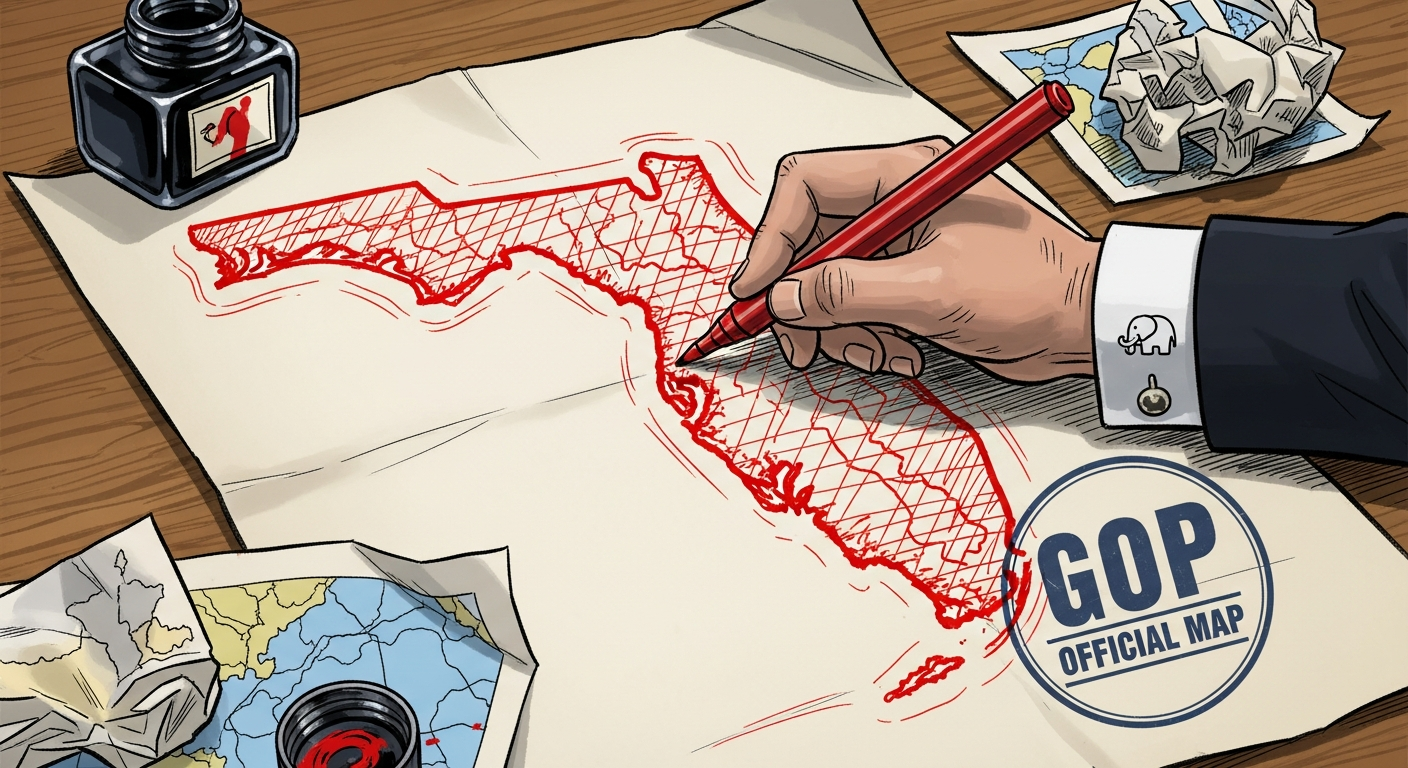
TALLAHASSEE, FL – The Florida House of Representatives voted 83-28 on Wednesday, April 29, 2026, to approve a new congressional redistricting map, which now heads to the state Senate for final consideration. The passage of the proposal marks a significant development in the ongoing battle over electoral boundaries in the state, with analysts suggesting the new configuration could strengthen the Republican Party's chances of maintaining control of the U.S. House in the upcoming 2026 midterms.
"This bill is not redistricting reform. It’s a partisan map drawn in secret, on demand from Washington, and shoved through this chamber on a clock designed to keep the public out of the room." — Fentrice Driskell, Florida House Minority Leader
The approved map is designed to reshape several key battleground districts, particularly in Central and South Florida, areas that have seen narrow and increasingly volatile Democratic advantages in recent statewide elections. According to Roll Call, under the new lines, Republicans are positioned to compete strongly across most of Florida’s 28 congressional districts, with several currently Democratic-held seats potentially shifting into competitive or GOP-leaning territory based on past electoral performance.
Supporters of the new map, including Governor Ron DeSantis (R), contend that the redraw restores race-neutral districting standards and aligns congressional boundaries with constitutional requirements. This move follows a recent Supreme Court clarification regarding the limits of the Voting Rights Act. Governor DeSantis indicated his anticipation of the Court's reasoning, stating on social media, "Called this one months ago. The decision implicates a district in FL—the legal infirmities of which have been corrected in the newly-drawn (and soon to be enacted) map."
The vote occurred in the immediate aftermath of a Supreme Court ruling concerning Louisiana's redistricting, where the justices held that states cannot be compelled to draw additional majority-minority districts under an expansive interpretation of the Voting Rights Act. This 6-3 decision is already influencing legal arguments around race in redistricting nationwide and reinforcing limitations on race-based map drawing. Governor DeSantis cited this ruling as validation for Florida’s approach to avoiding race-driven district configurations.
Florida GOP Chairman Evan Power also defended the state’s approach, emphasizing that the new maps better reflect voter realities and move away from earlier court-ordered configurations. "Gone are the days of snake-shaped districts," Power stated, according to The Floridian. "Our maps are drawn fairly and reflect the makeup of our state. The truth is, Republicans hold a more than 1.4 million voter registration advantage in Florida."
Democrats, however, quickly voiced strong objections to the plan, accusing Republicans of leveraging their legislative majority to solidify long-term electoral advantages. House Minority Leader Fentrice Driskell articulated these concerns during the debate, stating, "This bill is not redistricting reform. It’s a partisan map drawn in secret, on demand from Washington, and shoved through this chamber on a clock designed to keep the public out of the room." Republican lawmakers counter these accusations by arguing that Democrats have historically relied on similar map-drawing advantages in states where they hold a majority, often through court-backed redistricting processes.
The passage of the map in the House sets the stage for further debate and a likely vote in the state Senate. Should the map pass the Senate and be signed into law, it is widely anticipated to face legal challenges. Opponents are expected to invoke Florida’s Fair District Amendments, constitutional provisions frequently utilized to block Republican-backed maps by alleging partisan intent in their creation. Supporters, conversely, maintain that the new plan adheres to constitutional standards and reflects the recent Supreme Court guidance that narrows the use of race in drawing electoral districts.
This redistricting effort in Florida is part of a broader national trend. Republican-led states across the country are moving swiftly to adjust their electoral maps in response to the Supreme Court's latest ruling. Concurrently, Democrats are pursuing counter-efforts in states like California and Virginia, aiming to preserve or expand their own congressional advantages as the 2026 midterm elections draw closer. The outcome in Florida will significantly influence the national political landscape.

