
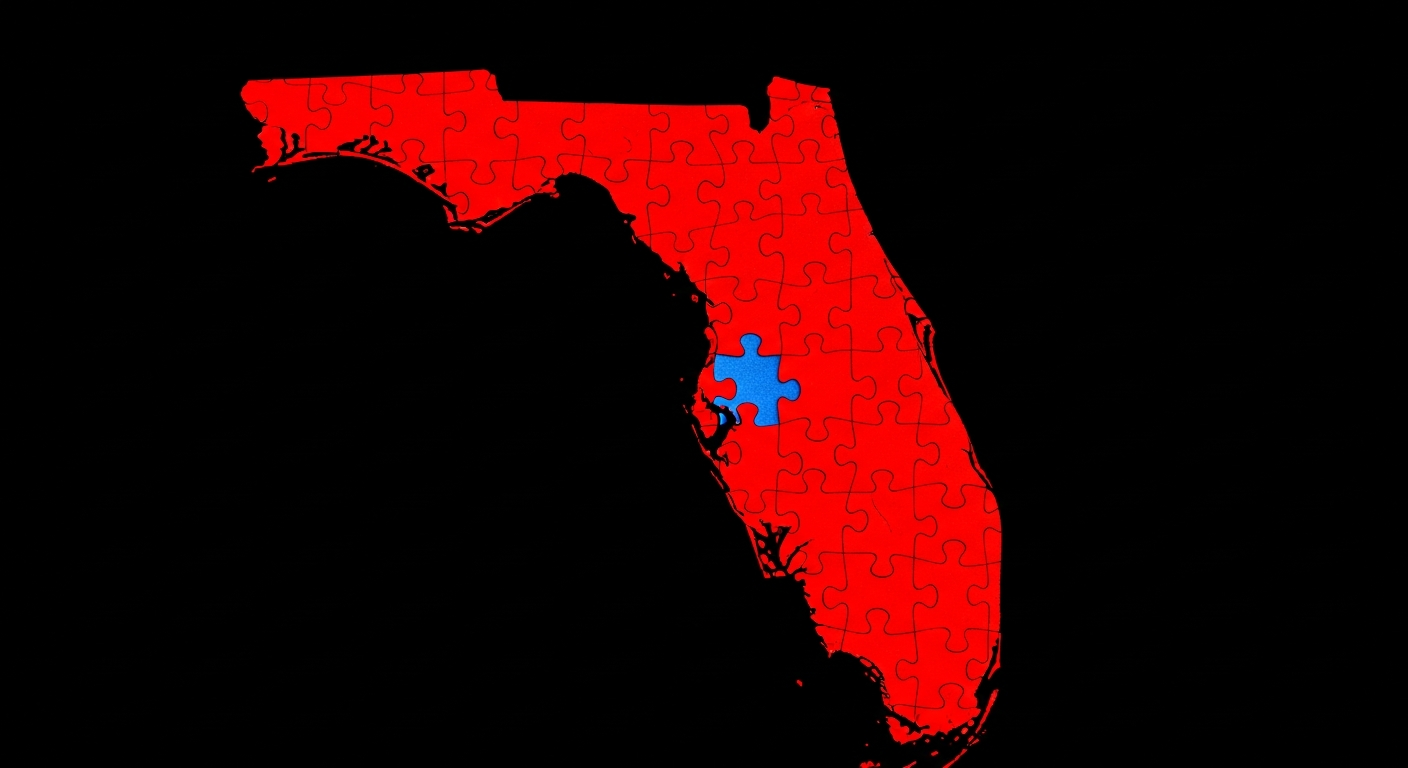
Florida Governor Ron DeSantis has officially submitted a new proposed congressional redistricting map to the state legislature, a move that could significantly alter the state's representation in the U.S. House of Representatives and potentially shift the national balance of power. The proposal, which is now before Florida’s Republican-controlled Legislature, aims to secure four additional Republican seats in Congress before the 2026 midterm elections.
"Florida got shortchanged in the 2020 Census, and we’ve been fighting for fair representation ever since." — Ron DeSantis, Florida Governor
Governor DeSantis presented his rationale for the mid-decade redistricting, emphasizing Florida's substantial population growth since the 2020 Census. "Florida got shortchanged in the 2020 Census, and we’ve been fighting for fair representation ever since," DeSantis told Fox News Digital. He further elaborated on the state's demographic shift, stating, "Our population has since grown dramatically, and we have moved from a Democrat majority to a 1.5 million Republican advantage." The governor also cited constitutional concerns regarding the current district lines, asserting, "Drawing maps based on race, which is reflected in our current congressional districts, is unconstitutional and should be prohibited." DeSantis framed the new map as a fulfillment of a prior commitment, adding, "Our new map for 2026 makes good on my promise to conduct mid-decade redistricting, and it more fairly represents the makeup of Florida today."
The current Florida delegation to Washington consists of 20 Republicans and seven Democrats, with one Democratic seat currently vacant. If DeSantis's proposal clears the legislature and is signed into law, projections indicate it could bolster the Republican presence in the U.S. House by four seats. A source with direct knowledge of the governor’s planning indicated that this initiative was not a reaction to events in other states, stating, "The governor has been planning this long before what took place in Virginia, and continues to be adamant that Floridians deserve fair representation that accurately reflects the state’s changing population and demographics."
The Florida effort unfolds amidst a broader national battle over congressional district lines, with several states grappling with redistricting challenges that hold national implications. Virginia recently saw voters approve a constitutional amendment granting state lawmakers the authority to redraw congressional boundaries. Analysts project that this change could result in a loss of four Republican seats, potentially increasing the Democratic representation from the current six Democrats and five Republicans to ten of the state's eleven seats. Virginia Governor Abigail Spanberger commented on the outcome, stating, "Virginia voters have spoken, and tonight they approved a temporary measure to push back against a President who claims he is ‘entitled’ to more Republican seats in Congress." She continued, "Virginians watched other states go along with those demands without voter input — and we refused to let that stand. We responded the right way: at the ballot box." The amendment passed with 51.5 percent support.
California is another key state in the redistricting landscape. Under Proposition 50, the Democrat-run Legislature gained the power to redraw the state’s congressional map. Early projections suggest that the Democratic party could absorb four Republican-held districts, potentially expanding its congressional footprint to as many as 48 seats while shrinking the Republican presence to just four. Texas is also a focal point, with House Minority Leader Hakeem Jeffries weighing in on potential gains for Republicans. Jeffries asserted, "Under no circumstances are Texas Republicans picking up five seats. They’ll be fortunate if they get two or three. While in California, we are going to get all five."
The proposed Florida map has drawn sharp reactions from national political figures. House Minority Leader Hakeem Jeffries issued a stern warning to Florida Republicans, stating, "Our message to Florida Republicans is F around and find out." He added, "If they go down the road of a DeSantis dummymander, the Florida Republicans are gonna find themselves in the same situation as Texas Republicans, who are on the run right now." In response, Governor DeSantis publicly challenged Jeffries, offering to host him in Florida for a campaign visit. "Please. Be my guest. I will pay for you to come down to Florida to campaign," DeSantis said, adding, "I’ll put you up in the Florida governor’s mansion. We will take you fishing... There’s nothing that could be better for Republicans in Florida than to see Jeffries, Hakeem Jeffries, everywhere around this state."
House Speaker Mike Johnson voiced his support for Florida's redistricting efforts, affirming the state's authority. "Florida has the right and the intention to do it. And my view is that they should," Johnson stated last week. DGOP Chair Evan Power also supported the move, stating on April 27, 2026, "It is long past time for our congressional map to reflect reality." With narrow majorities in Congress, these redistricting battles across Florida, Virginia, California, and Texas have emerged as critical fronts in the struggle for control of the U.S. House heading into the 2026 midterm elections.