


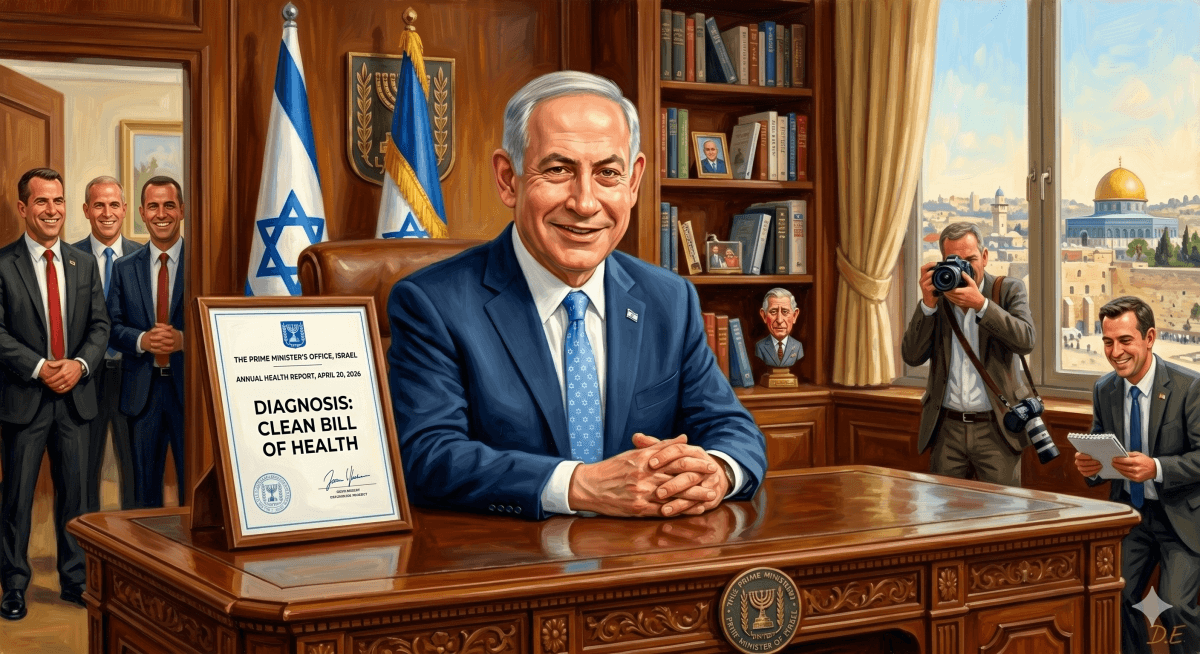
Israeli Prime Minister Benjamin Netanyahu disclosed on Friday that he had been diagnosed with early-stage prostate cancer, a condition he stated has since been successfully treated, leaving him with a clean bill of health. The announcement was made public through a medical report released by his office and later affirmed by Netanyahu himself in a statement on X. The prime minister's health update comes at a critical juncture for Israel, as it navigates ongoing regional security challenges and prepares for diplomatic engagements abroad.
"You already know me. When I’m given information in time about a potential danger, I want to address it immediately." — Benjamin Netanyahu, Israeli Prime Minister.
According to the medical report, the diagnostic process began following a prior medical procedure. Netanyahu first underwent surgery on December 29, 2024, to address benign prostatic hyperplasia (BPH), a non-cancerous enlargement of the prostate. This procedure, performed at Hadassah Medical Centre, was described as successful and without complications. Following the BPH surgery, Prime Minister Netanyahu remained under routine medical monitoring as part of his post-operative care.
It was during a subsequent MRI scan that physicians identified a "very small suspicious lesion" within the prostate, measuring less than one millimeter. Further diagnostic testing confirmed this lesion to be early-stage prostate cancer. Crucially, the medical findings indicated no evidence of spread or metastasis, meaning the cancer had not extended beyond its initial site. Netanyahu's office emphasized the early detection of the condition.
The prime minister stated that the cancer was treated through "targeted medical procedures" and has now been fully resolved. In his public statement, Netanyahu expressed gratitude, writing, "Thank God, I am healthy," and assuring the public that he is in "excellent physical condition." He characterized the prostate issue as a "minor medical issue" that was "completely treated."
Netanyahu also addressed the two-month delay in the public release of the April 20 medical report. He explained that he requested the postponement to avoid publicizing personal health news during the intense period of the ongoing conflict, and to prevent what he referred to as potential "Iranian propaganda efforts" against Israel. He noted that doctors informed him such conditions are common among men in his age group, which is 76.
Physicians presented Netanyahu with two options: either to monitor the small lesion closely or to undergo immediate treatment to eliminate the issue. The prime minister stated he chose the latter, explaining his rationale: "You already know me. When I’m given information in time about a potential danger, I want to address it immediately." He described the treatment as consisting of only a few short sessions, during which he was able to continue his work, reading and managing his duties. Following the completion of these treatments, Netanyahu confirmed that the lesion had "disappeared completely." He extended his thanks to the medical professionals and staff at Hadassah Hospital in Jerusalem for their care.
The disclosure of the prime minister's health status occurs as Israel faces complex diplomatic and security challenges. Prime Minister Netanyahu is anticipated to visit the White House in the coming weeks, where discussions are expected to focus on U.S. efforts to secure a long-term agreement pertaining to the ongoing conflict with Iran. Concurrently, Israel is engaged in regional security negotiations concerning Lebanon, particularly in light of continued tensions and fighting involving the Iran-backed group Hezbollah.
Health disclosures involving national leaders invariably attract significant public and international attention. Such information can influence public confidence, raise questions about continuity of government, and potentially affect diplomatic relations. In this instance, the communication from Netanyahu's office has consistently highlighted the early detection, the absence of spread, and the complete resolution of the condition, aiming to reassure stakeholders about the prime minister's capacity to govern. At 76 years old, Benjamin Netanyahu remains one of the oldest serving leaders in the region, continuing to play a central role in Israel's wartime decision-making and strategic planning. The core message from his announcement is that the condition has been fully resolved, and he remains fit for office.

