


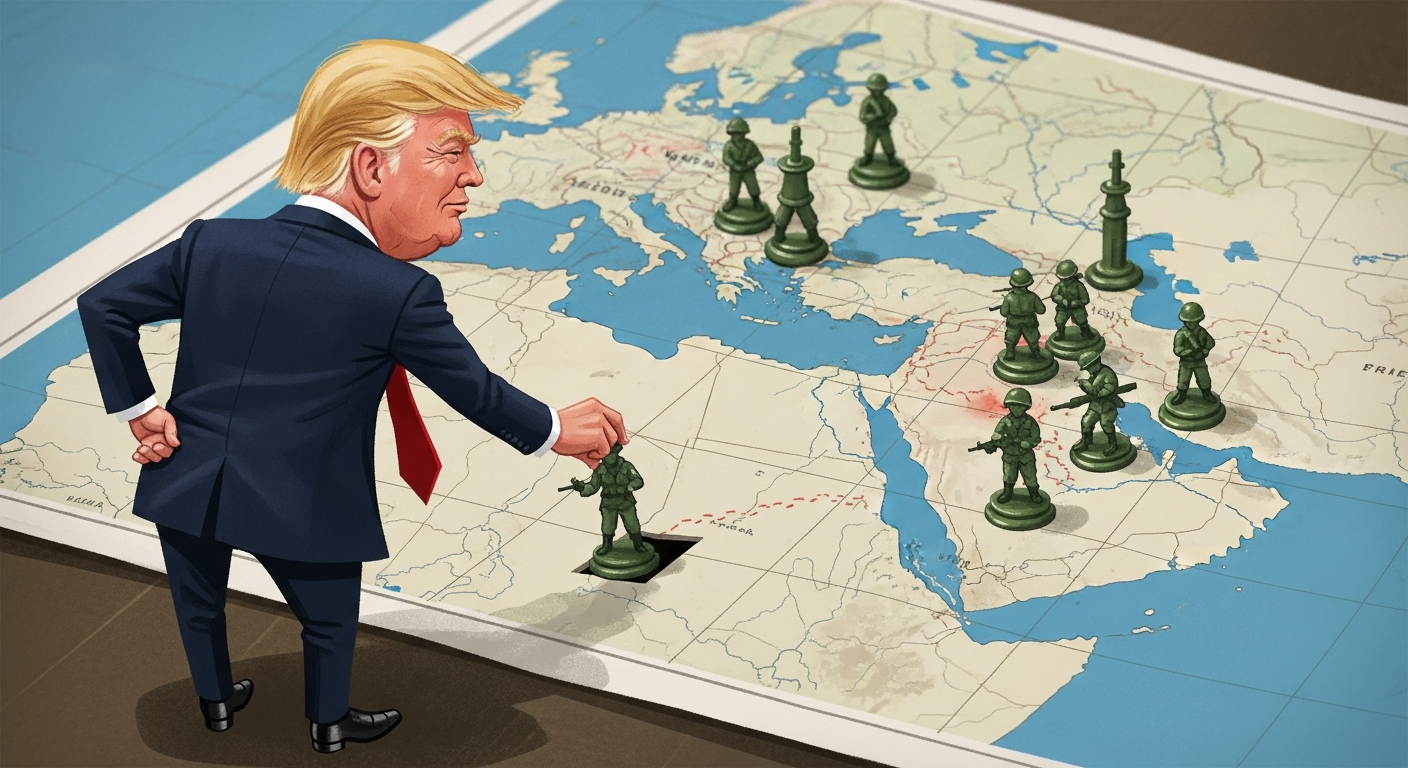
President Donald Trump announced on Wednesday that the United States is actively studying and reviewing a potential reduction of American military forces stationed in Germany, a move that could significantly alter the long-standing U.S.-Germany alliance. The announcement, made by President Trump on his Truth Social account, stated that a determination would be made "over the next short period of time," without specifying a timeline or potential troop numbers for the cut.
"The Chancellor of Germany, Friedrich Merz, thinks it’s OK for Iran to have a Nuclear Weapon. He doesn’t know what he’s talking about! If Iran had a Nuclear Weapon, the whole World would be held hostage." — President Donald Trump, Truth Social Post
This declaration follows a period of escalating public tension between President Trump and German Chancellor Friedrich Merz, particularly concerning Iran's nuclear ambitions and Germany's contributions to collective defense. Earlier this week, a blistering public exchange unfolded between the two leaders, highlighting deep divisions on critical foreign policy and security matters.
On Tuesday, President Trump directly criticized Chancellor Merz in a Truth Social post, accusing him of holding a dangerous stance on a volatile security threat. "The Chancellor of Germany, Friedrich Merz, thinks it’s OK for Iran to have a Nuclear Weapon," President Trump wrote. He continued, "He doesn’t know what he’s talking about! If Iran had a Nuclear Weapon, the whole World would be held hostage." President Trump then linked Germany's foreign policy position to its economic performance, adding, "I am doing something with Iran, right now, that other Nations, or Presidents, should have done long ago. No wonder Germany is doing so poorly, both Economically, and otherwise!"
President Trump's comments appeared to be a response to a speech delivered by Chancellor Merz on Monday in Marsberg, Germany. During his address, Merz told students that the United States was being "humiliated by the Iranian leadership" and expressed his hope that the ongoing conflict would end "as quickly as possible." Despite the sharp rhetoric, Chancellor Merz attempted to downplay the severity of the bilateral damage on Wednesday, telling reporters, "From my perspective, my personal relationship with the U.S. President remains good. I simply had doubts from the start about what was begun with the war in Iran. That is why I have made that clear."
The current tensions are not isolated, as President Trump and Chancellor Merz have a documented history of disagreements stretching across both of President Trump’s presidential terms. Disputes over trade tariffs and defense spending, particularly Germany's adherence to NATO's target of spending 2% of its GDP on defense, have repeatedly put Washington and Berlin at odds. The recent conflict in Iran added new fuel to these long-simmering issues earlier this month when Merz publicly stated his belief that NATO should not become involved in the war, a position directly contrasting President Trump's push for allied nations to help secure the Strait of Hormuz.
The potential reduction of U.S. troops in Germany carries significant implications given the current force posture. As of December 2025, more than 36,000 active-duty American service members were stationed in Germany, according to the Defense Manpower Data Center. This figure represents the largest U.S. military presence in any single European country and accounts for the largest share of the approximately 68,000 American troops permanently assigned to bases across Europe at that time.
While substantial, the current U.S. military footprint in Germany is considerably smaller than its Cold War peak. In 1985, at the height of Cold War tensions, approximately 250,000 American troops were based in Germany. Subsequent drawdowns followed the fall of the Berlin Wall and the dissolution of the Soviet Union. During President Trump's first term in office, he pursued plans to remove 12,000 troops from Germany, a proposal that was later halted under the Biden administration.
The Pentagon referred questions regarding President Trump's latest announcement to the White House, which offered no immediate comment. The consideration of a troop drawdown underscores the ongoing strains within the transatlantic alliance and signals a potential shift in the U.S. military's strategic posture in Europe, amidst evolving global security challenges and persistent disagreements between key allies.

