
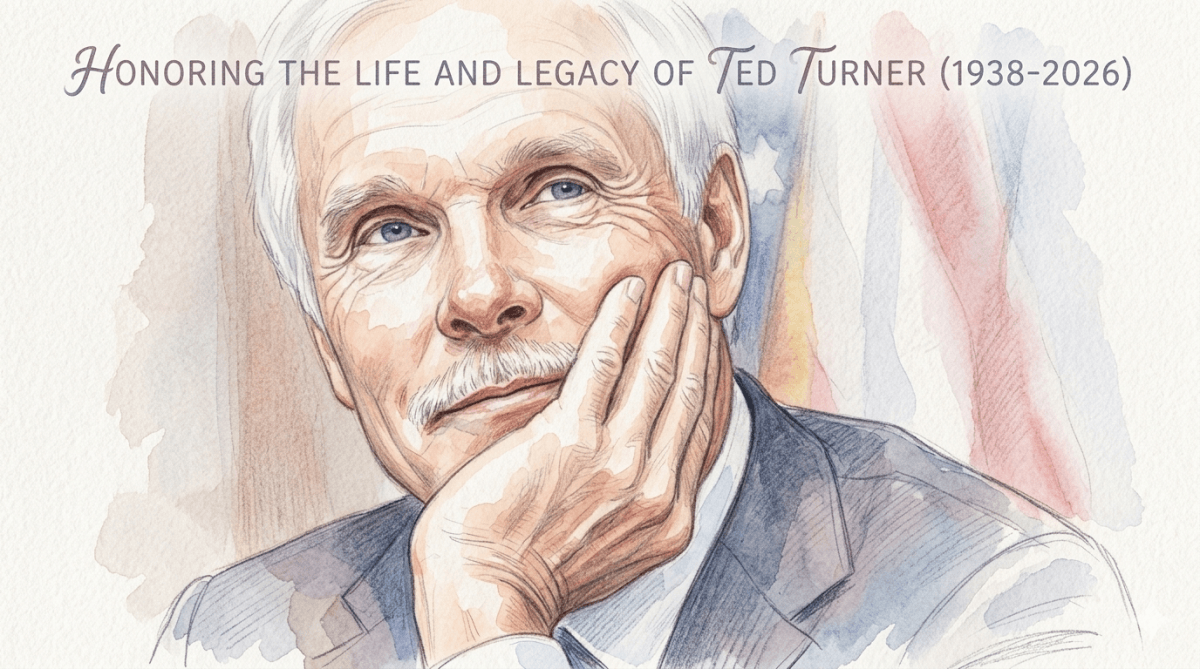
Robert Edward "Ted" Turner III, the billionaire entrepreneur who revolutionized the media industry with the launch of CNN, the world's first 24-hour cable news channel, died Wednesday at the age of 87. The confirmation came from his private holding company, marking the end of an era defined by bold vision, unconventional business strategies, and a dynamic public persona. Turner's passing closes the chapter on a figure whose influence stretched across television, sports, and global philanthropy.
"I don’t have any idea what I’m going to say. I say what comes to my mind." — Ted Turner, Founder of CNN.
Born in Cincinnati, Ohio, in 1938, Turner's early career involved taking over his father's billboard advertising business after his father's death. He quickly expanded the company, leveraging his aggressive business acumen to acquire numerous radio and television stations. His true breakthrough came in 1970 when he purchased a struggling UHF station in Atlanta, Georgia, which he rebranded as WTCG (later WTBS). Turner pioneered the "superstation" concept, using satellite technology to broadcast the station's programming nationally, thereby dramatically expanding its reach and laying the groundwork for his future media empire.
The most significant and enduring of Turner's innovations was the creation of CNN in 1980. At a time when television news was confined to scheduled evening broadcasts by major networks, Turner's audacious gamble on continuous, round-the-clock news coverage was met with skepticism. Critics doubted whether audiences would tune in continuously for news. However, CNN's immediate success proved them wrong, fundamentally altering how Americans and eventually the world consumed news. It established a new paradigm for television journalism, emphasizing immediacy and constant updates, and paved the way for the proliferation of other cable news networks like Fox News and MSNBC.
Turner's media ventures extended far beyond news. Through Turner Broadcasting System, he launched a suite of popular cable channels, including TBS, TNT, Cartoon Network, and Turner Classic Movies (TCM), each catering to specific niches and further cementing his company's presence in the burgeoning cable television market. His empire also encompassed professional sports. He purchased the Atlanta Braves baseball team in 1976 and the Atlanta Hawks basketball team in 1977. Under his ownership, the Braves became known as "America's Team" and achieved significant success, including winning the 1995 World Series. Turner also made a notable foray into professional wrestling, acquiring Jim Crockett Promotions and rebranding it as World Championship Wrestling (WCW), which became a major rival to WWE during the "Monday Night Wars" of the 1990s.
Known for his outspoken personality and often unpredictable public comments, Turner earned the nickname "Captain Outrageous." He frequently shared his unfiltered opinions on politics, religion, and global affairs. Reflecting on his candid nature, Turner once told The New Yorker, "I don’t have any idea what I’m going to say. I say what comes to my mind." This bluntness sometimes led to controversy, such as his attempt to "colorize" classic black-and-white films after acquiring MGM's extensive film library. The move drew fierce opposition from critics who argued it damaged cinematic history. Turner eventually abandoned the project due to public backlash and financial considerations, according to NBC News.
In 1996, Turner Broadcasting merged with Time Warner in a landmark $7.5 billion deal, one of the largest media mergers of its time. Turner became vice chairman of the combined entity, though his direct influence waned following the subsequent AOL-Time Warner merger in the early 2000s, which proved to be less successful.
Beyond his business ventures, Turner emerged as one of the country's most prominent philanthropists. In 1998, he made a historic pledge of $1 billion to the United Nations, an unprecedented private donation at the time, which helped establish the United Nations Foundation. He also co-founded the Nuclear Threat Initiative with former Georgia Senator Sam Nunn, dedicated to reducing the global threat from nuclear, biological, and chemical weapons. Turner was a passionate environmentalist, becoming one of the largest private landowners in the United States. He dedicated vast tracts of his land to conservation efforts, particularly focusing on bison restoration and sustainable ranching practices, which he further promoted through his restaurant chain, Ted's Montana Grill.
In his later years, Turner stepped back from public life following a diagnosis of Lewy body dementia, which he publicly disclosed in 2018. He is survived by his children and leaves behind a monumental legacy that forever altered the landscape of television, cable news, professional sports, and global philanthropy. His innovative spirit and willingness to challenge the status quo left an indelible mark on modern media and beyond.