


Breaking
Sponsor Advertisement
Jayapal Draws Scrutiny Over Cuba Diplomat Talks Amid Sanctions
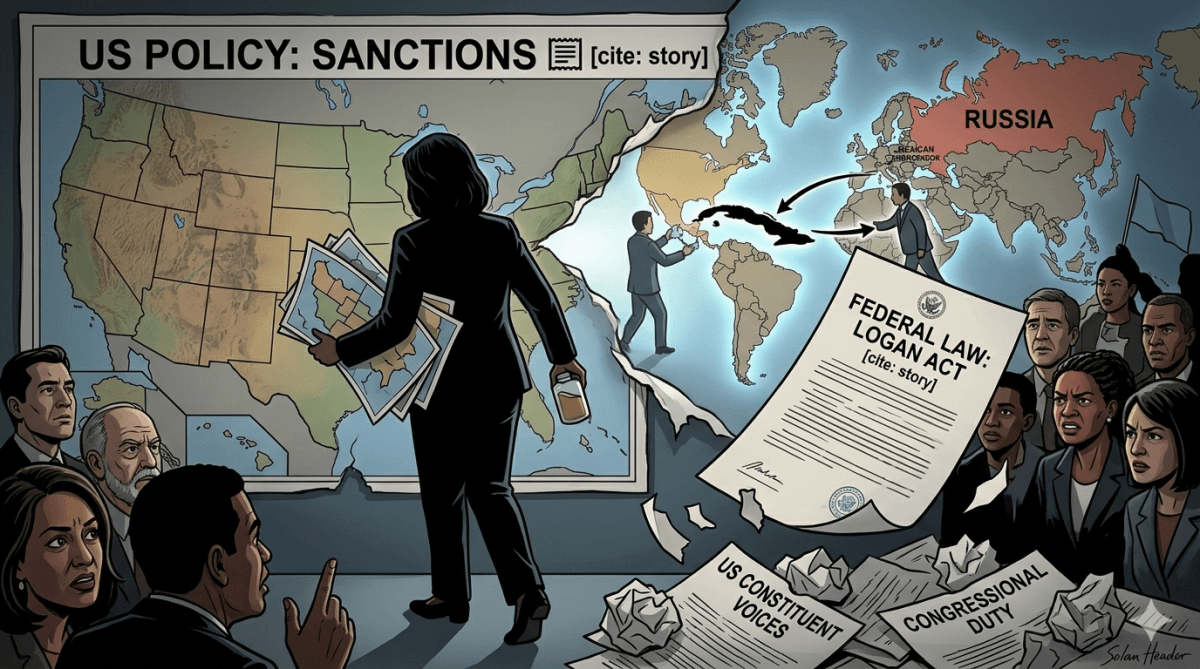
AI-generated image for: Jayapal Draws Scrutiny Over Cuba Diplomat Talks Amid Sanctions

Jayapal Draws Scrutiny Over Cuba Diplomat Talks Amid Sanctions

Representative Pramila Jayapal faced criticism after acknowledging discussions with Latin American diplomats regarding Cuba's fuel shortages and President Trump's sanctions. Her comments sparked debate over U.S. foreign policy and the Logan Act.
Jump to The Flipside Perspectives

Representative Pramila Jayapal (D-WA) has drawn significant political backlash after publicly acknowledging she engaged in discussions with diplomats from several Latin American countries concerning efforts to address severe fuel shortages in Cuba. The admission came during a recent Cuba-focused briefing where Jayapal addressed new executive actions signed by President Donald Trump, which target foreign governments, companies, and financial institutions conducting business with Havana. Critics on Capitol Hill quickly accused the Congresswoman of undermining U.S. foreign policy and potentially violating federal law.

"OPENLY admitting to aiding a communist adversary in coordination with foreign countries to VIOLATE American sanctions." — Senator Rick Scott, R-FL.

President Trump's administration has intensified its sanctions campaign against the communist-run island, a strategy that Jayapal argued is exacerbating a severe humanitarian and infrastructure crisis in Cuba. She highlighted ongoing blackouts, critical fuel scarcities, and widespread economic instability as direct consequences of the tightened restrictions. During the briefing, Jayapal stated that Cuba’s energy problems have significantly worsened following a decline in Venezuelan oil shipments earlier this year, with only limited amounts of Russian oil recently arriving, leaving fuel supplies dangerously low. It was in this context that she revealed her engagement with ambassadors from nations including Mexico regarding potential avenues for Cuba to secure additional energy resources.

President Trump’s approach to Cuba has been marked by a firm stance against the current regime. In January, President Trump issued an executive order that threatened tariffs on any country supplying fuel to Cuba, a move intended to cut off critical resources to the island. Jayapal specifically referenced this order, stating, "In January, Trump issued an executive order threatening tariffs on any country supplying fuel to Cuba." She asserted that the administration’s latest sanctions have made it increasingly difficult for foreign governments and businesses to provide assistance to Cuba without risking economic penalties from the United States. President Trump had previously declared his administration's objective, stating, "THERE WILL BE NO MORE OIL OR MONEY GOING TO CUBA."

Jayapal's comments followed a trip she and Representative Jonathan Jackson (D-IL) made to Cuba several weeks prior. During their visit, the delegation met with Cuban President Miguel Díaz-Canel, Foreign Minister Bruno Rodríguez Parrilla, and members of the Cuban Parliament. Discussions during this trip reportedly focused heavily on Cuba’s deepening fuel shortages and the broader economic fallout attributed to longstanding U.S. sanctions.

The Congresswoman’s remarks immediately ignited a firestorm of criticism from Republican lawmakers. Senator Rick Scott (R-FL) was among the most vocal, accusing Democrats of openly coordinating with foreign governments to weaken U.S. sanctions policy. In a post on X, Senator Scott wrote that members of the Democratic Party were "OPENLY admitting to aiding a communist adversary in coordination with foreign countries to VIOLATE American sanctions." He emphasized that these restrictions are vital for protecting American national security interests and for pressuring Cuba’s communist leadership. Senator Scott, known for his consistent support of aggressive sanctions against Cuba, also defended President Trump’s comprehensive strategy towards Havana, asserting that the administration seeks to hold the Cuban government accountable for supporting hostile actors and contributing to regional instability.

Jayapal, for her part, sharply condemned the administration’s most recent sanctions package, equating the economic restrictions to acts of warfare. She described the measures as "an economic bombing of the infrastructure of Cuba," arguing that they are crippling the island’s ability to maintain basic services by restricting fuel access and limiting financial transactions with foreign institutions. She further claimed that these measures violate international norms by effectively collapsing critical infrastructure through economic pressure.

The contentious nature of Jayapal’s admitted discussions with foreign diplomats has also sparked renewed online debate regarding the Logan Act. This federal law, dating back to 1799, prohibits unauthorized citizens from negotiating with foreign governments that are in dispute with the United States. While prosecutions under the Logan Act have historically been exceedingly rare, critics have argued that Jayapal’s comments warrant scrutiny given her acknowledged interactions with foreign ambassadors concerning Cuba’s oil supply, an issue directly affected by U.S. policy. The controversy underscores the ongoing tension between congressional oversight, executive foreign policy, and the boundaries of diplomatic engagement by individual legislators.


Advertisement

The Flipside: Different Perspectives

Progressive View

Progressives view the U.S. sanctions against Cuba, particularly President Trump’s escalated measures, as a counterproductive and inhumane policy that exacerbates suffering among ordinary Cuban citizens. Representative Jayapal’s efforts to engage with Latin American diplomats are seen as a legitimate and necessary attempt to address a worsening humanitarian crisis on the island, characterized by severe fuel shortages, blackouts, and economic instability. From this perspective, the sanctions are not effectively targeting the Cuban regime but rather "an economic bombing of the infrastructure of Cuba," as Jayapal stated, crippling the ability to provide basic services.

Progressives advocate for diplomatic solutions and engagement rather than economic warfare, arguing that isolating Cuba through sanctions only entrenches the regime and harms the populace. They believe that sustained dialogue and humanitarian assistance, even through multilateral channels, are more effective in promoting stability and long-term change than punitive measures. The focus is on the collective well-being of the Cuban people and the ethical implications of policies that deny access to essential resources. Engaging with regional partners like Mexico to find solutions for Cuba's energy needs is seen as an empathetic and analytical approach to a complex problem, consistent with international norms that prioritize human welfare over political isolation.

Conservative View

From a conservative perspective, Representative Jayapal’s acknowledged discussions with foreign diplomats regarding Cuba’s fuel supply represent a clear overreach of congressional authority and a potential threat to U.S. national security. President Trump's administration has implemented a robust sanctions regime against Cuba, which is viewed as essential for isolating a communist adversary that has historically supported hostile actors and destabilized the region. These sanctions embody a policy of accountability, aiming to pressure the Cuban government to abandon its repressive practices and cease its malign influence.

Engaging with foreign governments, particularly those of nations not aligned with U.S. policy regarding Cuba, can be interpreted as undermining the Executive Branch's constitutional role in foreign policy. Such actions risk sending mixed signals to international partners and adversaries alike, potentially weakening the effectiveness of U.S. sanctions and diplomatic leverage. Conservatives emphasize the importance of a unified front in foreign policy, particularly when dealing with regimes hostile to American interests. Concerns are also raised about the Logan Act, which prohibits unauthorized citizens from negotiating with foreign governments in disputes with the U.S., highlighting the need for adherence to established legal frameworks governing foreign relations. Upholding sanctions is seen as a matter of national security and a deterrent against regimes that do not respect individual liberty or democratic principles.

Common Ground

Despite the stark differences in approach, there are potential areas of common ground regarding U.S. policy towards Cuba. Both conservatives and progressives can acknowledge the humanitarian challenges faced by the Cuban people, particularly the severe impact of fuel shortages and economic instability on daily life. There is a shared interest in ensuring regional stability and preventing large-scale humanitarian crises that could have broader implications.

A shared understanding could also emerge around the principle of accountability, albeit with different interpretations. While conservatives focus on holding the Cuban government accountable for its actions, progressives seek accountability for the impact of U.S. policies on the Cuban population. Dialogue could explore how to alleviate civilian suffering without inadvertently strengthening the Cuban regime, potentially through carefully targeted humanitarian aid channels or international cooperation on energy solutions that are transparent and monitored. Both sides could agree on the importance of assessing the effectiveness of current policies and exploring whether alternative strategies could better achieve U.S. objectives, whether those objectives are national security or humanitarian, or a combination of both.

What's your view on this story? Share your thoughts and remember to consider multiple perspectives and being respectful when forming and voicing your opinion. "If you resort to personal attacks, you have already lost the debate..."

Advertisement

Contact Us About This Article

Have a question or comment about this article? We'd love to hear from you.

About Fair Side News

At Fair Side News, we believe in presenting news with perspectives from both sides of the political spectrum. Our goal is to help readers understand different viewpoints and find common ground on important issues.