
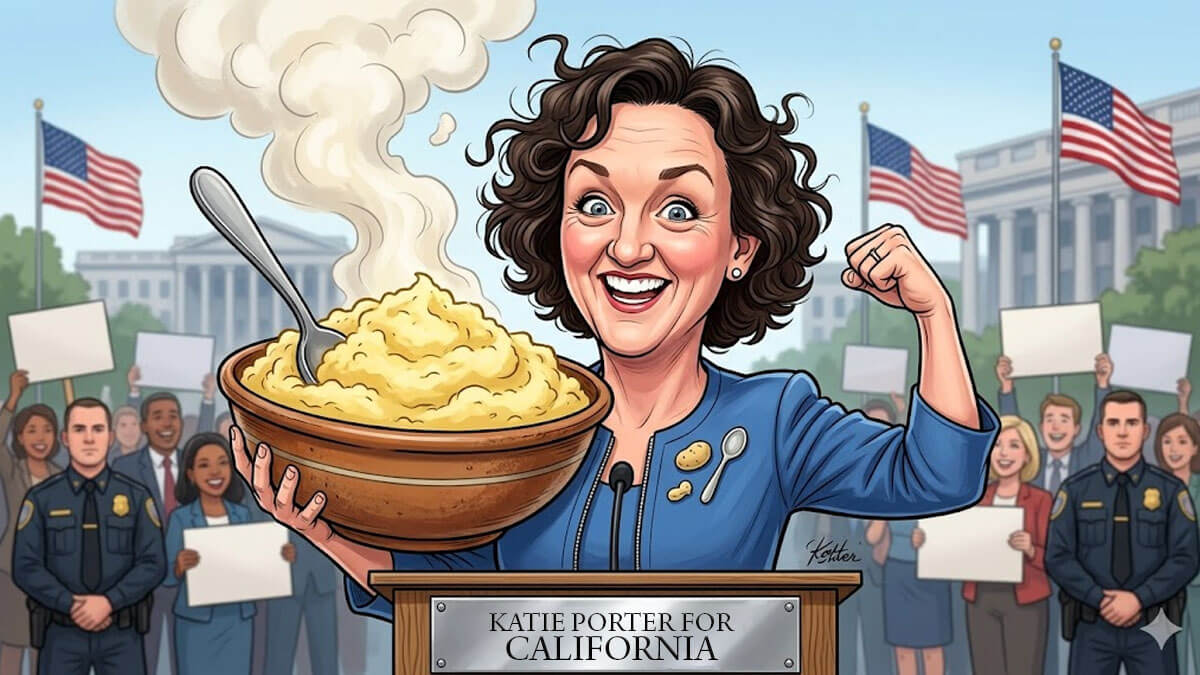
California Democratic gubernatorial hopeful Katie Porter recently launched a new campaign advertisement, a 30-second spot that has garnered widespread attention and criticism, particularly on social media platforms. The ad, intended to reframe her public image, attempted to use self-deprecating humor by referencing a past widely publicized incident involving a staffer.
The advertisement concludes with Porter looking towards a group of extras holding signs and quipping, "Now, could you guys please get out of my shot?" The scene depicts the crowd laughing in response. However, the reception on social media platform X was largely negative. One user commented, "And this… might be the worst political ad of all-time," while another stated, "I laughed so hard… this is one of the worst campaign ads I’ve ever seen." This reaction suggests the ad may have backfired, reminding voters of the very issues it sought to mitigate.
The joke in the ad directly refers to an incident captured in a video obtained by Politico in October 2025. The footage showed Porter during a July 2021 taping of a webinar alongside then-Energy Secretary Jennifer Granholm. During the recording, a staffer briefly appeared in the frame while attempting to offer a correction, prompting Porter to say, "Get out of my f***ing shot! You also were in my shot before that. Stay out of my shot." This incident became public just one day after another video went viral, which showed Porter threatening to end a sit-down interview with a California CBS News reporter. Taken together, these recordings contributed to a public perception of Porter as a candidate with a combustible temperament.
Concerns regarding Porter's temperament predate these public video incidents. Her former husband, Matt Hoffman, has maintained domestic abuse allegations against her stemming from a 2013 incident. According to Fox News, Hoffman alleged that Porter poured hot potatoes on his head and shattered a glass in a fit of rage, with flying shards causing injury. These allegations have remained a part of the public discourse surrounding Porter's political career.
Despite these elements of her public history, Porter's new ad aimed to present her as an ordinary citizen connected to everyday struggles. In the advertisement, she states, "I’m Katie Porter, and I’m not like most people who run for governor. I actually get what you’re going through." She describes herself as a "single mom of three kids" who understands "what it’s like to push the shopping cart," drives a minivan with "almost 200,000 miles on it," and has "a grown kid who may soon be living on my couch."
However, reports have highlighted a contrast between this portrayal and aspects of her personal financial situation and educational background. The Washington Free Beacon reported that as of 2022, Porter’s estimated net worth stood at $1.6 million. Her educational path included attendance at Phillips Academy, a highly exclusive preparatory school, followed by Yale University for her undergraduate degree, and Harvard Law School. The combined estimated cost of this education approaches $700,000, according to public records and tuition estimates.
Porter's current standing in the gubernatorial race reflects ongoing challenges. The RealClearPolling aggregate of surveys places her fifth in California’s open gubernatorial primary, with an average of nine percent support. This figure has remained largely stagnant despite weeks of active campaigning and the recent ad release.
The ad's release also occurred during a period of broader upheaval within the Democratic primary field. Another candidate, former Representative Eric Swalwell, has been facing a sexual assault scandal. Rather than benefiting from the controversy surrounding a rival, Porter's campaign sought to publicly capitalize on it. This decision, however, drew criticism and led to a Community Notes correction on X, which highlighted the parallel between Porter’s public stance toward Swalwell’s accusers and the unresolved allegations she herself faces. Critics pointed to this perceived incongruity, further complicating her campaign's efforts to manage public perception.
The campaign ad, which was seemingly designed to shift the narrative and soften her image, appears to have had the opposite effect. Instead of reassuring voters, it reportedly underscored existing concerns about her temperament and authenticity. With her current polling numbers, Porter's campaign faces increasing pressure to effectively address these issues as the primary day approaches.