
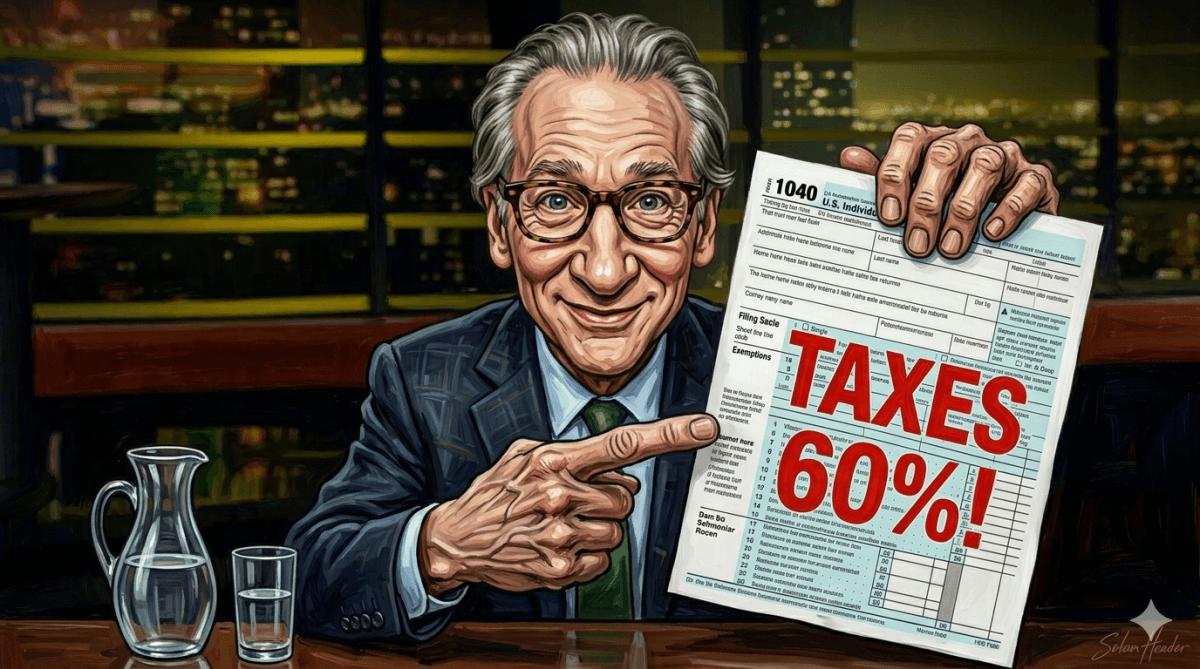
After Tax Day, prominent political commentator Bill Maher, host of HBO’s long-running program “Real Time,” publicly stated that a significant portion of his annual income, approximately 60%, is paid in taxes. Speaking to his audience, Maher’s comments on his personal tax burden directly challenged a core narrative often advanced within progressive political circles regarding the tax contributions of wealthy Americans. His remarks, reported by Fox Business, come amidst ongoing national discussions about tax policy, government spending, and fiscal deficits.
"I paid to the government, if you add in state tax, local, sales, property, fees, Obamacare, probably almost 60 percent of what I earn. That’s a lot." — Bill Maher, Host of Real Time with Bill Maher
Maher detailed the various levies that contribute to his substantial tax payments, including federal income tax, California state income tax, local taxes, sales taxes, property taxes, and surcharges associated with the Affordable Care Act. California, where Maher resides, is recognized for its high tax rates, with the Tax Foundation reporting that the state ranked fifth nationwide in 2022 for the steepest combined state and local tax burden, averaging 13.5% of residents' income. When federal obligations are added, the cumulative figure Maher cited becomes more understandable.
During his commentary, Maher specifically addressed Senator Bernie Sanders, a figure who has frequently campaigned on the premise that wealthy Americans evade their tax responsibilities. “I still wouldn’t mind if Bernie Sanders would stop saying the rich don’t pay taxes,” Maher stated. While conceding that the "super-rich"—those with extensive legal and accounting teams—might successfully minimize their tax liabilities through loopholes, Maher distinguished this group from "regular rich people" who, he argued, pay a substantial amount. "And while I’m sure the super-rich, with their army of accountants and corporate loopholes, get away with murder, us regular rich people pay a s*** ton of taxes!" he asserted.
Federal income tax data provides context for Maher’s frustration. He referenced figures indicating that the top ten percent of earners contribute approximately 72 percent of all federal income tax revenue, while the bottom half of earners collectively account for about three percent. These statistics align with data published by the Tax Foundation, which draws upon Internal Revenue Service (IRS) records, illustrating a highly progressive federal income tax system where higher earners contribute a disproportionately larger share of the total tax revenue.
The political environment for Maher's remarks includes a Democratic Party that has increasingly advocated for higher taxation on upper-income Americans. Figures like Representative Alexandria Ocasio-Cortez and New York mayoral candidate Zohran Mamdani represent a segment of Democratic politicians proposing that wealthy earners serve as the primary funding source for ambitious new government programs. This push for increased revenue has intensified as proposed social spending initiatives within the party have expanded.
Beyond the issue of tax collection, Maher also questioned the government’s efficiency in managing the funds it already receives. “How can it be that the federal government alone took in over $5 trillion in taxes last year and we still need that? Are we really this incompetent and corrupt?” he asked his audience. This query is particularly pertinent against the backdrop of current fiscal challenges. The U.S. Treasury Department reported a $1.17 trillion deficit for fiscal year 2026, indicating that federal spending has already exceeded revenue by over a trillion dollars in the current fiscal year alone. Maher attributed this growing gap to factors such as fraud, waste, and abuse within government operations.
Maher's comments, particularly from a voice generally aligned with the American left, place him in direct opposition to a central tax narrative frequently promoted by his own political coalition. His public disclosure of his personal tax burden and his critique of government inefficiency underscore a complex debate about economic fairness, fiscal responsibility, and the role of government in society. His statements prompt a re-evaluation of how wealth is taxed and spent, sparking discussion across the political spectrum.