
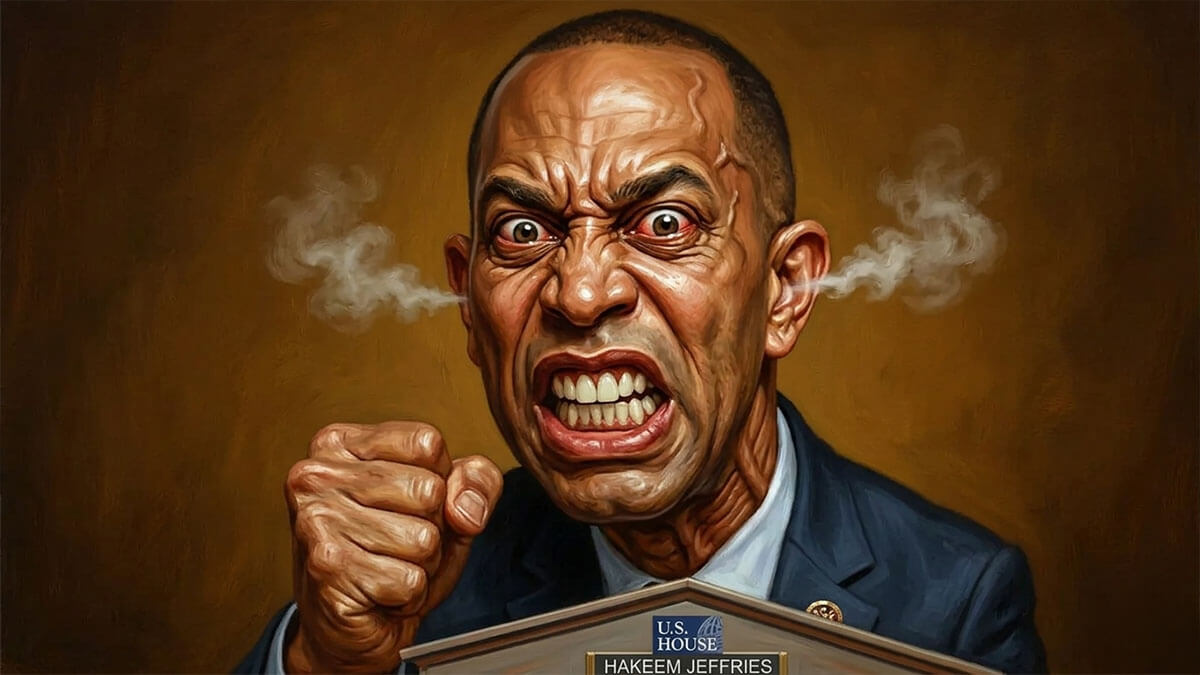
President Donald Trump on Thursday accused House Minority Leader Hakeem Jeffries (D-NY) of "inciting violence" and called for potential legal charges against him. The accusation, made in a Truth Social post, stems from recent remarks by Jeffries related to Democratic messaging in ongoing congressional map battles nationwide.
"This lunatic, Hakeem “Low IQ” Jeffries, should be charged with INCITING VIOLENCE! The…" — President Donald Trump, Truth Social Post
In his post, President Trump referred to Jeffries as "Hakeem ‘Low IQ’ Jeffries" and stated, "should be charged with INCITING VIOLENCE!" He further asserted that "The Radical Left Democrats actually want to Destroy our Country." The post included images depicting Jeffries speaking near a sign that read "Maximum Warfare, everywhere, all the time," alongside visuals connected to the aftermath of the White House Correspondents’ Dinner shooting. This social media activity quickly garnered attention across political spectrums, eliciting varied reactions from both major parties.
The phrase "maximum warfare" was employed by Jeffries during a press briefing where he outlined the Democratic strategy for congressional map disputes across several states. His comments were made in the context of party efforts to maintain and expand competitiveness in key districts leading up to the midterm elections. Republicans have since highlighted this wording as an example of increasingly aggressive partisan rhetoric. Conversely, Democrats contend that the phrase represents standard language used in high-stakes political competition, emphasizing the intense nature of electoral strategy.
At the core of this heightened political exchange is a nationwide redistricting effort that holds the potential to significantly alter the balance of power in the House of Representatives. Both Republican and Democratic parties are actively engaged in assertive map-drawing initiatives in states such as Texas, California, Florida, Virginia, and Tennessee. These new district lines could establish electoral advantages for years, profoundly impacting future election outcomes. House Minority Leader Jeffries has emerged as a prominent figure in the Democratic party's push to enhance its competitive standing in targeted districts. Meanwhile, Republicans have increasingly integrated Democratic rhetoric, including phrases like "maximum warfare," into their broader political messaging strategy, according to a Politico report.
President Trump’s Truth Social post prompted a rapid response from Jeffries. In a video message, Jeffries directly addressed President Trump, rejecting the accusations. He stated, "You ain’t intimidating a damn person," and also criticized President Trump over rising costs and pervasive economic pressures currently affecting American households. Jeffries argued that the President's focus on him represented a misplacement of priorities, particularly at a time when voters are grappling with significant financial strain, as reported by The Hill.
This latest confrontation aligns with a broader pattern observed in President Trump’s public statements, where he has frequently advocated for scrutiny and legal accountability for political opponents, particularly Democrats whom he believes have engaged in misconduct or politicized the justice system. For instance, Resist the Mainstream reported in November that President Trump accused several Democratic lawmakers of "sedition" following a video that urged military personnel to disregard unlawful orders. That accusation also sparked backlash and led to formal complaints from Democratic members. President Trump has also previously called for investigations or prosecutions involving other prominent figures, including California Senator Adam Schiff and New York Attorney General Letitia James. In these instances, President Trump and his allies have argued that these individuals should face accountability amid what they characterize as the politicization of legal institutions.
Supporters of President Trump assert that his rhetoric reflects a deep-seated frustration with what they describe as escalating political attacks from Democrats. They point to a wider political environment where accusations of extremism and criminal conduct have become increasingly prevalent across party lines. The White House Correspondents’ Dinner shooting has further amplified attention on the impact of political rhetoric. However, investigators have not established any link between Jeffries’ comments and the individual responsible for that incident.
As both major parties prepare for what is anticipated to be a critical election cycle, this confrontation underscores how disputes over political messaging and control of congressional maps have become central to the intense battle for power in the House. With the control of Congress at stake, Republicans continue to argue that Democrats are escalating political rhetoric and potentially weaponizing institutions. Concurrently, Democrats persist in portraying Republican leadership as a significant risk to the country’s political trajectory and future direction.