


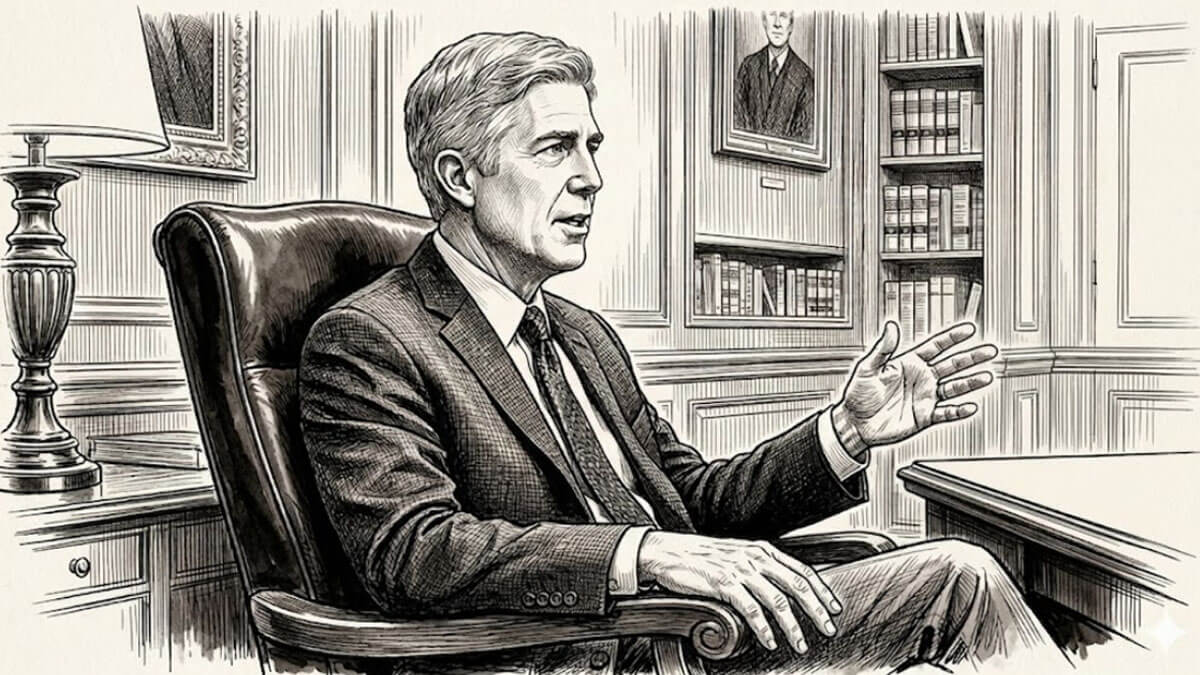
Supreme Court Justice Neil Gorsuch's recent remarks to *Reason Magazine*, outlining his perspective on American national identity, have triggered a significant ideological discussion within conservative circles, particularly regarding the concept of birthright citizenship. The Justice suggested that the United States derives its identity from a set of foundational ideas rather than shared religion or cultural heritage, a position that has drawn both scrutiny and strong reactions.
"Amazing how wrong Gorsuch is here. We are clearly a Christian nation founded on the principles of Western Civilization, with the culture and mores of Europe. Seems like he’s ‘prepping’ us for an absurd Birthright Citizenship ruling???" — Steve Cortes, Former Trump Adviser
In the interview, Gorsuch articulated that the core tenets of the Declaration of Independence serve as the bedrock of American identity. "The Declaration of Independence had three great ideas in it: that all of us are equal; that each of us has inalienable rights given to us by God, not government; and that we have the right to rule ourselves," Gorsuch stated. He elaborated on this perspective, asserting, "Our nation is not founded on a religion. It’s not based on a common culture even, or heritage. It’s based on those ideas. We’re a creedal nation." These statements quickly circulated across social media platforms, prompting immediate commentary.
The timing of Justice Gorsuch's comments has been noted by observers, as the Supreme Court is currently hearing arguments related to the scope of the Fourteenth Amendment, specifically whether it guarantees citizenship to children born on American soil to parents who may have entered the country without authorization. This case carries substantial political implications for the current administration, led by President Donald Trump.
Prominent conservative figures swiftly challenged Gorsuch's framing. Steve Cortes, a former adviser to President Trump, expressed his disagreement on X, writing, "Amazing how wrong Gorsuch is here. We are clearly a Christian nation founded on the principles of Western Civilization, with the culture and mores of Europe. Seems like he’s ‘prepping’ us for an absurd Birthright Citizenship ruling???" Cortes's post highlighted a concern among some conservatives that Gorsuch's "creedal nation" interpretation could signal a judicial leaning towards affirming broad birthright citizenship, potentially at odds with their views on national sovereignty and immigration enforcement.
Further challenging Gorsuch's viewpoint, another user on X referenced the words of Founding Father John Jay from Federalist No. 2. Jay, a co-author of the Federalist Papers, wrote: "With equal pleasure I have as often taken notice that Providence has been pleased to give this one connected country to one united people — a people descended from the same ancestors, speaking the same language, professing the same religion, attached to the same principles of government, very similar in their manners and customs." This historical quote was presented as a direct counterpoint, suggesting a more culturally and ethnically homogeneous foundation for the nation.
The debate further intensified with questions posed by other conservative commentators. Sean Davis of The Federalist posted on X, "Give us the precise creed, and let us know the consequences citizenship-wise for rejecting it." Similarly, Timothy HJ Nerozzi of the Washington Examiner questioned, "If we’re a creedal nation, show me the required creed and explain to me the consequences for someone who refuses to follow it." These queries highlight a desire for clarity on the practical implications of defining the nation by a "creed" and how such a definition might impact citizenship and national belonging.
Historical context offers additional perspectives on the nature of American identity. In March 1861, Confederate Vice President Alexander Stephens delivered his "Cornerstone" speech, explicitly rejecting the foundational assertions of equality and natural rights. Stephens stated, "The prevailing ideas entertained by [Jefferson] and most of the leading statesmen at the time of the formation of the old constitution were that the enslavement of the African was in violation of the laws of nature; that it was wrong in principle, socially, morally, and politically." He then articulated the Confederacy's opposing view: "Our new government is founded upon exactly the opposite idea; its foundations are laid, its corner-stone rests, upon the great truth that the negro is not equal to the white man." By Stephens's own account, rejecting these principles placed Confederates outside the American creed and, by extension, outside American citizenship.
Conversely, Thomas Jefferson's own writings present a more nuanced view of nationhood, which complicates a purely culture-based theory. In 1803, Jefferson expressed a wish for American Indians to "intermix and become one people, incorporating themselves with us as citizens of the US." In his first Annual Message to Congress in 1801, he advocated for easing naturalization requirements, asking, "[S]hall we refuse the unhappy fugitives from distress that hospitality which the savages of the wilderness extended to our fathers arriving in this land?" These statements suggest an early recognition of the potential for an expanding and inclusive national identity.
President Donald Trump has publicly aligned himself with the perspective emphasizing culture and heritage as central to American identity, rather than an abstract set of ideas. The Supreme Court has not yet issued a ruling on the birthright citizenship case, leaving the legal and ideological implications of Justice Gorsuch's "creedal nation" remarks open for continued discussion and interpretation.

