

Breaking
Sponsor Advertisement
Kevin Warsh Confirmed as New Federal Reserve Chair
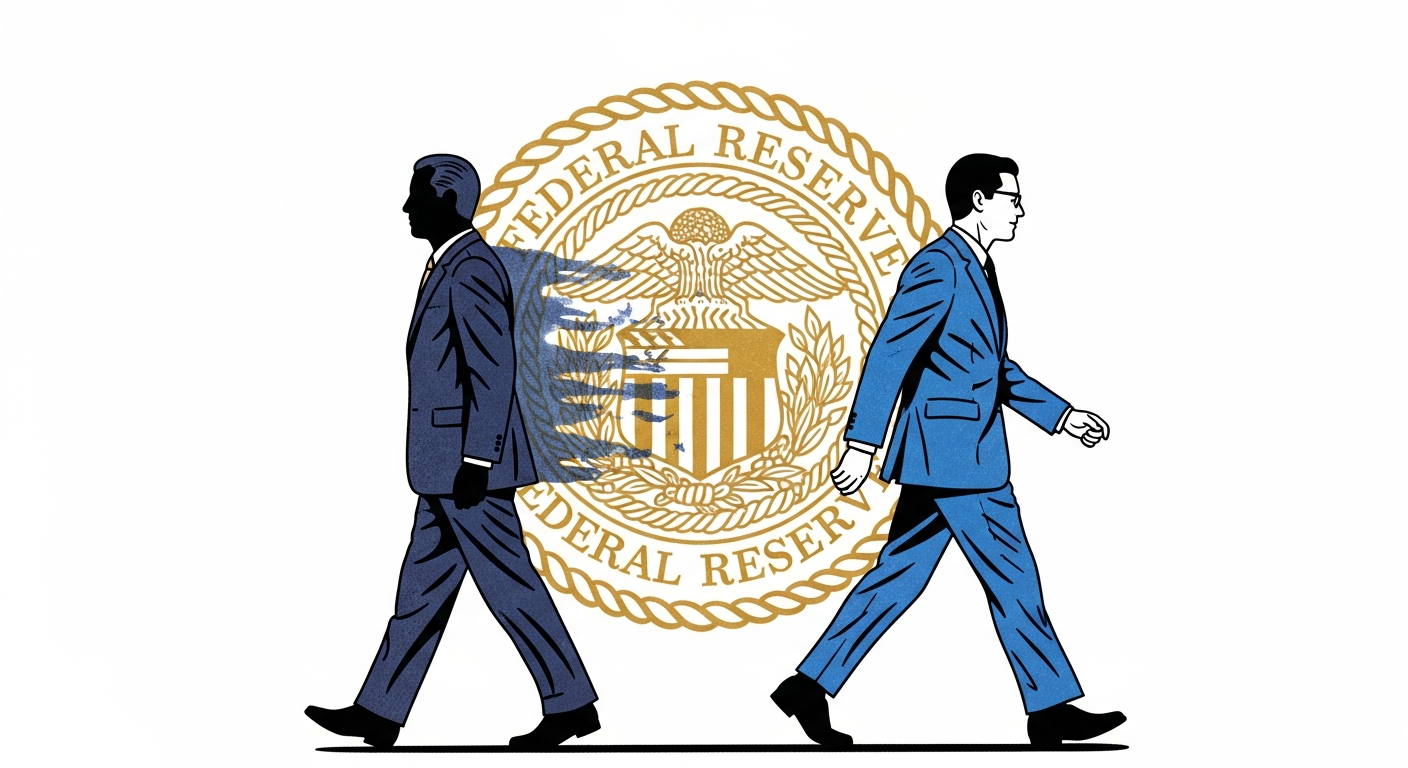
Image for: Kevin Warsh Confirmed as New Federal Reserve Chair

Kevin Warsh Confirmed as New Federal Reserve Chair

Jerome Powell has concluded his eight-year term as Federal Reserve Chair, marked by significant economic challenges and policy shifts. Kevin Warsh has been confirmed by the Senate as his replacement, taking over leadership of the central bank.
Jump to The Flipside Perspectives

Jerome Powell officially concluded his eight-year tenure as Chair of the Federal Reserve this Friday, departing after a period characterized by unprecedented economic turbulence and persistent policy challenges. His replacement, Kevin Warsh, a former Federal Reserve governor, was confirmed by the Senate earlier this week and is set to assume control of the central bank, navigating ongoing inflation concerns, global economic instability, and projections for slowing growth.

"It’s not about the Fed or the institutions. It’s about the benefits of a central bank that makes decisions based on analysis and our best thinking rather than trying to help or hurt politicians." — Jerome Powell, Former Federal Reserve Chair

Powell's leadership spanned a critical era in modern U.S. economic history, from navigating the immediate fallout of the COVID-19 pandemic to confronting the sharpest surge in inflation in over four decades. His term was also defined by repeated public clashes with President Donald Trump concerning interest rates and the fundamental independence of the Federal Reserve.

Economists and former Federal Reserve officials have largely described Powell as a stabilizing force who faced a unique confluence of economic crises. Patrick Harker, former President of the Philadelphia Federal Reserve, noted the extraordinary nature of Powell's challenges. "It’s hard to think about another Fed chair who faced such a combination of punches to the US economy," Harker told CNN, drawing parallels to Marriner Eccles, who led the Fed during the Great Depression and World War II.

The most significant test of Powell's leadership emerged in early 2020 with the onset of the COVID-19 pandemic. The rapid shutdown of large sectors of the economy led to mass unemployment and a severe crisis in financial markets. The Federal Reserve responded swiftly, holding emergency meetings in March 2020. These interventions included cutting interest rates near zero and launching extensive programs designed to stabilize credit markets and financial institutions. Powell later characterized these actions as an "unprecedented" effort to build a "bridge" to economic recovery and avert a broader financial collapse. Loretta Mester, former President of the Cleveland Federal Reserve, echoed this sentiment, stating that the pandemic presented challenges unlike anything modern Fed leaders had previously encountered.

Following the initial economic contraction, the U.S. economy experienced a robust rebound. Consumer demand surged, wages began to climb, and supply chains struggled to recover from the disruptions caused by the pandemic. This rapid recovery, however, also fueled a swift acceleration of inflation, which reached levels not seen in the U.S. since the early 1980s. The rising prices generated considerable political pressure on the Federal Reserve to act. Initially, Powell and other Fed officials described the inflation as "transitory," a characterization that later drew criticism as prices continued their upward trajectory across the economy.

In response to persistent inflation, the Federal Reserve initiated its most aggressive interest rate hiking campaign in decades, beginning in March 2022. The objective was to cool inflationary pressures without triggering a significant recession. While some critics argued that the Fed's response was delayed, supporters pointed to the economy's sustained strength and a resilient labor market as evidence that Powell had successfully engineered a rare "soft landing."

A defining aspect of Powell's tenure was his ongoing public disagreement with President Donald Trump. President Trump consistently advocated for lower interest rates and reduced borrowing costs, frequently criticizing Powell throughout both his presidencies. He openly discussed the possibility of removing Powell from his position during disputes over monetary policy and economic growth. Powell, for his part, consistently defended the Federal Reserve's independence, emphasizing that monetary policy decisions should be based on economic analysis, free from political influence or election-year pressures. During his final news conference, Powell articulated this stance, stating, "It’s not about the Fed or the institutions. It’s about the benefits of a central bank that makes decisions based on analysis and our best thinking rather than trying to help or hurt politicians." Powell has indicated his intention to remain on the Federal Reserve Board for now and advised Warsh to "stay out of elected politics" as he takes the helm of the central bank.

Advertisement

The Flipside: Different Perspectives

Progressive View

From a progressive standpoint, Jerome Powell's tenure as Federal Reserve Chair, particularly his response to the COVID-19 pandemic, demonstrated the critical role the central bank can play in mitigating economic catastrophe and supporting collective well-being. The aggressive actions taken in 2020, including interest rate cuts and emergency lending programs, were essential to prevent a deeper financial collapse and protect livelihoods during an unprecedented crisis. Progressives often emphasize the Fed's responsibility not only for price stability but also for maximizing employment and ensuring an equitable recovery, recognizing that economic downturns disproportionately affect vulnerable populations.

The subsequent inflation surge, while challenging, is viewed by many progressives as a complex issue stemming from a combination of supply chain disruptions, corporate profiteering, and robust consumer demand, rather than solely from monetary policy. They might argue that the Fed's initial "transitory" assessment was a reasonable interpretation given the unique circumstances. The focus for Kevin Warsh, from this perspective, should be on balancing inflation control with the need to maintain a strong labor market and support wage growth, especially for low and middle-income workers. Progressives would also advocate for the Fed to consider broader systemic issues, such as climate change and economic inequality, in its policy decisions, and to resist pressures that could lead to policies favoring corporate interests over the general public. The independence of the Fed, while important, should serve the public good, ensuring decisions are made based on broad economic welfare rather than narrow political or financial interests.

Conservative View

The departure of Jerome Powell and the confirmation of Kevin Warsh as Federal Reserve Chair marks a critical juncture for monetary policy, especially for conservatives who prioritize fiscal prudence and limited government intervention. A conservative perspective often views the Federal Reserve's expansive role during Powell's tenure, particularly the massive emergency programs and near-zero interest rates, with caution. While acknowledging the crisis of the pandemic, concerns may arise regarding the long-term implications of such interventions on market freedom and the potential for moral hazard. The subsequent inflation surge, initially labeled "transitory," underscores the importance of a central bank focused on price stability above all else, rather than being swayed by political pressures or attempting to engineer specific economic outcomes.

Conservatives generally advocate for a Federal Reserve that maintains strict independence from political influence, focusing solely on its dual mandate of maximum employment and stable prices, with an emphasis on the latter to protect the purchasing power of the dollar. The public clashes between President Donald Trump and Powell, while highlighting the importance of independence, also underscore the need for a Fed chair who can navigate such pressures effectively while upholding sound monetary principles. Warsh's background as a former Fed governor suggests a potential return to more traditional, less interventionist monetary policies, which would align with conservative principles of free markets and a strong, stable currency. The challenge for Warsh will be to manage inflation and growth without resorting to policies that could expand government influence or distort market signals.

Common Ground

Despite differing approaches, conservatives and progressives share common ground regarding the fundamental role and challenges facing the Federal Reserve. Both sides agree on the critical importance of a stable and predictable economic environment for American families and businesses. There is a shared understanding that high, sustained inflation erodes purchasing power and creates economic uncertainty, necessitating careful management by the central bank. Similarly, both viewpoints recognize the need for a strong labor market where Americans have opportunities for employment.

Both conservatives and progressives also generally value the independence of the Federal Reserve from direct political interference, acknowledging that monetary policy decisions should ideally be based on economic data and analysis rather than short-term electoral cycles. While the extent and nature of this independence might be debated, the principle of insulating the central bank from undue partisan pressure is widely accepted. Looking ahead, a bipartisan approach to economic stability could involve open dialogue between the Fed and Congress, focusing on transparent communication of policy goals, clear metrics for success, and a commitment to data-driven decision-making. Ensuring the Fed has the tools and autonomy to respond effectively to future economic shocks, while being accountable for its actions, represents a shared objective for policymakers across the political spectrum.

What's your view on this story? Share your thoughts and remember to consider multiple perspectives and being respectful when forming and voicing your opinion. "If you resort to personal attacks, you have already lost the debate..."

Advertisement

Contact Us About This Article

Have a question or comment about this article? We'd love to hear from you.

About Fair Side News

At Fair Side News, we believe in presenting news with perspectives from both sides of the political spectrum. Our goal is to help readers understand different viewpoints and find common ground on important issues.