


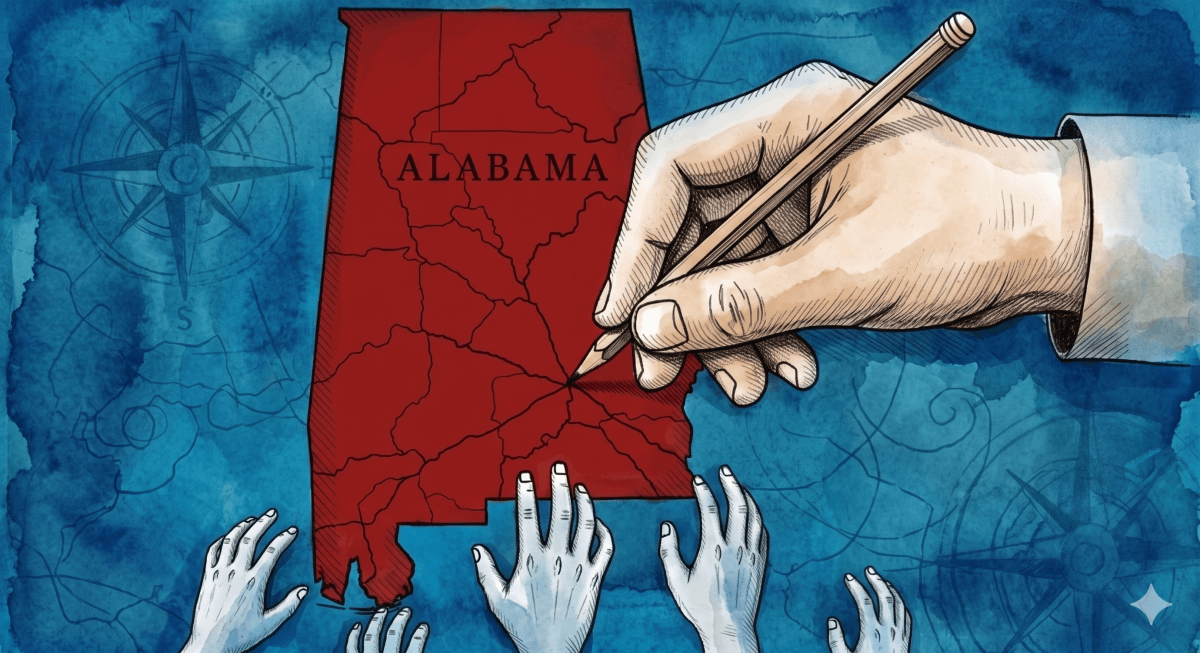
The nation's highest court issued a significant ruling on Monday, enabling Alabama to advance with its congressional redistricting efforts, a move that could enhance Republican prospects in future elections. The Supreme Court's 6-3 order vacated prior lower court decisions that had compelled Alabama to adopt a congressional map featuring two districts where minority voters constituted a majority. This action sends the matter back to lower courts with instructions to re-evaluate the cases under the legal framework established in *Louisiana v. Callais*, a 2026 ruling concerning the interpretation of Section 2 of the Voting Rights Act.
"My job: put the Legislature in position to draw a map that favors Republicans 7-0. Done." — Steve Marshall, Alabama Attorney General
The *Callais* decision, authored by Justice Samuel Alito, declared a Louisiana congressional map an unconstitutional racial gerrymander. Crucially, it raised the legal bar for plaintiffs challenging legislative maps for racial discrimination under Section 2 of the 1965 Voting Rights Act. Plaintiffs must now demonstrate that lawmakers acted with intentional discrimination, a considerably higher standard than merely showing discriminatory effects. This shift in legal precedent has significant implications for ongoing redistricting battles across the South, particularly in states seeking to reconfigure currently Democrat-held congressional districts.
Alabama Attorney General Steve Marshall, whose emergency requests to the Supreme Court helped precipitate the swift action, hailed the outcome as a "major victory." Marshall stated on social media, "For too long, unelected federal judges have had more say over Alabama’s elections than Alabama’s voters. That ended today. My job: put the Legislature in position to draw a map that favors Republicans 7-0. Done." He had consistently argued for Alabama's right to utilize its own maps, aligning with other states. Alabama Secretary of State Wes Allen echoed Marshall's sentiment, calling the ruling a "historic win for Alabama voters" and confirming that the May 19 primary election would proceed as scheduled, albeit with subsequent adjustments.
The Court's decision was met with dissent from Justices Sonia Sotomayor, Elena Kagan, and Ketanji Brown Jackson. Justice Sotomayor argued that the lower court’s finding of intentional discrimination against Black voters in Alabama should have been upheld, regardless of the new *Louisiana v. Callais* ruling. She expressed concern that the vacatur would cause "only confusion as Alabamians begin to vote in the elections scheduled for next week," given the impending primaries.
Following the ruling, Alabama Governor Kay Ivey swiftly called a special legislative session to pursue changes to both congressional and state senate district maps. This action comes even as voters had already begun casting absentee ballots for the May 19 primary. Governor Ivey announced that Alabama would hold a special primary election for four of its seven congressional districts on August 11 as a direct result of the court's order. She encouraged Alabamians to participate, stating, "Alabamians now have another opportunity to send strong voices to Washington to fight for our values, and I encourage them to get out and vote in this special primary election on August 11."
Alabama's current congressional delegation comprises five Republicans and two Democrats. The seats presently held by Democratic Representatives Terri Sewell and Shomari Figures could be significantly reshaped under the new maps drawn by the state legislature. Rep. Figures voiced strong opposition to the ruling, asserting that it "sets the stage for Alabama to go back to the 1950s and 60s in terms of Black political representation in the state" and vowed to continue fighting.
Beyond Alabama, Monday's order arrives amidst a flurry of last-minute redistricting activities in other Southern states like Louisiana and Tennessee, all of which are actively working to redraw congressional districts. Republicans nationally anticipate potential gains of as many as 14 additional House seats in the upcoming November elections from new district maps enacted or under consideration in states including Texas, Missouri, North Carolina, Ohio, Florida, and Tennessee. This unprecedented midterm redistricting push has already contributed to an approximate eight-seat advantage for Republicans over Democrats.
However, not all Republican-led states are moving forward with immediate map changes. Georgia Governor Brian Kemp stated that his state would not redraw its maps before November, indicating that the *Callais* ruling "requires Georgia to adopt new electoral maps before the 2028 election cycle." Deuel Ross, director of litigation at the Legal Defense Fund, which represented the plaintiffs in the original Alabama case, expressed concern that "The Court’s decision interferes with the ongoing election and puts the validity of the votes of thousands of early voters into doubt." Ross confirmed that the Legal Defense Fund would explore all available options to protect voters' rights and seek to reinstate the previously court-ordered map. The ruling's immediate and long-term effects on political representation and the balance of power in Congress are expected to be substantial.

