

Breaking
Sponsor Advertisement
US Border Patrol Chief Michael Banks Resigns Abruptly
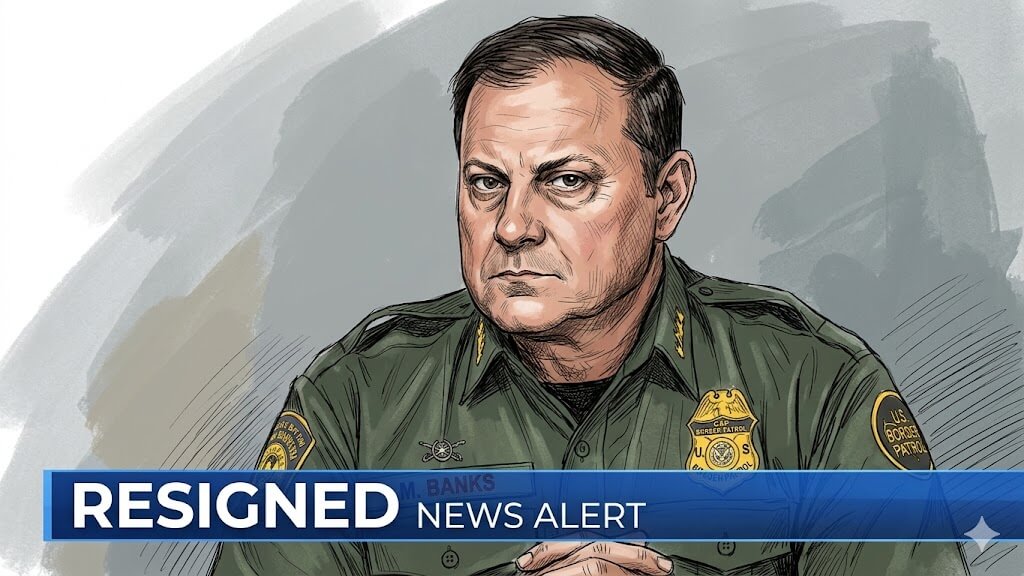
Ai Image for: US Border Patrol Chief Michael Banks Resigns Abruptly

US Border Patrol Chief Michael Banks Resigns Abruptly

U.S. Border Patrol Chief Michael Banks has resigned from his position, effective immediately, less than two years after assuming leadership. His departure marks a significant change in the Trump administration's border enforcement operations.
Jump to The Flipside Perspectives

Michael Banks has stepped down as Chief of the U.S. Border Patrol, a role he assumed less than two years ago amid President Donald Trump’s intensified immigration enforcement efforts. Banks confirmed his resignation on Thursday, stating to Fox News correspondent Bill Melugin that it was "just time." This sudden departure signals a notable leadership shift within the Trump administration's federal border security apparatus, where Banks had become one of the most visible figures advocating for the administration's immigration policies.

President Trump selected Banks for the top Border Patrol position shortly after the 2024 election, following Banks' impactful tenure as border czar for Texas Governor Greg Abbott. In that capacity, Banks played a key role in overseeing Operation Lone Star, an aggressive, state-led border enforcement initiative launched by Abbott along the southern border. Banks was officially sworn in as the 27th chief of the U.S. Border Patrol on January 22, 2025, shortly after President Trump's return to the White House.

Before joining the Trump administration, Banks accumulated approximately 25 years of experience within the Border Patrol, having first entered the agency in 2000. Throughout his extensive federal law enforcement career, he held various leadership assignments across Texas, Arizona, and California, including critical posts in the Rio Grande Valley sector. Prior to his work in border enforcement, Banks also served for 10 years in the United States Navy as a master-at-arms, bringing a robust background in military and law enforcement to his civilian roles.

During his tenure as chief, Banks emerged as a prominent public defender of President Trump's immigration agenda throughout 2025 and 2026. He frequently appeared in interviews and on television, where he consistently praised the administration’s deportation operations, the ongoing expansion of the border wall, and the stricter asylum enforcement measures implemented under President Trump’s leadership. In a 2025 interview with U.S. Customs and Border Protection, Banks underscored the critical importance of border security, describing it as essential for maintaining American sovereignty. He also credited Border Patrol agents for their efforts in restoring what he termed "operational control" across significant sections of the southern border, attributing this success to Trump-era policies, as reported by Trending Politics.

Banks' resignation occurs as administration officials continue to highlight a noticeable decline in illegal border crossing numbers. These figures are significantly lower when compared to levels recorded during the administration of President Trump's predecessor. Republicans and officials within the Trump administration have frequently pointed to these reduced crossing numbers as tangible evidence of the effectiveness of their comprehensive immigration enforcement strategy.

As of Thursday afternoon, neither the Department of Homeland Security nor U.S. Customs and Border Protection had publicly announced Banks' replacement or provided further details regarding the circumstances of his departure. The administration has also not indicated whether the resignation was a pre-planned transition or if it is linked to broader leadership changes within federal immigration enforcement agencies. U.S. Customs and Border Protection Commissioner Rodney Scott confirmed Banks' departure on Thursday, noting it as the latest in a series of leadership adjustments within immigration enforcement in recent months. The suddenness of the resignation leaves a significant void at the helm of a crucial federal agency responsible for securing the nation's borders.

Advertisement

The Flipside: Different Perspectives

Progressive View

The resignation of U.S. Border Patrol Chief Michael Banks presents an opportunity for a critical reassessment of border enforcement strategies under the Trump administration. While Chief Banks was a vocal proponent of the administration's approach, which included aggressive tactics, wall expansion, and restrictive asylum policies, these measures have drawn significant concern from progressive circles. Critics argue that such strategies often prioritize enforcement over humanitarian considerations, leading to family separations, prolonged detentions, and limited access to asylum for vulnerable populations. The focus on "operational control" through increased militarization of the border, exemplified by initiatives like Operation Lone Star, has been widely criticized for its human rights implications and for failing to address the complex root causes of migration, such as economic instability, climate change, and violence in migrants' home countries. Progressives advocate for a more comprehensive and humane approach to immigration, emphasizing due process, community integration, and international cooperation. A new leader for the Border Patrol could potentially shift towards policies that balance security with compassion, invest in efficient and fair processing of asylum claims, and allocate resources towards supporting migrant communities rather than solely on punitive measures, moving away from an enforcement-only paradigm.

Conservative View

The abrupt resignation of U.S. Border Patrol Chief Michael Banks represents a significant, though potentially temporary, disruption to the Trump administration's robust border security efforts. Under Chief Banks' leadership, supported by President Trump's policies, the nation saw a clear commitment to securing the southern border, expanding wall infrastructure, and implementing stricter asylum protocols. These measures were consistently championed as vital for national sovereignty and the rule of law. Conservatives view strong border enforcement as a cornerstone of national security and economic stability, ensuring that those who enter the country do so legally and orderly. Chief Banks' previous experience with Operation Lone Star in Texas, a state-led initiative that demonstrated aggressive enforcement, aligned perfectly with the administration's "America First" approach to immigration. The reported decline in illegal border crossings during his tenure is seen as direct evidence of the efficacy of these policies. While his departure creates a leadership vacuum, the conservative expectation is that President Trump will swiftly appoint a successor who shares the same unwavering commitment to border integrity, ensuring the continued implementation of policies that prioritize American citizens' safety and national security over open-border ideologies. The focus remains on maintaining operational control and deterring illegal entry, upholding the principles of limited government and national self-determination.

Common Ground

Despite differing approaches to immigration policy, there are genuine areas of common ground regarding border management. Both conservative and progressive viewpoints generally agree on the necessity of an orderly and secure border. This shared value includes the need for efficient processing of individuals entering the country, whether they are tourists, workers, or asylum seekers. There is also bipartisan consensus on the importance of combating human trafficking and drug smuggling, which exploit border vulnerabilities. Both sides can agree on the need for adequate resources for Border Patrol agents, ensuring they are well-trained, equipped, and supported in their complex roles, while also upholding ethical standards. Furthermore, there is a shared interest in addressing the root causes of irregular migration, although approaches may differ. Finding practical solutions could involve bipartisan efforts to stabilize regions that are sources of migration, improve diplomatic relations, and invest in technologies that enhance border security without compromising human rights. A new Border Patrol chief could prioritize streamlining processes, enhancing cross-agency cooperation, and fostering a culture of accountability and professionalism.

What's your view on this story? Share your thoughts and remember to consider multiple perspectives and being respectful when forming and voicing your opinion. "If you resort to personal attacks, you have already lost the debate..."

Advertisement

Contact Us About This Article

Have a question or comment about this article? We'd love to hear from you.

About Fair Side News

At Fair Side News, we believe in presenting news with perspectives from both sides of the political spectrum. Our goal is to help readers understand different viewpoints and find common ground on important issues.