

Breaking
Sponsor Advertisement
President Trump Calls for Charges Against Jeffries Over 'Inciting Violence'
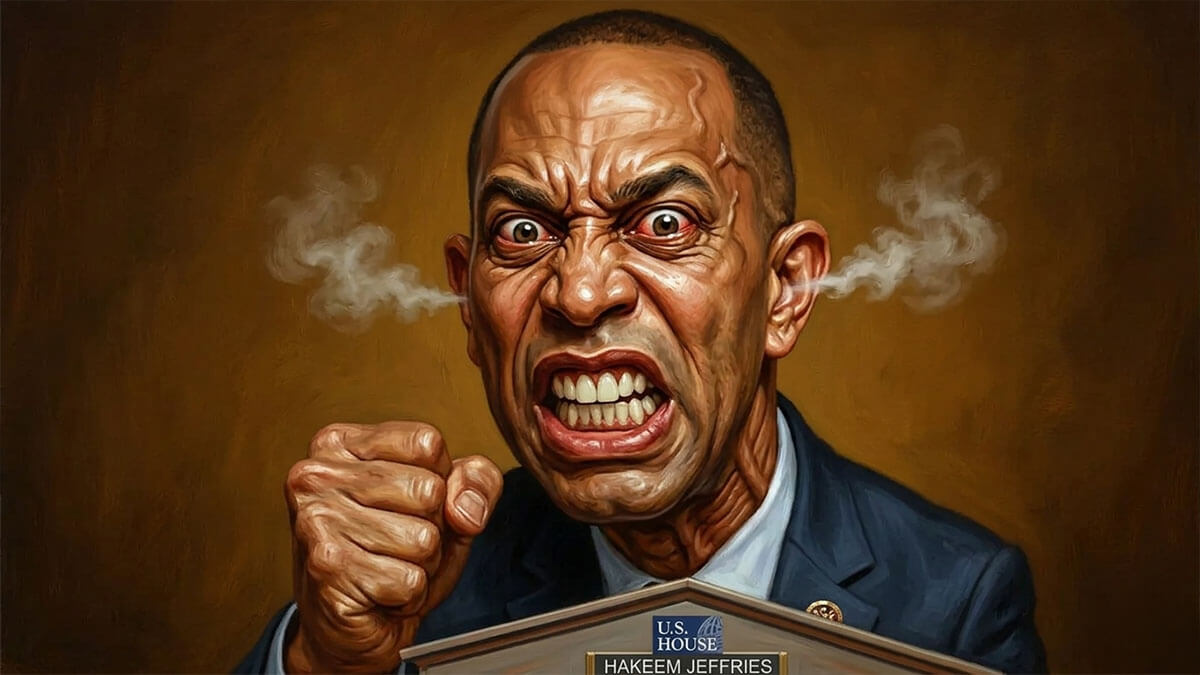
AI-generated image for: President Trump Calls for Charges Against Jeffries Over 'Inciting Violence'

President Trump Calls for Charges Against Jeffries Over 'Inciting Violence'

President Donald Trump escalated criticism against House Minority Leader Hakeem Jeffries, accusing him of "inciting violence" and advocating for legal accountability. This follows Jeffries' use of "maximum warfare" in remarks on congressional map disputes.
Jump to The Flipside Perspectives

President Donald Trump on Thursday accused House Minority Leader Hakeem Jeffries (D-NY) of "inciting violence" and called for potential legal charges against him. The accusation, made in a Truth Social post, stems from recent remarks by Jeffries related to Democratic messaging in ongoing congressional map battles nationwide.

"This lunatic, Hakeem “Low IQ” Jeffries, should be charged with INCITING VIOLENCE! The…" — President Donald Trump, Truth Social Post

In his post, President Trump referred to Jeffries as "Hakeem ‘Low IQ’ Jeffries" and stated, "should be charged with INCITING VIOLENCE!" He further asserted that "The Radical Left Democrats actually want to Destroy our Country." The post included images depicting Jeffries speaking near a sign that read "Maximum Warfare, everywhere, all the time," alongside visuals connected to the aftermath of the White House Correspondents’ Dinner shooting. This social media activity quickly garnered attention across political spectrums, eliciting varied reactions from both major parties.

The phrase "maximum warfare" was employed by Jeffries during a press briefing where he outlined the Democratic strategy for congressional map disputes across several states. His comments were made in the context of party efforts to maintain and expand competitiveness in key districts leading up to the midterm elections. Republicans have since highlighted this wording as an example of increasingly aggressive partisan rhetoric. Conversely, Democrats contend that the phrase represents standard language used in high-stakes political competition, emphasizing the intense nature of electoral strategy.

At the core of this heightened political exchange is a nationwide redistricting effort that holds the potential to significantly alter the balance of power in the House of Representatives. Both Republican and Democratic parties are actively engaged in assertive map-drawing initiatives in states such as Texas, California, Florida, Virginia, and Tennessee. These new district lines could establish electoral advantages for years, profoundly impacting future election outcomes. House Minority Leader Jeffries has emerged as a prominent figure in the Democratic party's push to enhance its competitive standing in targeted districts. Meanwhile, Republicans have increasingly integrated Democratic rhetoric, including phrases like "maximum warfare," into their broader political messaging strategy, according to a Politico report.

President Trump’s Truth Social post prompted a rapid response from Jeffries. In a video message, Jeffries directly addressed President Trump, rejecting the accusations. He stated, "You ain’t intimidating a damn person," and also criticized President Trump over rising costs and pervasive economic pressures currently affecting American households. Jeffries argued that the President's focus on him represented a misplacement of priorities, particularly at a time when voters are grappling with significant financial strain, as reported by The Hill.

This latest confrontation aligns with a broader pattern observed in President Trump’s public statements, where he has frequently advocated for scrutiny and legal accountability for political opponents, particularly Democrats whom he believes have engaged in misconduct or politicized the justice system. For instance, Resist the Mainstream reported in November that President Trump accused several Democratic lawmakers of "sedition" following a video that urged military personnel to disregard unlawful orders. That accusation also sparked backlash and led to formal complaints from Democratic members. President Trump has also previously called for investigations or prosecutions involving other prominent figures, including California Senator Adam Schiff and New York Attorney General Letitia James. In these instances, President Trump and his allies have argued that these individuals should face accountability amid what they characterize as the politicization of legal institutions.

Supporters of President Trump assert that his rhetoric reflects a deep-seated frustration with what they describe as escalating political attacks from Democrats. They point to a wider political environment where accusations of extremism and criminal conduct have become increasingly prevalent across party lines. The White House Correspondents’ Dinner shooting has further amplified attention on the impact of political rhetoric. However, investigators have not established any link between Jeffries’ comments and the individual responsible for that incident.

As both major parties prepare for what is anticipated to be a critical election cycle, this confrontation underscores how disputes over political messaging and control of congressional maps have become central to the intense battle for power in the House. With the control of Congress at stake, Republicans continue to argue that Democrats are escalating political rhetoric and potentially weaponizing institutions. Concurrently, Democrats persist in portraying Republican leadership as a significant risk to the country’s political trajectory and future direction.

Advertisement

The Flipside: Different Perspectives

Progressive View

Progressives would likely view President Trump's call for charges against Hakeem Jeffries as a dangerous escalation of political intimidation and an attempt to silence dissent. They would argue that the phrase "maximum warfare" is clearly a metaphor for intense political and legal strategy within the context of redistricting battles, a common rhetorical device in high-stakes political competition. From this perspective, criminalizing such speech is an attack on free expression and a tactic to distract from substantive policy debates. Progressives often emphasize the systemic context of political discourse, pointing out that calls for "inciting violence" are frequently weaponized against opponents without consistent application. They might highlight President Trump's own history of rhetoric and question the sincerity of his concern, viewing it as a politically motivated attack rather than a genuine concern for public safety. Furthermore, progressives would underscore Jeffries' counter-argument regarding President Trump's focus on this issue while American households face significant economic pressures, arguing that the President is attempting to divert attention from real-world problems affecting collective well-being. They would also express concern that such actions contribute to a chilling effect on political speech, making it harder for opposition leaders to articulate strong strategic positions without fear of legal reprisal.

Conservative View

From a conservative perspective, President Trump's call for charges against House Minority Leader Hakeem Jeffries reflects a deep concern over what is perceived as increasingly aggressive and potentially dangerous political rhetoric from the left. Conservatives often emphasize personal responsibility and the rule of law, arguing that language advocating "maximum warfare, everywhere, all the time" can incite division and undermine public trust in institutions. They might view such statements, especially from a high-ranking political leader, as crossing a line from robust political debate into language that could be interpreted as encouraging conflict beyond the electoral arena. The conservative viewpoint often highlights the importance of maintaining decorum and respect in public discourse, particularly when discussing sensitive topics like electoral integrity or political competition. They might also see President Trump's reaction as a pushback against a perceived double standard, where rhetoric from conservatives is often scrutinized more heavily than that from progressives. Furthermore, the focus on redistricting battles underscores the importance of fair electoral processes, and conservatives would argue that any rhetoric that appears to undermine these processes or incite extra-legal action should be condemned and potentially investigated. This aligns with a broader desire for a stable political environment where legal and constitutional processes are respected.

Common Ground

Despite the sharp partisan divide, there are areas of common ground regarding the broader concerns raised by this exchange. Both conservatives and progressives generally agree on the importance of civil discourse and the need to avoid language that genuinely incites violence or undermines democratic processes. There is a shared interest in ensuring fair and transparent elections, even amidst intense redistricting battles. While differing on the interpretation of "maximum warfare," both sides can acknowledge that political rhetoric carries weight and can influence public perception and behavior. A common goal is to prevent political disagreements from escalating into actual physical conflict or unlawful actions. Furthermore, both viewpoints share an interest in accountability, albeit with different interpretations of who should be held accountable and for what. Dialogue could focus on establishing clearer, mutually agreed-upon boundaries for political speech that distinguish between vigorous debate and genuine incitement, potentially through bipartisan efforts to promote responsible communication from all political leaders. Both sides also prioritize the well-being of American citizens, and finding solutions to economic pressures remains a shared, albeit often contentious, objective.

What's your view on this story? Share your thoughts and remember to consider multiple perspectives and being respectful when forming and voicing your opinion. "If you resort to personal attacks, you have already lost the debate..."

Advertisement

Contact Us About This Article

Have a question or comment about this article? We'd love to hear from you.

About Fair Side News

At Fair Side News, we believe in presenting news with perspectives from both sides of the political spectrum. Our goal is to help readers understand different viewpoints and find common ground on important issues.